
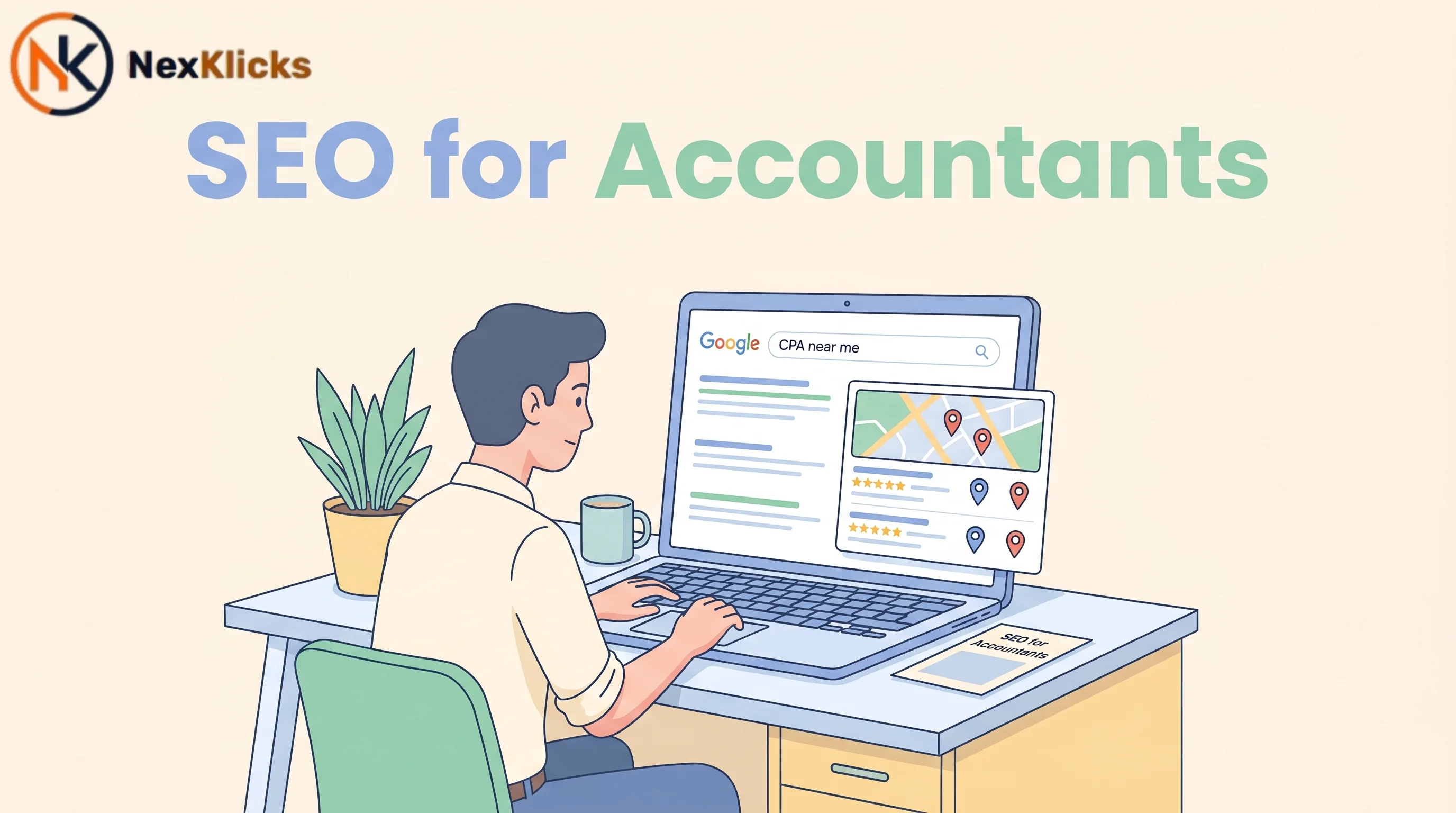
If your accounting firm is invisible on Google, you’re not alone. Most firms survive entirely on referrals, a strategy that feels stable until a competitor starts showing up on page one for every search your ideal clients are typing. SEO for Accountants is the most cost-effective, compounding client acquisition channel available today.
In this guide, you’ll learn how accounting firm website optimization works, which keyword research for accountants strategy fits your firm, and how to build organic search traffic for accountants that grows month after month without paying for every click.
What Is SEO for Accountants and Why It’s a Game-Changer for Your Firm
SEO for Accountants refers to optimizing your firm’s website and online presence so Google ranks your pages when potential clients search for your services. It covers everything from the words on your service pages to your Google Business Profile reviews to the credible websites linking back to yours.
In 2026, this matters more than ever. AI-generated content is flooding Google with generic articles. Clients are Googling before they call. If your firm doesn’t appear, a competitor’s does. Most accounting websites are surprisingly weak on SEO, so even modest, consistent effort puts you ahead of the majority of local competitors.
How Google Decides Which Accounting Firms Show Up First
Google uses three core pillars to rank accounting firm pages: relevance, authority, and user experience. Relevance means your page clearly matches what the searcher typed. Authority means other credible sites vouch for yours. User experience means your pages load fast, work on mobile, and actually answer the visitor’s question.
There’s one more layer specific to your industry. Google classifies accounting content as YMYL financial content, short for “Your Money or Your Life.” These pages can directly affect a reader’s financial well-being, so Google holds them to a higher standard of trust and expertise than it applies to lifestyle blogs or recipe sites.
The Real ROI of SEO for Accounting Firms vs. Paid Advertising
According to BrightLocal’s 2024 Local Consumer Review Survey, 98% of consumers used the internet to find a local business in the past year. That makes accounting firm online visibility non-negotiable.
Paid Google Ads deliver traffic immediately and stop the moment your budget runs out. CPA firm digital marketing through organic SEO works differently. A well-optimized blog post or service page keeps attracting visitors for months and years with no incremental spend. SEO is the only marketing channel that gets cheaper and more effective the longer you do it.
How SEO Works for an Accounting Firm. From Crawl to Client
Google’s automated bots discover pages across the web, evaluate them for quality and trustworthiness, and store them in Google’s index. When someone searches, Google pulls the most relevant, authoritative indexed pages and ranks them. A visitor clicks your result, lands on your page, and, if your content earns their trust, becomes a lead.
SEO for accounting firms works by making your website easy for Google to find, understand, and trust. When a small business owner in Austin searches “small business CPA near me,” Google evaluates hundreds of signals, including your content, your Google Business Profile, your backlinks, and your site speed, to determine which firm to show first. According to Google’s own Search Essentials documentation, pages that are helpful, accurate, and technically accessible are the ones that earn and hold rankings.
How Search Engines Read and Rank Your Accounting Website
Before Google can rank your pages, it has to find them. Sitemaps list every page so Google can discover them. The robots.txt file tells Google which pages to crawl and which to skip. Internal links between your own pages help Google understand which content is most important. A poorly structured site means Google may index your homepage and nothing else, leaving service pages and blog content invisible. This is almost always fixable without a developer.
What AEO, GEO, and AI Optimization Mean for Accountants in 2026
Many clients now ask ChatGPT, Perplexity, or Google’s AI Overviews to recommend accountants. AEO (Answer Engine Optimization) focuses on getting your content selected as a direct answer. GEO (Generative Engine Optimization) targets AI-generated summaries. AIO (AI Optimization) makes content legible and quotable by AI tools. The foundation for all three is the same as traditional SEO: helpful, authoritative content written for real humans.
Understanding E-E-A-T and Why Google Holds Financial Content to a Higher Standard
E-E-A-T stands for Experience, Expertise, Authoritativeness, and Trustworthiness. It is the framework Google’s quality raters use to evaluate whether a page deserves to rank for YMYL topics like tax advice, bookkeeping, and financial planning.
Google’s E-E-A-T guidelines mean accounting websites must demonstrate real credentials, not just publish content. According to Google’s Search Quality Evaluator Guidelines, financial content should be created or reviewed by someone with verifiable expertise. For CPAs and enrolled agents, this means author bios that list your license, years of experience, and specialization. It also means linking to authoritative sources like IRS.gov and the AICPA. These E-E-A-T signals for financial websites directly influence whether Google trusts your pages enough to rank them.
Strategic Keyword Research for Accountants. Local vs. Niche Targeting
Keyword research is the foundation of any successful accounting firm SEO strategy. You need to know what your ideal clients are actually typing into Google before you can create content that attracts them. There’s a strategic decision most guides skip entirely, and getting it wrong wastes months of effort.
The most important keyword decision for accounting firms is choosing between local intent keywords and niche industry keywords. Local keywords like “tax accountant in Dallas” attract clients in your geographic area. Niche keywords like “accountant for real estate investors” attract clients with a specific business profile, regardless of location. According to Ahrefs’ keyword data, niche long-tail keywords often have lower competition and higher conversion rates because the searcher already knows exactly what they need. The right choice depends entirely on your firm’s ideal client profile.
How to Choose Between “CPA Near Me” and Niche Keywords Like “Accountant for Real Estate Investors”
Local keywords like “tax accountant in Dallas” are ideal for generalist firms serving a geographic market. The intent is clear. Someone typing that phrase is ready to hire.
Niche keywords like “ecommerce bookkeeping services” or “accountant for Airbnb hosts” work best for firms that specialize in a specific client type. These terms often have lower search volumes, but even 50 to 200 monthly searches can generate two to three high-value clients per month who are already a perfect fit.
The practical answer: target both. Run local keywords on your service and location pages. Run niche keywords through your blog content. Keep them in separate content tracks so they don’t compete with each other.
Local Keywords vs. Niche Keywords: Local keywords are better suited for generalist accounting firms serving a defined metro area because they capture broad geographic intent from clients ready to hire. Niche keywords work better when your firm specializes in a specific client vertical. The key difference is conversion quality: niche keywords attract pre-qualified leads who already understand their specific need.
Best Keyword Research Tools for Accounting Firms
Ahrefs is the gold standard for keyword difficulty for CPA firms, competitor gap analysis, and accounting niche backlink strategy research. It shows exactly which keywords competitors rank for and where your content gaps are. Even one month of access gives you enough data to plan a year of content.
Google Search Console is free and shows exactly what queries are already bringing visitors to your site. The Google Search Console impressions data reveals keywords you didn’t know you were ranking for, many sitting just outside page one.
Google’s “People Also Ask” boxes and autocomplete are the fastest free tools available. Those suggestions are real queries from real clients.
You can explore keyword difficulty scores and real search volumes for any accounting-related term directly using Ahrefs Keyword Explorer, which is the most reliable free starting point for understanding how competitive your target keywords actually are.
How to Find Low-Competition Keywords Your Accounting Competitors Are Missing
Look for long-tail keywords for accounting with three to five words: “tax planning for self-employed freelancers in California,” “bookkeeping for dental practices,” or “quarterly estimated taxes for Etsy sellers.” These phrases have genuine commercial intent and almost no competition from established firms.
Understanding how to research and map those keywords systematically is covered in detail in the keywords for content writing guide, which walks through the full keyword selection process for content-heavy sites.
Use Ahrefs’ Content Gap tool to find keywords competitors rank for that you don’t. This is one of the fastest ways to identify content gap analysis for CPA firms opportunities already proven to attract traffic. Start with informational keywords to build topical authority in the accounting niche, then pursue commercial terms once Google recognizes your site as credible on the topic.
Key SEO Strategies for Accountants That Actually Drive Client Inquiries
Everything above was research and strategy. This is where the work happens. These strategies function as a system. Implementing one in isolation produces limited results.
Setting Up and Fully Optimizing Your Google Business Profile
Your Google Business Profile optimization is the single most important local SEO asset your firm has. It determines whether you appear in the Map Pack, the three local results that sit above the organic listings for searches like “accountant near me.”
To claim and optimize your Google Business Profile for maximum local visibility, follow these steps:
- Claim your profile at business.google.com and verify ownership.
- Select the most accurate primary category, “Accounting Firm” or “Tax Preparation Service.”
- Add every service you offer using Google’s services feature.
- Write a 750-character keyword-rich business description that naturally includes your location and core services.
- Upload at least ten photos: office exterior, interior, team headshots, and logo.
- Enable messaging and keep your hours accurate, including holiday hours.
46% of all Google searches have local intent. Firms with complete profiles consistently earn more direction requests, website clicks, and phone calls than firms with sparse or unclaimed profiles.
Writing Blog Content That Ranks and Converts Visitors Into Leads
Accounting blog content strategy isn’t about posting frequently. It’s about publishing the right content in the right structure.
Your firm needs two types of content. Informational content attracts traffic by answering questions clients are already asking. Commercial content converts that traffic by making the case for your specific services.
The most effective structure is a topic cluster. Write a pillar post on a broad topic like “The Complete Guide to Small Business Tax Deductions,” supported by cluster posts on sub-topics: “Home Office Deduction for Freelancers,” “Vehicle Deductions for Self-Employed Professionals.” Each cluster post links back to the pillar, building topical authority in the accounting niche over time. One 2,000-word expert guide beats ten shallow 400-word posts. Every post should close with a clear CTA: a free consultation, a downloadable checklist, or a contact form.
If you’re running SEO for Accountants through a WordPress site, structuring your content correctly from the start will save you significant rework later. SEO for Accountants requires both the right content strategy and the right technical foundation working together.
On-Page SEO Checklist for Accounting Firms
On-page SEO for financial services covers everything on the page that signals relevance and quality to Google.
Title tag: Include your primary keyword plus a location or niche modifier, under 60 characters.
Meta description: 150 to 160 characters. Lead with a clear benefit and close with a soft CTA. Meta description optimization directly influences click-through rates.
H1 and H2 structure: Use keyword variations naturally. Never stuff keywords.
Image alt text: Every image needs a descriptive alt tag. Example: “CPA reviewing tax return for small business client in Dallas.” This contributes to accounting firm website optimization.
Schema markup: Add LocalBusiness and ProfessionalService structured data for accountants to help Google display rich results like your phone number and star rating.
Internal links: Every blog post should link to at least two or three service pages. This is how organic lead generation for CPAs gets built into your site architecture.
How to Build E-E-A-T Signals as a Licensed CPA or Enrolled Agent
This is the one area where accountants have a genuine structural advantage that most SEO guides ignore. Your CPA license, years of experience, and specialization are exactly the signals Google looks for when evaluating YMYL financial content. Most generic content marketers can’t credibly claim these credentials. You can.
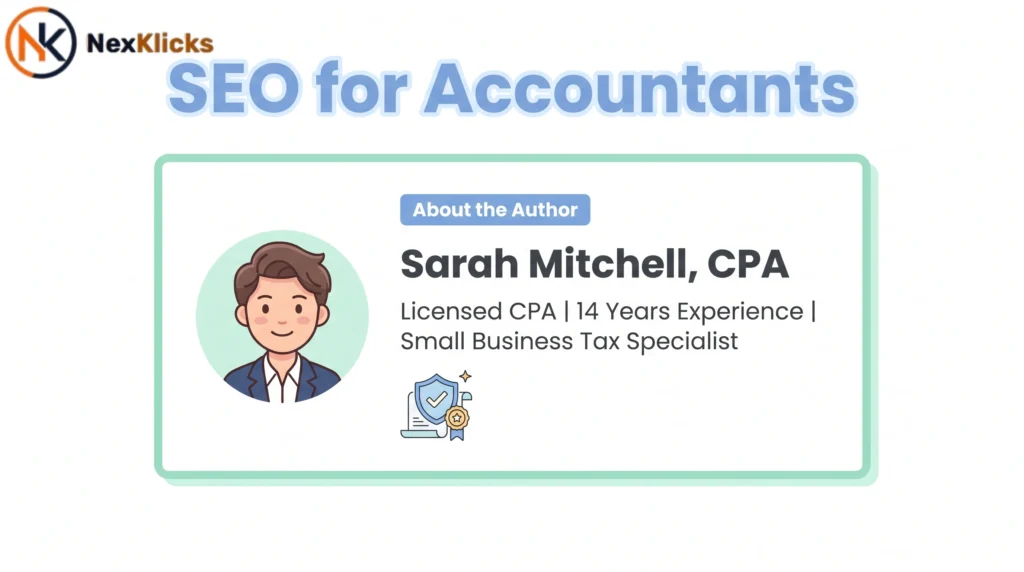
Add a detailed author bio to every article: CPA license number or enrolled agent designation, years of experience, specialization, and a professional headshot. Create a dedicated “About” page highlighting credentials and verifiable client outcomes. Link out to IRS.gov, the AICPA, and your state CPA society to reinforce E-E-A-T signals for financial websites. Google reviews for local accountants on your service pages further signal trustworthiness across your entire online presence.
Link Building for Accountants. Guest Posts, Citations, and Niche Directories
Backlinks for accounting websites remain one of Google’s top three ranking factors. Each external link is a vote of confidence in your content.
Guest posts on small business blogs and financial planning sites put your expertise in front of ideal clients and earn editorial backlinks. Target publications your clients actually read, not just sites with high domain authority scores.
Directory listings in AICPA Find-a-CPA, NASBA, your local Chamber of Commerce, Thumbtack, and the BBB are foundational local search ranking factors. They also contribute to NAP consistency.
Local press mentions are underused. Sponsor a community event, comment on a local tax policy change, or offer a free resource to a local outlet. One mention in a respected local publication earns a backlink that local rankings directly reward. A single high-authority backlink outperforms 50 links from irrelevant or low-quality sites.
Matching Your Content With User Intent for Maximum SEO Impact
Google’s job is to match search queries to the most relevant content. When your pages don’t match the intent behind a query, they don’t rank regardless of how well-written they are. Search intent for accounting queries is one of the most frequently misunderstood elements of accounting firm SEO.
SEO for accountants is the practice of optimizing an accounting firm’s website and online presence to rank higher in Google search results. It involves keyword research, content creation, technical optimization, and local presence management to attract prospective clients organically.
Informational vs. Commercial Intent. How to Target Both in Your Accounting Content
Informational intent (“what is a tax deduction,” “do I need a CPA or a bookkeeper”) is the top of your funnel. Commercial intent (“best CPA for small business,” “tax planning services for freelancers”) converts at a much higher rate and should target your service pages directly.
Use informational blog content to build trust and topical authority in the accounting niche, then use internal links to guide readers toward commercial service pages. Conversion tracking for accounting websites starts with understanding which pages attract which type of intent and building a path between them.
How to Structure Service Pages for Tax Preparation, Bookkeeping, and Advisory Services
Each core service needs its own dedicated page, not a combined “Services” page. Bounce rate on accounting landing pages is almost always high when pages are too thin. Each service page should follow this structure: keyword headline, what the service is, who it’s for, what the process looks like, social proof, and a direct CTA. Aim for 600 to 900 words minimum. Google will not rank a thin commercial page.
Optimizing Your Accounting Website for Technical SEO and User Experience
Technical SEO is the foundation under everything else. Great content on a slow or broken site still won’t rank.
Page Speed, Mobile Friendliness, and Core Web Vitals for Accounting Websites
Nearly 60% of Google searches come from mobile devices. A slow or non-mobile-friendly accounting website loses more than half its potential visitors. Mobile SEO for accounting websites is a fundamental ranking requirement in 2026.
Use Google PageSpeed Insights (free) to identify specific issues. Monitor LCP (page load speed), CLS (visual stability), and INP (responsiveness). Quick wins: compress images, switch to a fast hosting provider, and enable browser caching.
For a full mobile SEO checklist tailored to professional service firms, SEO for accountants on mobile requires a specific set of optimizations beyond basic responsiveness.
Internal Linking Strategy That Builds Authority Across Your Firm’s Website
Internal links pass authority from high-traffic pages to deeper service and location pages, a concept called PageRank flow. Every blog post should link to at least one relevant service page. Your site architecture should follow a clean hierarchy: Homepage to Service Pages and Location Pages, those to Blog Posts, Blog Posts back to Service Pages. No page should be orphaned. An orphan page is invisible to Google regardless of its content quality.
How to Fix the Most Common Technical SEO Issues on Accounting Websites
Duplicate content: Two pages on the same topic, like “/tax-preparation” and “/tax-preparation-services,” confuse Google. Consolidate with canonical tags.
Broken links: Use Google Search Console for accountants or Ahrefs to find and fix 404 errors.
Missing HTTPS: If your site still runs on HTTP, fix it immediately. HTTPS is a direct ranking signal and a trust signal that visitors notice consciously on financial websites.
For a broader look at the technical and strategic mistakes that quietly hold back small service businesses on Google, the SEO mistakes small business owners make article is worth reading before you start your first audit.
Ranking on Google Map Pack. Local SEO for Accounting Firms
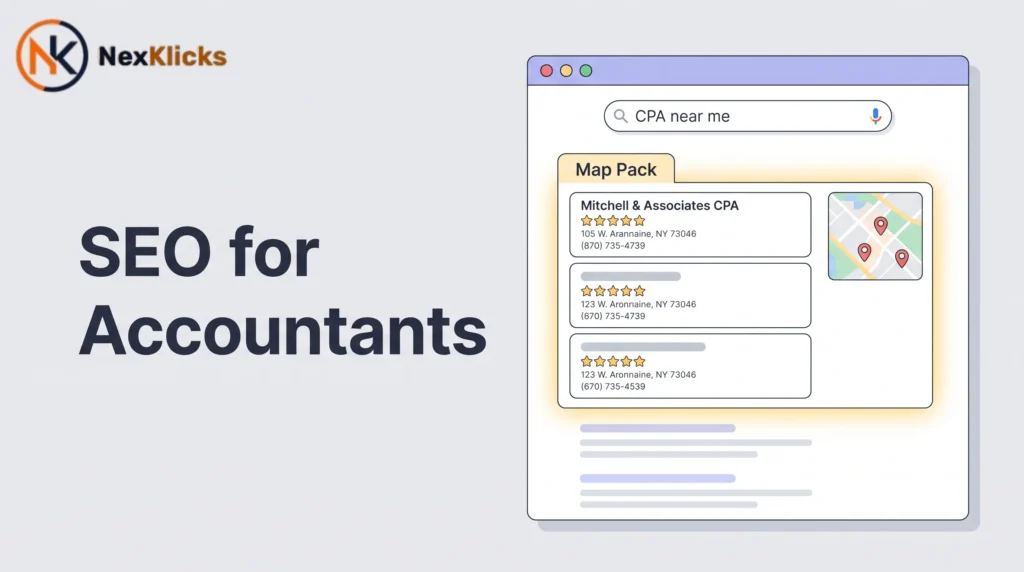
The Map Pack is the block of three local listings that appears above organic results for searches like “accountant near me” or “CPA in Houston.” It is the most valuable digital real estate for a locally focused firm. Local SEO for accounting firms is specifically about earning a position there.
The Three Factors Google Uses to Rank Local Accounting Firms
Google uses three factors to determine local pack ranking for accountants: relevance, distance, and prominence.
Relevance is how well your Google Business Profile matches the query. Distance is how close your office is to the searcher. Prominence is how well-known your firm is online. Reviews, citations, backlinks, and website authority all contribute, and it’s the factor you have the most control over.
How to Get More Google Reviews and Why They Directly Impact Your Local Rankings
Reviews are one of the strongest local search ranking factors. Firms with more recent, positive reviews consistently outrank those without. Ask immediately after a client win, share a direct Google review link to reduce friction, and respond to every review, positive and negative, to signal active engagement to Google.
NAP Consistency, Local Citations, and Accounting Directories That Move the Needle
NAP stands for Name, Address, and Phone Number. These must be identical across your website, Google Business Profile, Yelp, and every directory listing. Even minor inconsistencies, like “Suite 200” versus “Ste. 200,” can suppress your Map Pack rankings. Top directories to prioritize: AICPA Find-a-CPA, Thumbtack, Yelp, your local Chamber of Commerce, and the BBB. Inconsistent NAP is one of the most common and damaging local SEO mistakes accounting firms make.
Building Backlinks to Your Accounting Website
Backlinks remain one of Google’s top three ranking factors, carrying extra weight for YMYL financial content. Domain Rating (Ahrefs) is a useful proxy for how much link equity your site has accumulated.
Why Backlinks Still Matter for Accounting Firm SEO in 2026
A firm with strong backlinks for accounting websites will consistently outrank a firm with better content but no backlinks. Google interprets external links as third-party endorsements, and for YMYL content, those endorsements verify your firm is the real thing. The accounting niche backlink strategy that works best combines three channels: guest content, directories, and earned media. Target publications your clients actually read, lead with value for their audience, and always link to a relevant internal page. Two to three quality guest posts per quarter are enough to move your domain authority meaningfully.
If you want to see exactly how off-page SEO tactics translate into ranking improvements for service businesses, the off-page SEO tactics guide covers the full link-building process step by step.
How to Use HARO, Podcast Appearances, and Local Press to Earn High-Authority Links
HARO (now called Connectively) connects journalists covering finance and small business topics with expert sources. Respond quickly to relevant queries and earn editorial backlinks from authoritative publications. Podcast guest appearances earn backlinks in show notes and drive direct inquiries. Local press is the most overlooked channel: sponsor a community event, comment on a local tax policy change, or offer a free resource to a regional outlet. Small business accounting lead generation through earned media starts with being the local expert journalists call first.
You can sign up for journalist query alerts and start pitching directly at Connectively, the platform formerly known as HARO, where finance and small business queries appear regularly and response times are the difference between getting quoted and getting ignored.
Measuring and Tracking SEO Success for Your Accounting Firm
SEO without measurement is guesswork. Most accounting firm SEO efforts take three to six months to show meaningful results. Firms that quit at month two miss the compounding returns that arrive at month four.
Key Metrics Every Accounting Firm Should Track
Organic traffic: Total visitors from Google search, tracked in Google Analytics 4.
Keyword rankings: Where your target keywords sit in Google’s results, tracked in Ahrefs or Search Console. Focus on positions 5 to 15 as your best quick-win opportunities.
Click-through rate (CTR): What percentage of searchers who see your listing actually click it. Google Search Console impressions data makes this visible. A low CTR on a well-ranked page usually means your title tag needs rewriting.
Conversions: Form submissions, phone call clicks, consultation bookings. Conversion tracking for accounting websites in Google Analytics 4 requires setting up conversion goals for each action.
Bounce rate and time on page: High bounce rates on service pages signal a problem worth investigating.
How to Use Google Search Console and Google Analytics to Track Accounting SEO Performance
Google Search Console for accountants is free. Once verified, it shows impressions, clicks, average position, and crawl errors for every page. Google Analytics 4 tracks which pages drive the most conversions and which blog posts bring in leads. Set up conversion goals in GA4 for contact form submissions and phone call clicks. Together, these two tools give you a complete picture: Search Console covers Google-side data, GA4 covers on-site behavior.
How to Run a Quarterly SEO Audit and Plan Your Next 90 Days
Four tasks cover the most important ground: refresh top-performing pages with updated statistics; push positions-5-to-15 keywords to page one with small title tag and internal link improvements; plan new content based on keyword difficulty for CPA firms gaps in Ahrefs or Search Console; and check for new crawl errors, broken links, and page speed regressions.
Quick Comparison Table:
| Tool | Best For | Key Benefit | Limitation |
|---|---|---|---|
| Google Search Console | Tracking existing rankings and impressions | Free, shows real query data for your site | Limited keyword research capability |
| Ahrefs | Keyword research and competitor analysis | Deep data on difficulty, volume, and backlinks | Paid subscription required |
| Surfer SEO | On-page content optimization | Scores your content vs. top-ranking competitors | Requires existing content to optimize |
| Google Business Profile | Local Map Pack visibility | Free, most important local ranking asset | Only affects local search results |
| Google Analytics 4 | Conversion and traffic behavior tracking | Shows which pages actually generate leads | Requires goal setup to track conversions |
Frequently Asked Questions
Q: What’s the best first step for an accounting firm that has never done SEO?
A: The first step to SEO for Accountants is to claim and fully optimize your Google Business Profile. It’s free, takes a few hours, and directly impacts your local Map Pack visibility.
Q: How do I know if my accounting website is already ranking for any keywords?
A: Set up Google Search Console, verify your site, and check the Performance report. It shows every query your site appeared for in the past 16 months, including ones you never targeted.
Q: Should I hire an SEO agency or do it myself?
A: If you have fewer than 10 employees and limited time, a focused agency is more efficient. The basics are learnable. The execution is what most firm owners don’t have time for.
Q: Why does my competitor rank higher even though my website looks better?
A: Design and rankings are unrelated. Your competitor likely has more backlinks, more optimized content, or more Google reviews. Use Ahrefs to compare their backlink profile against yours.
Q: When should I expect to see results from accounting firm SEO?
A: Most firms see meaningful ranking movement within three to four months. Local Map Pack improvements from Google Business Profile optimization can appear within four to six weeks.
Conclusion
SEO for Accountants in 2026 is not optional. It is the most scalable, highest-ROI client acquisition strategy available to any firm that wants to grow beyond referrals. Start with your Google Business Profile, do structured keyword research, publish expert content that demonstrates your credentials, build backlinks, and track your results monthly.
The one mistake to avoid: waiting another six months before starting. Every month without SEO is a month your competitors compound their advantage. Open Google Search Console today, verify your site, and look at the queries report. What you find there will tell you exactly where to focus first.
This guide provides accounting firm owners with a step-by-step approach to SEO for Accountants, covering everything from keyword research and Google Business Profile setup to backlink building and technical optimization. Follow these steps to transform your firm’s website into a reliable source of qualified client leads from Google.
Last update: June 2026

Leave a Reply