
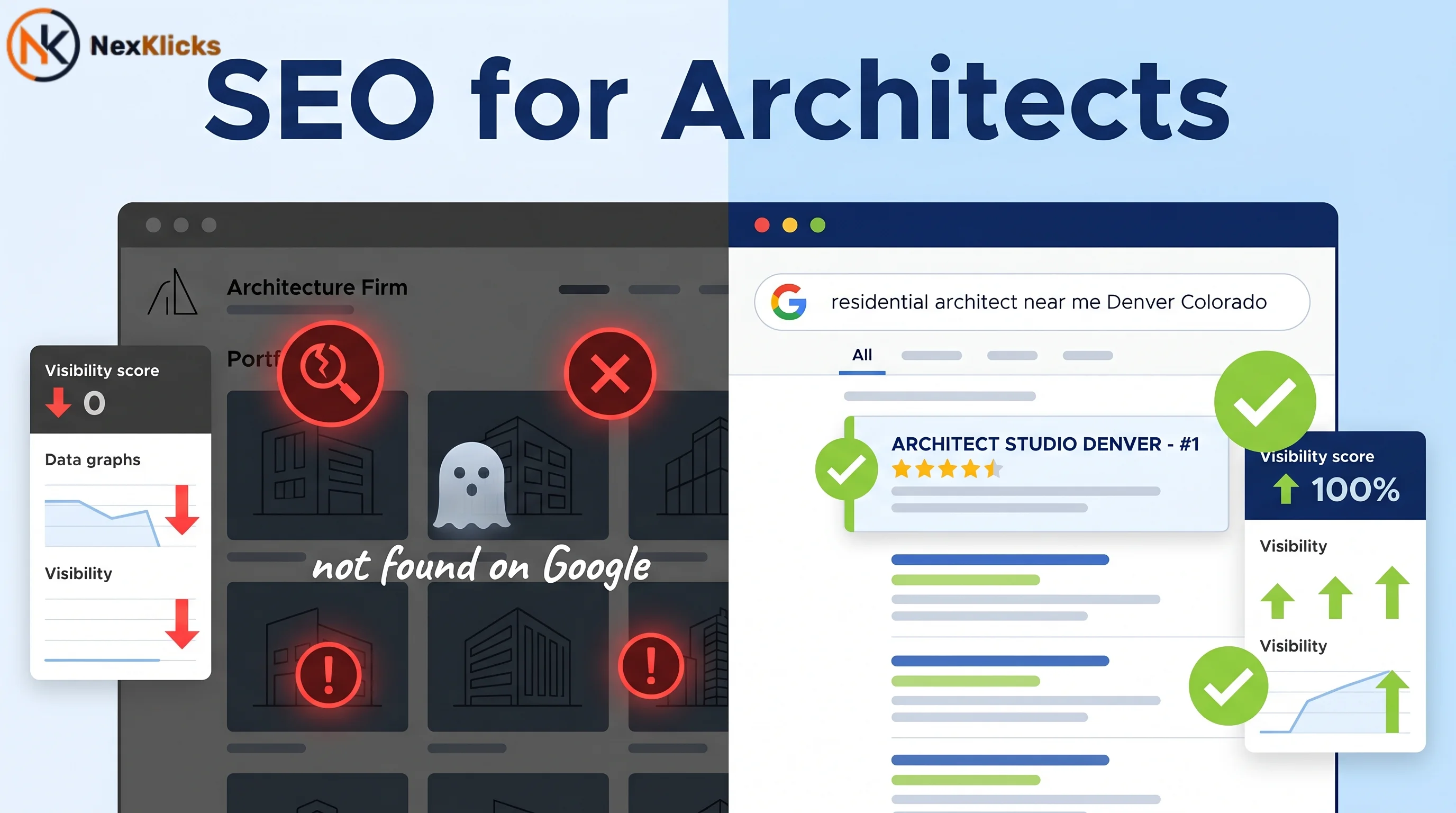
A potential client in Denver searches “residential architect near me” at 9 PM on their phone. Three firms appear instantly. Yours isn’t one of them. That gap is exactly what SEO for architects is designed to close. According to BrightLocal (2023), 98% of consumers used the internet to find local business information.
Even referral-based clients will Google you before calling. Your portfolio may look stunning, but without an architecture website ranking strategy, Google simply cannot find you. This guide covers keyword research for architecture firms, local map pack visibility, portfolio SEO, and technical fixes to turn your website into a consistent lead engine.
SEO for architects is the process of optimizing an architecture firm’s website so it ranks on Google when clients search for design services nearby. It combines keyword targeting, local visibility, technical performance, and content strategy to generate consistent, qualified leads.
Why SEO for Architects Matters More Than Ever in 2026
How Google Has Changed the Way Clients Find and Vet Architecture Firms
Clients begin their search on Google months before a project moves forward. Over 70,000 architectural firms compete in the U.S., and 75% of users never scroll past page one. Being on page two is functionally invisible. Google’s AI Overviews now surface expert-driven content directly in answer boxes, and thin pages are being pushed down. Industry data shows 70% of potential architecture clients begin their search online before contacting a firm. That is the window SEO for architecture firms captures.
Architects searching for growth beyond referrals need SEO because organic search creates a compounding lead pipeline. According to BrightLocal (2023), 98% of consumers search online for local businesses, meaning even warm referrals verify your firm digitally before making contact. SEO for architects positions your firm exactly where that verification happens.
The Real ROI of Organic Search vs. Referrals and Paid Ads
Quick Comparison
| Option | Best For | Key Benefit | Limitation |
|---|---|---|---|
| Referrals | High-trust leads | Strong conversion rate | Unpredictable, doesn’t scale |
| Paid Ads | Fast visibility | Immediate traffic | Stops when budget stops |
| SEO | Long-term growth | Permanent compounding asset | Takes 6 to 12 months to build |
| Social Media | Brand awareness | Visual reach | Low direct lead conversion |
SEO for architects builds something paid ads never can: a permanent digital asset. A page that ranks today keeps generating leads two years from now without additional spend.
How Clients Search for Architects Online
Local Search Intent and What Triggers a Hiring Decision
Most architecture clients search through the lens of their problem or location. Phrases like “architect in Portland” or “residential architect near me” dominate local search. Clients start searching when something real happens: a budget gets approved, or a property gets purchased. Your content needs to meet them at that exact moment. Client lead generation for architects depends entirely on understanding this timing.
Service-Based vs. Project-Based Search Behavior
Two distinct searcher types exist. Service-searchers type “commercial architecture firm Chicago.” Project-searchers type “loft conversion architect” or “passive house design” and may not even know they specifically need an architect. Your site needs pages that serve both. Service pages handle the first group. Blog posts and case studies handle the second.
How Prospects Compare Architecture Firms Before Making Contact
After a search surfaces options, clients evaluate in under a minute based on: portfolio style match, visible credentials like AIA membership, social proof through reviews, and website clarity. The firm with the clearest positioning wins the inquiry. Architectural firm credibility is not built by aesthetics alone.
E-E-A-T for professional services (Experience, Expertise, Authoritativeness, Trustworthiness) is the framework Google uses to evaluate your site. Display your AIA membership, project credentials, and client testimonials prominently. Google rewards demonstrable expertise, not just good design.
Why Local SEO Needs a Different Approach for Architects
The Minimalist Website Problem and Why It Hurts Rankings
Architecture websites prioritize aesthetics over searchability. Google cannot read images. Without text content, it has no basis for understanding what your pages are about. Large image files also increase bounce rate on portfolio sites and damage rankings on mobile. The fix: short keyword-rich descriptions beneath each image, a clear H1 on every page, and compressed images.
Why Referral-Dependent Firms Still Need Search Visibility
Referrals dry up when a key contact moves on. More importantly, referred clients still Google you before calling. A weak online presence undermines a warm referral. Local SEO for small architecture practices creates a parallel pipeline that works independently of your network.
How to Attract the Right Clients, Not Just More Traffic
More traffic isn’t automatically valuable. Broad, untargeted SEO attracts clients whose budgets don’t match your fees. Define your ideal client first, then build every page to speak to that person. Niche keywords like “luxury residential architect Denver” filter in aligned clients and filter out mismatches before they ever contact you.
Keyword Research for Architects: Finding Terms That Actually Drive Revenue
How to Identify the Best SEO Keywords for Your Specific Firm
Start with your service list, then add geography. Use Ahrefs for architecture firm keyword research and competitor gap analysis. Google Search Console shows which queries already trigger your pages. The most underused method: ask your last five clients exactly what they typed into Google. That qualitative data is often more accurate than any tool.
Long-Tail vs. Broad Keywords: Which Drives Better Leads?
Broad keywords like “architects” are dominated by national directories. Long-tail keywords for architecture like “sustainable residential architect in Portland” attract visitors with specific intent and a real project ready to move. Lower search volume, far higher conversion rate. Our guide on how to choose keywords for content writing covers selection in detail.
To build a keyword map for your architecture firm, follow these steps:
- List every service your firm offers.
- Add your target cities to each service.
- Assign one primary keyword per page.
- Validate search volume in Ahrefs or Google Keyword Planner.
- Map each keyword to its URL in a spreadsheet.
Mapping Keywords to Service Pages, Location Pages, and Blog Content
Keyword mapping for your architecture website prevents two pages from competing for the same term. One page, one primary keyword. Homepage targets your broadest local term. Service pages target individual specialties. Location pages target individual cities. Blog posts target long-tail educational queries.
On-Page SEO for Architecture Websites
Optimizing Your Homepage, Service Pages, and Contact Page
Your homepage H1 should state your value and location clearly. Include your primary service and city within the first 100 words. Service pages need minimum 500 words each. Answer: What is the service? Who is it for? Why your firm? Your contact page is underused for SEO. Include full NAP (Name, Address, Phone), embed a Google Map, and add a short paragraph with your city and service keywords. On-page optimization for architecture websites means giving Google enough context to rank confidently.
Writing Title Tags, Meta Descriptions, and URLs That Get Clicks
Meta description optimization determines click-through rate, which influences rankings indirectly.
- Title tags: Under 60 characters. Keyword plus location. Example: “Residential Architect in Austin | Studio Name”
- Meta descriptions: Under 155 characters. Client benefit first. Example: “Planning a custom home in Austin? We design homes built around how you live. Free consultation.”
- URLs: Short and keyword-rich. Use
/services/residential-architecture-austin.
How to Use Internal Linking to Distribute Authority Across Your Site
Anchor text for internal links should be descriptive. “Residential architect in Chicago” signals to Google exactly what the destination page is about. Every blog post should link to at least one service or location page. Audit pages in Google Search Console with high impressions but low clicks, then link to them from stronger pages.
Portfolio SEO: How to Turn Project Galleries Into Search-Ranking Assets
Why Most Architecture Portfolios Are Invisible to Google
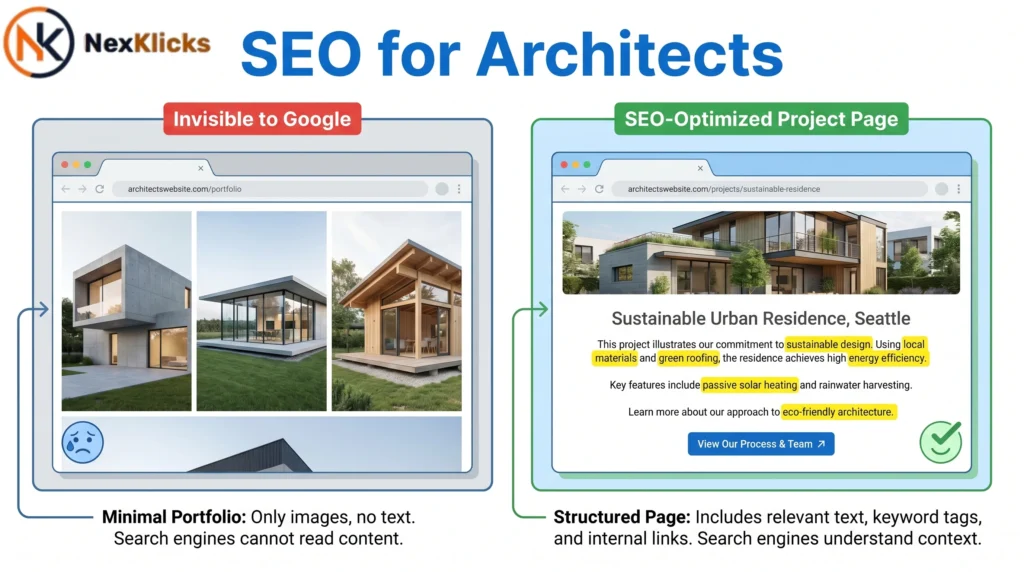
A gallery of images with no supporting text is an empty page to Google. Architectural portfolio content without written context has no keyword relevance. “IMG_4823.jpg” tells Google nothing. Your competitors’ portfolios are equally invisible. This is one of the largest untapped SEO advantages in the architecture industry.
How to Write SEO-Optimized Case Studies (Problem, Solution, Outcome Structure)
Transform every portfolio project into a structured case study. Architectural case studies for SEO contain the specific language clients search for, embedded naturally in a narrative.
Structure each project page as:
- Title with keyword: “Modern Passive House Design, Boulder, Colorado”
- Client challenge: 50 to 100 words on the problem and constraints.
- Design solution: 100 to 200 words on materials, methods, and philosophy.
- Outcome and metrics: Timeline, square footage, awards, client quote.
- Internal link to the relevant service page.
Each case study targets a long-tail keyword, builds topical authority for architecture, and links internally. Triple value from one page.
Image Optimization: File Naming, Alt Text, and Compression
Rename every image before uploading. “modern-passive-house-boulder-colorado.jpg” is searchable. “DSC_0047.jpg” is not. See our full guide on how to name images for SEO. Write one-sentence alt text including project type, style, and location. Compress every image to under 200KB using Squoosh or ShortPixel. Use WebP format where your CMS supports it. Mobile site speed for design firms is a confirmed ranking factor, and oversized images are the most common cause.
Local SEO for Architects: A Step-by-Step Process
Step 1: Claim and Fully Optimize Your Google Business Profile
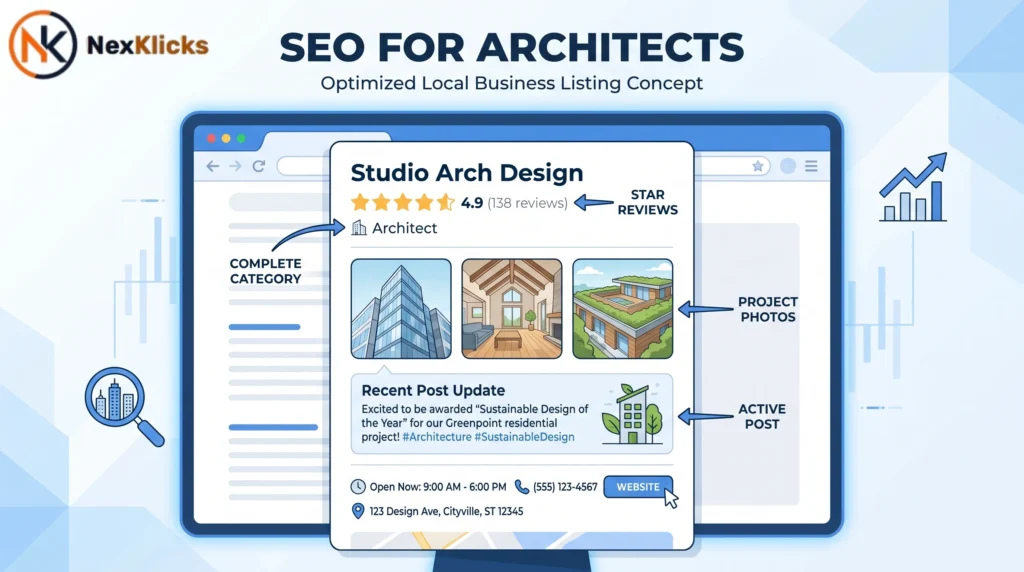
Google Business Profile for architects is free and appears above your website in local results. Select “Architect” as your primary category. Write a 750-character business description including location and specialties. Upload at least ten project photos. Post updates regularly and respond to every review. A complete profile can generate 200 or more monthly profile views before your website ranks.
Step 2: Standardize Your NAP Across All Directories
NAP consistency is a foundational local ranking signal. “Suite 200” and “Ste. 200” register as different businesses to Google. Audit: Google Business Profile, Yelp, Houzz, AIA directory, Angi, BBB, Apple Maps, and Bing Places. Use BrightLocal or Moz Local to fix inconsistencies at scale.
Step 3: Build Location Pages Without Duplicating Content
Create a dedicated page per city. Do not copy-paste the same template with only the city name changed. Google penalizes near-duplicate content, and those pages rarely rank. Location pages for architects need to be genuinely distinct. Reference local building codes, mention neighborhood design trends, include a local project example, and link to the local planning department. Target 600 to 800 words minimum per page.
For architects targeting multiple cities, the duplicate content risk is real. The correct approach is one authoritative blog post per topic that links internally to each relevant location page, rather than republishing the same article with different city names swapped in. Google may consolidate or demote near-identical pages.
Step 4: Earn and Respond to Google Reviews
Reviews are a confirmed local ranking factor. Send a direct Google Business Profile review link within one week of project completion. Respond to every review within 48 hours. According to BrightLocal, 56% of consumers choose businesses that respond to reviews.
Step 5: Track Local Rankings and Measure Lead Quality
Use Google Search Console to identify which local queries trigger your pages. Track map pack positions with LocalFalcon or BrightLocal. Connect ranking data to contact form submissions and calls. Adjust quarterly based on which location pages produce actual inquiries.
Content Strategy for Architect SEO
What Types of Content Google Rewards for Architecture Firms in 2026
Content marketing for architects works when it answers real questions. In 2026, Google’s AI Overviews favor structured, expert-driven content and actively demote thin pages. Ranked by SEO value: educational blog posts, project case studies, location pages, service pages, and FAQ pages.
How to Write Blog Posts Around Real Client Questions
The best blog topics come from your own discovery calls. High-performing formats for SEO for architects content:
- “Do I need an architect for a home addition in [State]?”
- “How much does it cost to hire an architect in [City]?”
- “Passive house vs. standard build: which is right for your Colorado home?”
Publish two posts per month minimum. Our content writing tips for service businesses cover structure and tone in detail.
Using Location-Specific Content Without Triggering Duplicate Content Penalties
Write one authoritative article per topic, then link to the relevant location page within it. Never publish the same article ten times with only the city name changed. Use canonical tags when similar content exists across multiple URLs.
Technical SEO for Architecture Firms
Site Speed and Mobile Optimization for Image-Heavy Portfolios
Over 60% of portfolio browsing happens on mobile. Google’s Core Web Vitals measure LCP, INP, and CLS, and all three affect rankings. Compress all images to under 200KB in WebP format. Enable lazy loading. Use a CDN like Cloudflare. Test at Google PageSpeed Insights and aim for a mobile score above 70. Work through our mobile SEO checklist for service websites.
Site Structure, Crawlability, and Indexing Basics
Submit an XML sitemap via Google Search Console. Fix broken links monthly. Use robots.txt to block low-value pages from being indexed. Use a logical URL hierarchy: yourfirm.com/services/residential-architecture/. See our technical SEO audit guide for a full checklist.
Schema Markup Types Every Architecture Firm Should Use
Schema markup for professional services helps Google understand your content and can trigger rich results. Use LocalBusiness or ProfessionalService, Organization, AggregateRating, FAQPage, and BreadcrumbList. Implement via Google’s Structured Data Markup Helper or a plugin like Yoast or Rank Math.
Link Building for Architecture Websites
How to Earn Backlinks from Design Publications and Industry Directories
Backlinks for architecture firms are votes of confidence that Google uses as a core ranking signal. Submit projects to ArchDaily, Dezeen, and Dwell. Frame submissions as stories: client problem, design solution, community impact. Local media is often overlooked. City business journals regularly cover project completions, and a single local news link can meaningfully lift your rankings.
AIA Profiles, Houzz Listings, and Partner Cross-Linking Strategies
Your AIA directory listing is a high-authority citation. Make sure it links to your website. Houzz profile optimization with project photos can independently rank for local keywords and pass link equity to your site. Partner cross-linking with engineers, interior designers, and contractors is natural, relevant, and trusted. See our guides on outsourcing backlink building and off-page SEO tactics for building authority.
Creating Linkable Assets That Earn Backlinks Organically
Produce content so useful that other sites naturally link to it. Strong ideas: “State of Sustainable Architecture in the U.S., 2026 Report,” “The True Cost of Hiring an Architect in Every U.S. State,” or a local zoning explainer like “Chicago ADU Zoning Guide for Homeowners.” Publish it, then email it to relevant journalists and industry contacts.
The data behind this comes directly from the BrightLocal Local Consumer Review Survey 2023, which found that 98% of consumers used the internet to find local business information.
How to Measure SEO Performance as an Architecture Firm
The Metrics That Actually Matter
Forget total page views. Revenue-predicting metrics: organic contact form submissions, phone calls from organic traffic tracked via CallRail, Google Business Profile actions including calls and direction requests, and organic traffic to service and location pages specifically. Ask one question each month: how many qualified inquiries came from search?
Tools to Use: Google Search Console, Ahrefs, and Google Analytics 4
Google Search Console (free): shows queries, rankings, click-through rates, and indexing issues. Start here. Google Analytics 4 (free): connects organic traffic for design firms to business outcomes. Ahrefs (paid): tracks domain authority, keyword rankings, and competitor gaps. BrightLocal (paid): specialized for local SEO and map pack tracking.
How Often to Audit and Update Your SEO Strategy
Monthly: check Search Console for errors and review GBP activity. Quarterly: review rankings and update underperforming pages. Annually: full audit covering technical health and backlink profile. SEO is ongoing maintenance, not a one-time task.
Test your own site using Google PageSpeed Insights, which gives a free, real-time performance score and specific recommendations for your architecture website.
Should You Hire an SEO Agency for Architects or DIY It?
When It Makes Sense to Manage SEO In-House
DIY SEO is viable when your firm has a dedicated marketing coordinator with consistent time, you’re targeting a low-competition market, and you can publish content regularly. Time investment: 8 to 15 hours per month. Tools: Google Search Console and Google Analytics 4 (both free), plus Ahrefs or SEMrush at $100 to $200 per month.
DIY SEO vs. hiring an agency for architects: DIY suits small firms in low-competition markets with time to execute monthly. Agency SEO works better in competitive metros or when there’s no internal marketing resource. The key difference is time invested vs. speed of results.
What to Look for in an SEO Partner Who Understands the Architecture Industry
Green flags: they ask about your ideal client and fee range before discussing keywords, they focus on lead quality, not just traffic volume, they show case studies from SEO for professional service firms, and they provide transparent monthly reports. Red flags: guaranteed rankings in 30 days, no discovery phase, and lock-in contracts with no performance benchmarks. Review our guide on common SEO mistakes small firm owners make before committing.
Red Flags to Avoid When Evaluating SEO Agencies
“We guarantee number one on Google” is the most common red flag. No ethical agency can guarantee a specific ranking. Watch also for agencies that start without an audit phase, have no clear ownership of content creation, and offer very low pricing with no clear strategy behind it.
Frequently Asked Questions About SEO for Architects
Q: What’s the best way to start SEO for a small architecture firm?
A: Claim your Google Business Profile, compress your portfolio images, and write one structured project case study. Three steps, no budget required, immediate impact.
Q: How do I rank for local searches as an architect?
A: Optimize your Google Business Profile, build location-specific pages with unique content per city, earn Google reviews consistently, and standardize your NAP across all directories.
Q: Should I use social media or SEO to get architecture clients?
A: Both serve different purposes. Social media builds awareness. SEO captures clients actively searching for an architect. SEO produces higher-intent leads with stronger conversion rates.
Q: Why does my architecture website rank for nothing even though it looks great?
A: Visual design has no direct SEO value. Google ranks text content. Minimal written content, no keyword strategy, and slow load times from uncompressed images keep any site invisible regardless of how it looks.
Q: When should I hire an SEO agency for my architecture firm?
A: When you’re in a competitive metro, have no internal marketing resource, or have tried DIY SEO for six months with no measurable results.
Final Thoughts: Building a Long-Term SEO Foundation for Your Architecture Firm
SEO for architects isn’t about gaming Google. It’s about building a clear, credible digital presence that connects your expertise with clients already searching for what you offer.
The most common mistake architects make is treating SEO as a one-time task. A redesigned website isn’t a strategy. Posting on Instagram isn’t a strategy. What works is a layered, consistent approach: keyword research, on-page optimization, portfolio case studies, local SEO, content publishing, and technical maintenance, each building on the last over 12 to 24 months.
Start today. Claim your Google Business Profile. Write one SEO-optimized project case study using the Problem, Solution, Outcome structure. Those two steps put you ahead of most competitors who are still waiting for referrals to find them.
This guide to SEO for Architects explains how architecture firms can increase their Google visibility, attract higher-quality clients, and build a sustainable source of leads beyond referrals. It covers keyword research, local SEO, portfolio optimization, content strategy, technical SEO, and link building to help architects rank higher and grow their business in 2026.
Last update: June 2026


Leave a Reply