
A homeowner spills red wine on a white carpet and grabs their phone. Within seconds, they’ve searched “carpet cleaning near me” and called the first business in the local 3-pack. Was that you? If not, carpet cleaning SEO is the reason. Over 39,000 carpet cleaning companies compete for local customers in the U.S., and the ones getting consistent calls aren’t necessarily the best. They’re the most visible.
This guide covers carpet cleaning keywords, Google Business Profile optimization, location pages, review building, and call tracking, so you can market your professional carpet cleaning business and turn your website into a lead machine.
Carpet cleaning SEO refers to the process of optimizing a carpet cleaning business’s online presence to rank higher in Google search results and local map listings. It combines on-page optimization, local SEO tactics, and review management to attract customers who are actively searching for cleaning services nearby.
Why Carpet Cleaning SEO Is Different from Every Other Industry
Generic SEO advice doesn’t map to your business, and understanding what makes carpet cleaning SEO work requires recognizing the six traits that separate this industry from every other local service vertical.
Hyper-local intent. Every commercial query carries implicit “near me” intent even without those words. Google’s location-aware ranking dominates the SERP.
Phone-led conversions. Most jobs book by call, not form. Click-to-call prominence matters as much as rankings.
Trust transaction. Letting a stranger into your home is high-trust. Reviews, real team photos, and owner bios carry outsized conversion weight.
Seasonal carpet cleaning demand. Spring cleaning, end-of-tenancy, holiday prep. Your SEO calendar has to anticipate demand peaks two months before they happen.
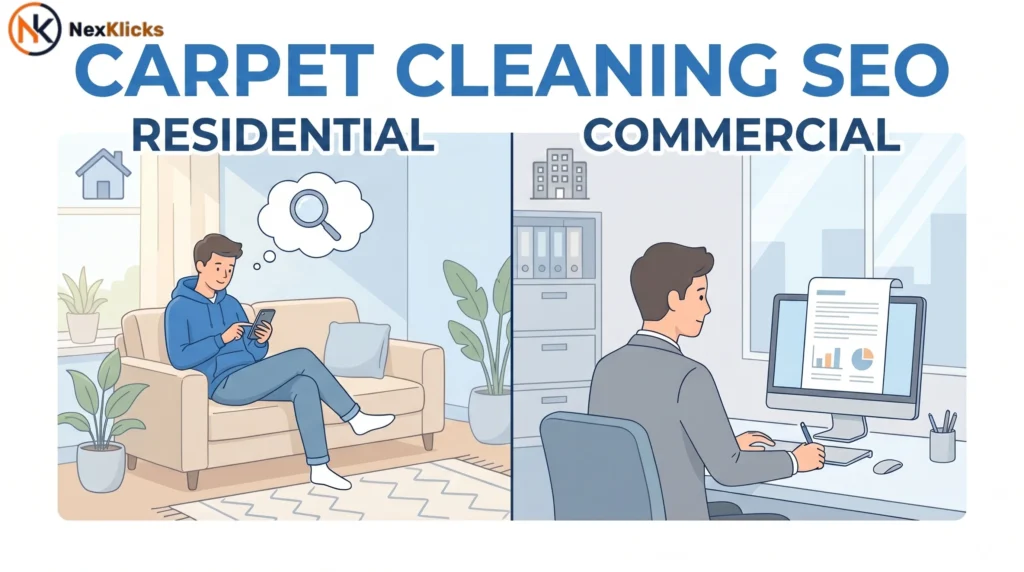
Residential vs. commercial split. Two completely different buyer types, sales cycles, and keyword universes on one website.
Emergency carpet cleaning queries convert at extremely high rates. Pet accidents and water damage create searchers who need someone immediately.
Why Is SEO Important for Carpet Cleaning Businesses?
According to the BrightLocal 2024 Local Consumer Review Survey, 98% of consumers used the internet to find local businesses last year, and 87% used Google specifically.
If you’re not in the Google local 3-pack when someone searches “carpet cleaning Dallas” or “carpet cleaning Phoenix,” you’re invisible to the majority of searchers who never scroll past the map. Local search intent doesn’t wait.
SEO for carpet cleaning companies delivers three things paid ads can’t replicate long-term. Consistent lead flow from improving search engine rankings that compounds instead of stopping when your budget runs out. Qualified buyer intent, because SEO captures people already searching for your service. And market authority, because ranking at the top signals credibility before a searcher reads a single word. Topical authority built through content and reviews tells Google and your prospects that you’re the real deal.
A competitor with worse service and better SEO is taking your calls right now. The fundamentals of local SEO for small businesses apply here with one critical difference: in carpet cleaning, speed of trust-building through reviews and GBP signals compresses what takes other industries months into weeks.
How to Find the Right Carpet Cleaning Keywords (By Intent)
Keyword difficulty and search volume are the two numbers that frame every keyword decision. But most carpet cleaners chase the wrong terms entirely.
Here’s how to structure your carpet cleaning keywords strategy across four buckets.
Bucket 1: Transactional Core Keywords (High Intent, High Competition)
These are the money terms. Searchers using these phrases are ready to hire someone today.
| Keyword | Monthly Searches | Keyword Difficulty |
|---|---|---|
| carpet cleaning | 54,000 | 29 |
| carpet cleaning near me | 49,000 | 37 |
| carpet cleaning service | 14,000 | 34 |
| carpet cleaning company near me | 7,000 | 13 |
| carpet steam cleaning | 2,500 | 5 |
The problem is intense carpet cleaning franchise competition from Stanley Steemer, Zerorez, Chem-Dry, and Oxi Fresh, plus aggregators like Angi, Thumbtack, and Yelp. You won’t out-content those players. You win here on local search intent, review volume, and a dialed-in Google Business Profile optimization.
Bucket 2: City-Qualified Terms
“Carpet cleaning Las Vegas,” “carpet cleaning Houston,” “carpet cleaning Phoenix.” These city-qualified variations pull 1,200 to 1,600 monthly searches each and are won the same way: local relevance and reviews. Each deserves its own dedicated location page.
Bucket 3: Informational and Cost Keywords (Almost Zero Competition)
“How to get stains out of carpet” (2,400/mo, KD 8), “best carpet cleaning solution” (1,700/mo, KD 0), “carpet cleaning cost” (1,000/mo, KD 1). Most carpet cleaners refuse to publish pricing. That refusal hands these nearly uncontested searches to whoever is willing to be transparent.
Bucket 4: Misleading Volume to Avoid
“Carpet cleaner” shows roughly 148,000 searches a month at KD 5. Sounds perfect. It isn’t. The intent is split between people searching for rental machines, the appliance itself, and the actual service. Chasing that volume wastes your effort on unqualified traffic.
Use Ahrefs for keyword difficulty scores and competitor gap analysis, Google Keyword Planner for free baseline search volume data, and Google Search Console to see what you already rank for. Think like your customer. They don’t search “hot water extraction.” They search “how to get coffee stain out of carpet.” Long-tail keywords framed around real problems are where the fastest wins live.
The Adjacent Services Keyword Opportunity Most Carpet Cleaners Ignore
Most carpet cleaning businesses already offer upholstery cleaning, rug cleaning, tile cleaning, and mattress cleaning with the same truck and crew. But their website only has a carpet page. That means they’re invisible for searches like these:
Quick Comparison: Adjacent Service Keywords vs. Core Carpet Terms
| Service | Monthly Searches | Keyword Difficulty | Typical Site Coverage |
|---|---|---|---|
| upholstery cleaning | 21,000 | 0 | Rarely a dedicated page |
| rug cleaning | 15,000 | 3 | Rarely a dedicated page |
| area rug cleaning | 5,500 | 12 | Almost never |
| tile and grout cleaning | 5,400 | 2 | Almost never |
| mattress cleaning | 3,300 | 2 | Almost never |
| carpet cleaning near me | 49,000 | 37 | Always covered |
Together, these adjacent services pull more low-competition search volume than the contested core carpet cleaning terms at a fraction of the ranking difficulty. A new site can rank for several within months. Build one optimized service page per service. Each page targets one keyword cluster, covers the process in detail, includes FAQs, and ends with a clear call to action. Rug and upholstery cleaning and tile and grout cleaning pages are among the fastest SEO wins in this category right now.
On-Page and Technical SEO for Carpet Cleaning Websites
Carpet cleaning website optimization starts with getting four fundamentals right. Strong on-page SEO is what makes each page readable to both Google and your customers.
Title tags. Keep under 60 characters. Formula: Keyword + City + Differentiator. “Carpet Cleaning Denver | 1-Hour Dry Time” tells Google what the page is about and gives searchers a reason to click.
Meta descriptions. Not a direct ranking factor, but they drive click-through rate. Under 155 characters, include your keyword, location, and one differentiator like same-day service.
Page speed. 76% of people who conduct a local search on mobile visit the business within 24 hours. Uncompressed before-and-after photos are the most common reason carpet cleaning sites fail Core Web Vitals. Compress every image before uploading.
Schema markup for local business. LocalBusiness, Service, FAQPage, and Review schema help Google and AI tools extract your information accurately. HTTPS is a confirmed ranking signal. If your site runs on HTTP in 2026, fix that before anything else.
If you’re unsure where your site stands on any of these, a full technical SEO audit will surface every crawl error, speed issue, and schema gap in one pass.
To optimize a carpet cleaning website:
1. Set title tag to Keyword + City + Differentiator (under 60 chars).
2. Write meta description under 155 chars with keyword and location.
3. Compress all images to pass Core Web Vitals.
4. Add LocalBusiness and FAQPage schema.
5. Verify site loads under 3 seconds on mobile.
How to Build Service Pages That Actually Rank and Convert
The most common mistake in seo for carpet cleaning companies is cramming every service into one page. Google can’t determine the primary intent and won’t rank it well for any specific term.
Each service needs its own dedicated page targeting one keyword cluster. Every service page needs: a keyword-optimized H1 and title tag, a detailed process description, transparent pricing (even “starting from $X per room” builds trust), an FAQ section, service-specific testimonials, and one clear call to action.
Priority pages to build: residential carpet cleaning, commercial carpet cleaning, upholstery cleaning, area rug cleaning, tile and grout cleaning, stain and odor removal, and emergency same-day cleaning. Seven pages minimum, whereas most sites have one. Before and after photos belong on every page. Compress them first.
Location Pages: The Fastest Way to Dominate Every City You Serve
If you serve Dallas, Plano, and Fort Worth, your single homepage cannot rank in all three. Google associates your site with one location. This is one of the most costly mistakes in local SEO for carpet cleaners.
Each city needs its own dedicated page with genuinely unique, locally relevant content. Include neighborhoods served, local references, a local phone number or map, reviews from that specific city, and a local FAQ. A “Do you serve the Uptown area of Dallas?” FAQ section signals local authority Google rewards.
Location page structure:
- URL:
/carpet-cleaning-[city-name]/ - Title tag: “Carpet Cleaning [City] | [Company Name]”
- H1: “Professional Carpet Cleaning Services in [City], [State]”
Boilerplate “We serve [city]” pages get filtered. Unique content is non-negotiable. Businesses like Dalworth Clean have built strong multi-city visibility by treating each location page as a standalone content asset.
How to Claim and Fully Optimize Your Google Business Profile for Carpet Cleaning
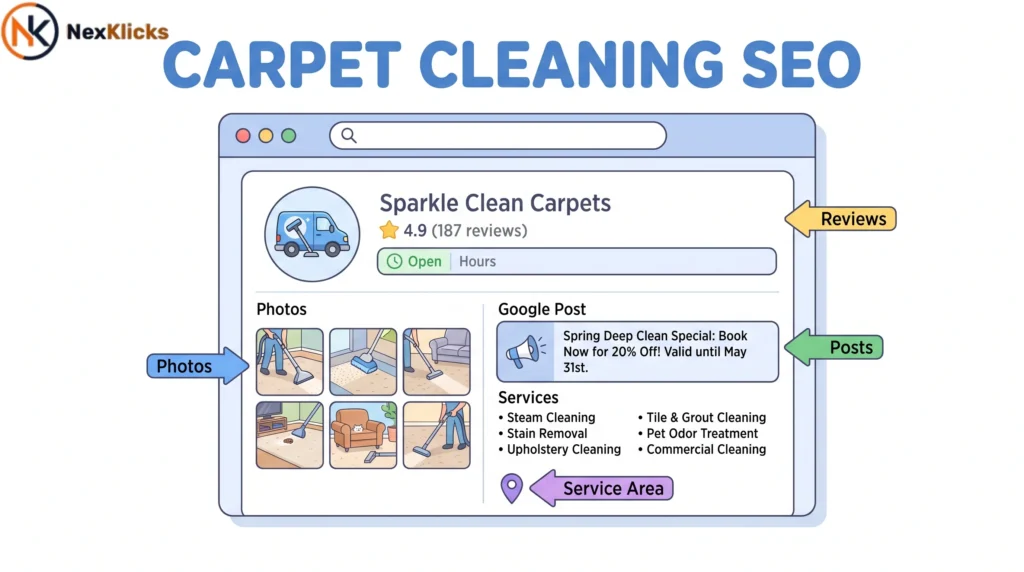
Your Google Business Profile is the single most important SEO asset for a carpet cleaning service area business. It drives the local 3-pack, the map results that appear above all organic listings for searches like “carpet cleaning near me” and “carpet stain removal [city].”
Most operators claim the listing and stop there. Full optimization is what separates the top 3 from the bottom 10.
According to the Whitespark Local Search Ranking Factors survey, GBP signals are the number one driver of local map pack rankings, more than any other factor.
Step-by-Step GBP Optimization for Carpet Cleaners
Step 1. Claim your listing at google.com/business and verify it via postcard, phone, or video.
Step 2. Complete every field. Business name, service area business radius, phone, website, hours, and a full services list. Empty fields are missed ranking signals.
Step 3. Set your service area correctly. List only the cities you actually serve. Google detects inflated service areas through clickstream data and suppresses your visibility.
Step 4. Upload real photos. Team photos, equipment shots, and before-and-after results. Listings with 10 or more photos get significantly more clicks.
Step 5. Use Google Posts and pre-populate Q&A. Publish at least one post per week. Add your most common customer questions to the Q&A section so answers surface directly in search results.
GBP Category Strategy: The Hidden Local Pack Lever Most Cleaners Get Wrong
No major competitor covers this. It’s one of the most actionable tactics in carpet cleaning SEO, and it costs nothing to fix.
Google Business Profile categories carry significant weight in local pack rankings. Choosing the wrong primary category directly suppresses your visibility for the searches that matter most.
Category Selection Strategy
Primary category: “Carpet cleaning service.” Not “Cleaning service,” which is too broad, and not “Janitorial service,” which targets a completely different vertical. This single selection heavily influences which searches trigger your listing to appear.
Secondary categories. Add every service category that applies to your business: “Upholstery cleaning service,” “Rug cleaning service,” “Tile contractor” for tile and grout work, and “Water damage restoration service” if you offer it. Each secondary category expands the search queries your profile can appear for without requiring a separate website page.
The most common mistake is leaving the profile on the default “Cleaning service” category from initial setup. Many operators never revisit this after claiming their listing.
How to audit your categories. Search for your top competitors in Google Maps, click on their profiles, and scroll to the Category field in the overview panel. Compare their selections against yours and against the top-ranked results in your city. If they’re using “Carpet cleaning service” as primary and you’re not, you’ve found the problem.
“Carpet cleaning service” vs “Cleaning service” as a GBP primary category: “Carpet cleaning service” is the correct choice for companies focused on residential and commercial carpet work because it directly matches the search queries that generate booking calls. “Cleaning service” is too broad and triggers your profile for irrelevant searches like house cleaning and office janitorial. The key difference is specificity: the more precisely your category matches your service, the higher your local pack visibility.
How to Build Reviews Consistently (The Highest-Leverage Local SEO Activity)
Review velocity is the single most impactful local pack ranking factor and the most underinvested area in carpet cleaning SEO.
The 4-star operator with 200 reviews almost always outranks the 4.8-star operator with 12 reviews. Volume and recency beat a perfect average score. A review profile that went quiet 8 months ago sends a negative signal to Google’s algorithm.
The Review Generation System
In-person ask. The technician verbally asks every satisfied customer at job completion: “Would you mind leaving us a quick Google review? It really helps our small business.” Simple. Effective. Most operators never do it.
Text follow-up. Send a text with a direct Google review link within 2 hours of job completion while the experience is fresh. Tools like Podium or NiceJob automate this step entirely.
Email follow-up. Send an email 24 hours later for customers who didn’t click the text. Include before and after photos of their specific job to trigger the positive memory of the result.
Respond to every review. Responses to positive reviews demonstrate professionalism. Responses to negative reviews, calm, factual, and solution-oriented, show future readers that you handle problems well. That matters in a trust transaction like home services.
Review Goal Benchmarks:
- Under 25 reviews: This is Priority #1, before almost any other SEO activity.
- 25 to 100 reviews: Focus on consistency. Aim for at least 3 to 5 new reviews per month.
- 100 or more reviews: Maintain velocity. The competitive edge shifts from volume to recency.
Residential vs. Commercial Carpet Cleaning SEO: Two Different Strategies
Most carpet cleaning websites treat commercial as a footnote. A single paragraph on the services page. This is a significant strategic error.
Commercial carpet cleaning services and residential SEO are effectively two separate programs running on the same domain.
Residential Carpet Cleaning SEO
Primary buyers are homeowners, renters, and property managers who convert by phone. Keywords are high-volume, location-based, and driven by immediate need. Trust drivers are Google reviews, before and after photos, and local map pack presence.
Commercial Carpet Cleaning SEO
Primary buyers are facilities managers, office managers, and franchise operators. Keywords like “commercial carpet cleaning” (10,000/mo, KD 9) sit at a fraction of the competition in residential terms, with far higher contract values attached. Trust drivers are case studies and IICRC certifications, not review stars. The sales cycle is longer, and conversion often starts with a form or email rather than a phone call.
How to structure the site. Build a separate /commercial-carpet-cleaning/ section with its own keyword targeting and content. Don’t redirect commercial inquiries to the residential homepage. They will bounce.
A single commercial contract can be worth 10 times the residential equivalent. The per-deal math often justifies serious SEO investment even when the search volume looks small.
Seasonal Patterns and Emergency Positioning in Carpet Cleaning SEO
Seasonal carpet cleaning demand follows predictable patterns. Spring (March to May) is peak residential demand. Early fall brings the second residential peak. November and December drive holiday prep cleaning. Rental market end-of-month cycles spike “move-out carpet cleaning” searches around lease turnover dates.
The rule: publish content two months before the peak. Publishing a spring cleaning article in April means you rank in May. Publish in February, and you rank when demand is rising.
Emergency and Urgent-Intent Positioning
Emergency carpet cleaning captures a smaller but extremely high-intent audience. Pet accidents, water damage, flooding, wine spills. These searchers need someone today, and they’ll call the first business they find.
Build a dedicated page at /emergency-carpet-cleaning/ or /same-day-carpet-cleaning/. Target terms like “emergency carpet cleaning,” “24-hour carpet cleaner,” and “water damage carpet cleaning [city].” Mark “same-day service available” in your GBP attributes if you offer it. Include an after-hours phone number prominently.
Link Building for Carpet Cleaners: Local Authority Without the Guesswork
Backlink building signals to Google that your business is trusted, established, and relevant. The off-page SEO tactics that work best for local service businesses prioritize local link relevance over raw domain authority metrics. For local service businesses, local links carry more weight than generic high-authority links from unrelated domains.
Local directories. Submit to Yelp, Angi, HomeAdvisor, Thumbtack, Nextdoor, BBB, and your local Chamber of Commerce. Ensure NAP consistency across every listing. Name, address, and phone number must be identical everywhere. A phone number change that isn’t updated across 15 directory listings creates conflicting signals that can suppress Google Maps ranking.
Local citations and business partnerships. Connect with real estate agents, property managers, interior designers, and moving companies. Offer a referral arrangement that includes a backlink building opportunity from their resources page.
Community sponsorships. Sponsor local youth sports teams, school events, or charity fundraisers. Most include a link from the organization’s website and carry genuine local relevance signals.
Stain removal content outreach. A genuinely useful stain removal guide covering wine, coffee, and pet stains can be pitched to local home improvement blogs and neighborhood association websites. Use Ahrefs Backlink Research to evaluate prospective sources. Target local relevance over raw domain authority.
How AI Overviews Are Changing Carpet Cleaning Search (And What to Do About It)
Google’s AI Overviews now appear on approximately 21% of all searches (Search Engine Journal, 2024). For carpet cleaning, this splits clearly by query type.
Informational queries like “how much does carpet cleaning cost” and “steam cleaning carpets vs dry cleaning” are increasingly answered in an AI Overview before anyone clicks. The stain removal guide content that once pulled steady traffic now often resolves at the top of the page.
Transactional and local queries like “carpet cleaning near me” still resolve to the local pack. AI Overviews rarely appear there. That’s where the calls come from.
Don’t abandon informational content. Being cited in an AI Overview for “how much does carpet cleaning cost in Denver” builds brand recognition that feeds local conversions. To be cited, lead with the direct answer, use short paragraphs, and implement FAQPage schema. Target question-format long-tail keywords to build topical authority and capture AI Overview placements.
But prioritize local-pack SEO above all. Reviews, GBP, and location pages drive the bookings. Blog content compounds on that foundation. It doesn’t replace it.
Call Tracking and SEO Performance: Connecting Rankings to Real Revenue
Here’s what no other carpet cleaning SEO guide covers.
Conversion tracking for service businesses in this category is almost entirely phone-based. If you’re measuring success through website traffic and form submissions alone, you’re missing 80% or more of your actual conversions.
You cannot optimize what you don’t measure, and that’s what separates operators who treat carpet cleaning SEO as a cost from those who treat it as a documented revenue channel.
A Basic Call Tracking Setup
CallRail assigns unique phone numbers to each traffic source: organic SEO, your GBP listing, Yelp, Google Ads. You see exactly which channel drove each call and can cut what isn’t working.
Enable call tracking in GBP Insights to see how many calls come from your profile each month. Connect Google Analytics 4 and Search Console to track which keywords and pages drive traffic, and set up conversion goals for click-to-call links.
Track monthly: inbound calls by source, Google Business Profile call volume, top landing pages by call conversion rate, keyword rankings, and new review count. That’s what turns carpet cleaning SEO from a leap of faith into a measured investment with a clear return.
Common Carpet Cleaning SEO Mistakes That Kill Local Rankings
These patterns appear in nearly every carpet cleaning site audit.
One generic services page. All services crammed into one URL. Google can’t determine primary intent and won’t rank it well for any specific term.
No adjacent service pages. Missing dedicated pages for upholstery cleaning, rug cleaning, tile cleaning, and mattress cleaning, the highest-volume, lowest-competition opportunities in the category.
No location pages. A single homepage trying to rank in every city. Google picks one and the rest stay invisible.
Ignoring reviews. Gaps in review velocity signal a dormant business to Google’s local algorithm.
Slow, image-heavy sites. Uncompressed photos tank Core Web Vitals and cost you visitors before they inquire.
Wrong GBP primary category. Default “Cleaning service” instead of “Carpet cleaning service” suppresses your most valuable searches.
No call tracking. You can’t optimize what you can’t measure. Every operation above one truck needs call attribution.
Neglecting commercial SEO. A separate commercial section is typically under-built despite contract values that can justify serious investment.
Thin About and team content. A real owner photo and visible certifications move conversion rates more than most operators expect.
Carpet Cleaning SEO Checklist: Everything You Need to Rank in 2026
Keyword and Content
- Research keywords across all four intent buckets and map them to each page
- Build dedicated pages for upholstery, rug, tile, and mattress cleaning
Website
- Optimize title tags and meta descriptions for all key pages
- Create a dedicated page per service and per city served
- Compress images, pass Core Web Vitals, ensure HTTPS, and mobile-friendly website design
- Implement LocalBusiness, Service, and FAQPage schema markup
Google Business Profile
- Set the primary category to “Carpet cleaning service” and add all relevant secondary categories
- Complete every field, upload 10 or more real photos, and publish at least one Google Post per week
Reviews and Local Authority
- Ask every customer in person and send a text review link within 2 hours of job completion
- Respond to every review within 48 hours
- Build local citations on Yelp, Angi, BBB, and your Chamber. Audit NAP consistency across all listings
Tracking
- Install CallRail, set up Google Analytics 4, and Search Console
- Monitor GBP call volume, review velocity, and keyword rankings monthly
Carpet Cleaning SEO FAQs
Q: How long does carpet cleaning SEO take to show results?
A: GBP optimization and review building can move your local pack position in 60 to 90 days. Location and service pages build rankings over 3 to 4 months.
Q: How much does carpet cleaning SEO cost?
A: Most operators invest $750 to $2,500 per month, depending on service area size. Single-truck operations sit at the lower end. GBP and review work deliver the earliest ROI.
Q: Should I publish pricing on my carpet cleaning website?
A: Yes. Cost queries like “carpet cleaning cost” sit at KD 0 to 1 with real buyer intent, and most operators publish nothing. Transparent cost per room pricing wins those searches and pre-qualifies inbound calls.
Q: What’s the best GBP category for a carpet cleaning business?
A: “Carpet cleaning service” as your primary category, every time. Add secondary categories for each adjacent service: upholstery cleaning, rug cleaning, and tile and grout.
Q: When should I hire an agency for carpet cleaning SEO?
A: When you serve multiple cities, have commercial as a serious revenue line, or you’ve handled GBP basics but aren’t seeing local pack movement after 90 days.
Conclusion
Carpet cleaning SEO isn’t about out-spending Stanley Steemer or Zerorez. It’s about out-localizing them. The four levers that matter most are a fully optimized GBP with the right primary category, consistent review velocity, dedicated pages for every service and every city, and call tracking that connects your rankings to actual booked jobs.
The operator who dominates local SEO for carpet cleaners in 2026 isn’t the one with the most polished website design. It’s the one with 200 recent reviews, 12 active location pages, and a GBP profile updated every week.
The one mistake to avoid: claiming your GBP and stopping there. That’s where most carpet cleaners stall.
Your next action: run through the checklist above and identify the first gap. Fix that one thing this week. Then move to the next. Or contact Nexklicks Agency for a free carpet cleaning SEO audit, and we’ll show you exactly where your rankings are stuck.
This guide covers every carpet cleaning SEO strategy that moves the needle in 2026, from Google Business Profile optimization and location pages to keyword targeting, link building, and AI Overview visibility. If you run a carpet cleaning business and want more calls from Google without guessing, start here.
Last update: June 2026

Leave a Reply