
Most landscaping businesses in the U.S. are invisible on Google. Not because their work is poor, but because their websites are unoptimized. According to BrightLocal’s Local Consumer Review Survey (2023), 98% of consumers used the internet to find information about local businesses, making local search optimization the single most important digital channel for service businesses like yours.
Landscaping SEO is the system that changes that. It connects your website, your Google Business Profile, and your content to the customers already searching for what you offer. Whether you’re starting from scratch or fixing what isn’t working, this guide walks you through every step.
What Is Landscaping SEO and Why Does It Matter for Your Business?
Landscaping SEO Defined. More Than Just Keywords
Landscaping SEO refers to the process of optimizing a landscaping company’s website and online presence to rank higher in Google search results. It connects website content, local signals, and Google’s algorithm to generate consistent leads from customers actively searching for landscaping services in your area.
Landscaping SEO isn’t just about stuffing “lawn care” into your homepage. It’s a connected system. Your website content tells Google what you do. Your Google Business Profile for landscapers tells Google where you do it. Your backlinks tell Google you’re trustworthy. A homeowner in Dallas types “landscaping company near me” at 7pm on a Tuesday. If your landscaping website optimization is solid, your business appears. If it isn’t, your competitor’s does.
The Real Cost of Not Ranking on Page One
Over 90% of searchers never click past the first page of Google results. Every day your site sits on page two, those leads go to whoever outranks you. Lawn care services near me and landscape design in your city are searched thousands of times per month across every U.S. market. Investing in SEO for lawn care business directly translates to more calls, quote requests, and booked jobs.
Why SEO for Landscapers Is a Long-Term Growth Engine
SEO vs. Paid Ads. The ROI Difference for Lawn Care Businesses
Quick Comparison
| Option | Best For | Key Benefit | Limitation |
|---|---|---|---|
| Google Ads | Immediate lead generation | Fast visibility | Stops when budget runs out |
| Landscaping SEO | Long-term growth | Compounds over time | Takes 3 to 6 months to build |
| Local SEO (GBP) | Local pack visibility | Free and high-intent traffic | Requires ongoing management |
| Social Media Ads | Brand awareness | Visual engagement | Low purchase intent |
| Directory Listings | Citations and backlinks | Builds local trust | Limited standalone impact |
SEO vs. Paid Ads: Landscaping SEO is better suited for long-term lead generation because rankings compound over time and don’t stop working when you pause spending. Paid ads work better when you need immediate visibility for a new service or seasonal push. The key difference is sustainability. SEO builds an asset. Ads rent attention.
Paid ads stop delivering the moment you stop paying. Organic search rankings built through SEO are an asset you own. A well-optimized service page can generate leads for two or three years without additional spend. That’s a meaningful difference for any landscaping crew watching margins.
How Organic Search Drives Landscaping Leads Differently
People who find you through organic search are already looking for what you sell. That purchase intent is much higher than someone who scrolls past a Facebook ad. Local SEO for landscapers captures bottom-of-funnel customers, homeowners with overgrown yards, commercial property managers with upcoming projects, and new homeowners ready to spend. That’s why organic traffic landscaping converts at a higher rate than almost any other channel. Search intent optimization ensures your business appears exactly when someone is ready to hire, not just browsing.
Conducting Landscaping Keyword Research That Actually Attracts Local Clients
How to Find High-Intent Local Keywords Using SEMrush or Ahrefs
Landscaping keyword research starts with a seed keyword, then gets specific. Open SEMrush’s Keyword Magic Tool or Ahrefs’ Keywords Explorer and type “landscaping services.” Layer in city and neighborhood modifiers: “Landscaping services Austin TX,” “lawn care near me,” “landscape design Chicago suburbs.” Focus on keywords with local intent and moderate competition. A term with 500 monthly searches and low difficulty is worth more right now than a term with 10,000 searches where national chains dominate. Before building your own list, analyze what competitors rank for. Our guide on how to get topical map of competitor SEO shows you how to extract their keyword architecture and find the gaps.
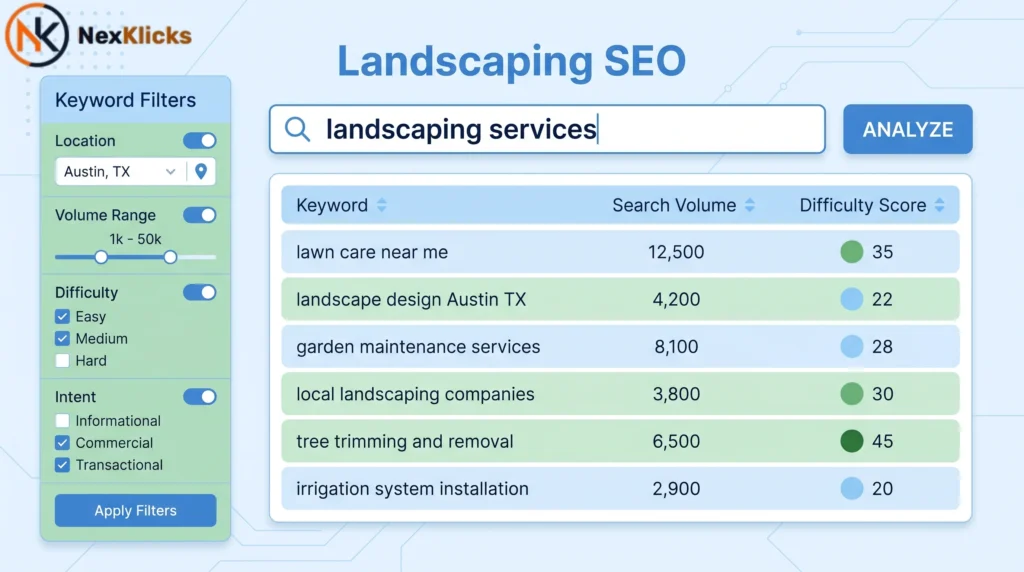
To find high-intent local keywords for your landscaping business, follow these steps:
- Open SEMrush or Ahrefs and enter a broad seed keyword.
- Filter results by local intent and low-to-medium keyword difficulty.
- Add your city or service area as a modifier to each term.
- Export the top 20 terms and group them by service type.
- Assign one primary keyword to each service or location page.
For a hands-on starting point, the SEMrush Keyword Magic Tool gives you search volume, keyword difficulty, and intent data for every term you enter.
Long-Tail vs. Short-Tail Keywords. What to Target First
Short-tail keywords like “landscaping company” are owned by national chains and agencies with decade-old domains. Long-tail keywords lawn care terms like “affordable landscaping services in Austin TX” are the smarter play. Lower competition, higher conversion rates. Build long-tail pages first, generate early wins, then push toward broader terms.
Quick-Win Keyword Categories Every Landscaper Should Target
Landscape design keywords fall into three buckets. Service-based: “lawn care services,” “hardscaping contractor,” “irrigation installation.” Location-based: “[service] in [city],” “lawn care services near me.” Problem-based: “how to fix patchy lawn,” “best grass for Texas heat,” “why is my yard flooding.” If you’re writing blog content around problem-based terms, our resource on keywords for content writing shows how to integrate them without over-optimizing.
On-Page SEO for Landscaping Websites — Optimize Every Page to Rank
Writing Title Tags and Meta Descriptions That Get Clicks
Your title tag formula: Primary Service plus City plus Brand. “Lawn Care Services in Dallas | GreenScape Co.” Keep it under 60 characters. Your meta descriptions landscaping pages should include a benefit and a soft CTA: “Professional lawn care in Dallas. Licensed crew, free estimates. Call today.” Under 160 characters. Most landscaping sites use titles like “Home” or “Services,” which is a missed opportunity on every single page.
Using H1, H2, and H3 Headings to Structure Service Pages
On-page optimization through heading structure helps Google understand your page and keeps visitors reading long enough to convert. Each service page needs one H1 with the primary keyword. H2s cover main subtopics. H3s answer the specific questions visitors actually ask. A lawn care service page with H2s like “What’s Included,” “Service Areas,” and “Get a Free Estimate” does the work. A page with one paragraph of generic text does not.
Image Optimization. How Your Project Photos Can Rank on Google Images
Rename every image file before uploading. “backyard-patio-design-chicago.jpg” tells Google something. “IMG_4892.jpg” tells us nothing. Add keyword research tools-informed alt text to every image. Then compress every file before uploading. TinyPNG or ShortPixel cuts sizes by 60 to 80 percent without visible quality loss, directly improving page load speed. We cover the exact naming system in our guide to SEO image names.
Local SEO Strategies Landscaping Companies Should Use
Setting Up and Fully Optimizing Your Google Business Profile
If you do one thing from this guide, make it your Google Business Profile optimization. It controls whether you appear in the Google local pack, and most landscaping businesses treat it like an afterthought. Claim and verify it. Fill out every field: services, service areas, hours, a keyword-informed description, photos of completed projects. Post updates at least once a month. Google Maps listing performance is directly tied to how active and complete your profile is.
NAP Consistency. The Silent Rankings Killer
NAP consistency means your Name, Address, and Phone Number are identical across every directory. Not almost identical. Identical. “123 Oak Street” and “123 Oak St” are different in Google’s eyes. Inconsistencies across Yelp, Yellow Pages, and Angi suppress your Google local pack rankings silently. Audit all listings, pick one canonical format, and update everything to match.
How to Earn and Manage Google Reviews to Boost Local Pack Rankings
Customer reviews local SEO is a confirmed Google ranking factor. More positive reviews mean higher placement and more clicks. A landscaping company with 4.8 stars and 80 reviews will almost always get the call over a competitor with 3.9 stars and 12. After every completed job, send a follow-up text with a direct review link. Respond to every review, positive and negative. Responses signal engagement to Google and build trust with potential customers.
Building a Topical Content Silo for Maximum SEO Authority
Most guides say “create helpful content.” That’s incomplete. The architecture of that content matters as much as the content itself.
How to Structure Service Pillar Pages
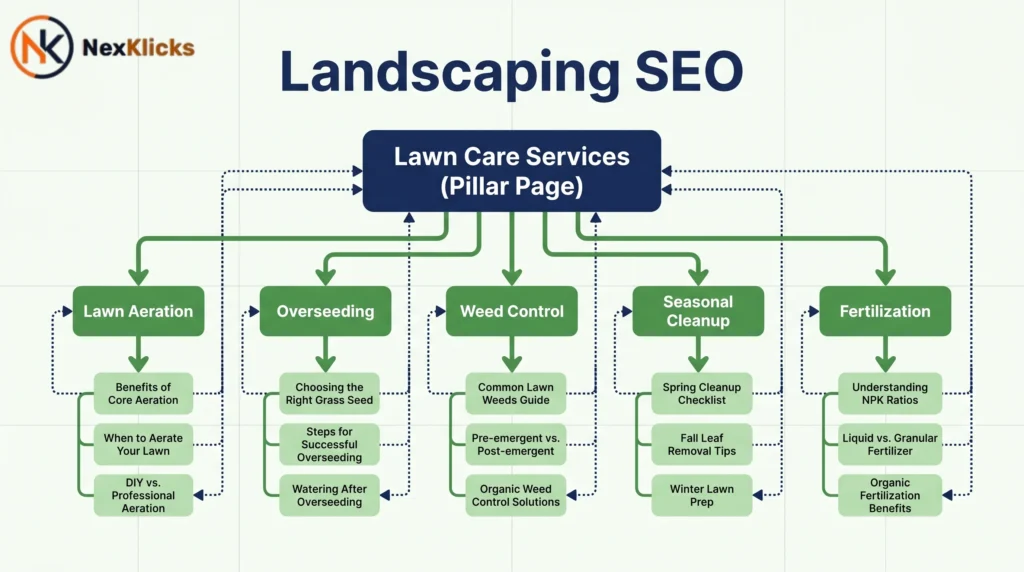
A pillar page covers one broad service comprehensively and links out to supporting cluster pages covering subtopics. Your “Lawn Care Services” pillar links to pages for “lawn aeration,” “overseeding,” “weed control,” and “seasonal cleanups.” This is what topical authority landscaping is built on. Google rewards websites that demonstrate deep expertise across a connected topic. A site with one lawn care page looks thin. A site with a pillar page and six cluster pages looks authoritative. Service area website pages follow the same logic, with a city-level pillar linking to neighborhood or service-specific cluster pages.
Blog Content Clusters That Support Your Core Service Pages
Each blog post should target a specific lawn maintenance search terms query, answer it thoroughly, and link back to the relevant service page. Examples: “Best Grass Types for Texas Lawns” links to your lawn care page. “How to Fix Drainage Problems in Your Backyard” links to your hardscaping page. Content marketing for landscapers built this way earns link building for local business opportunities, drives long-tail traffic, and signals topical authority to Google. Our content writing tips guide covers how to structure posts that hold attention and earn organic clicks.
Internal Linking Strategy That Passes Authority Across Your Site
On-page SEO service pages benefit directly from smart internal linking. Use descriptive anchor text. “Learn more about our lawn care services in Dallas” beats “click here.” Link from high-traffic blog posts to service and contact pages. If you’re pointing multiple blog posts to the same service page, read our guide on SEO multiple links to same page to structure your anchors correctly.
Technical SEO Essentials Every Landscaping Website Needs
Page Speed and Mobile-First Design
Technical SEO landscaping website problems are often invisible until they cost you rankings. 83% of users expect a site to load in under 3 seconds. Run your site through Google PageSpeed Insights. Fix the three most common issues first: oversized images, unnecessary plugins, and missing browser caching. On mobile, the stakes are even higher. Over 60% of internet traffic is mobile. Mobile-first indexing means Google ranks the mobile version of your site first. Use a responsive theme. Make sure your phone number is click-to-call, and your contact form works on a 375px screen. Run your URL through Google PageSpeed Insights right now. It’s free and returns a specific list of issues ranked by impact. Our mobile SEO checklist covers every technical item your mobile site needs to pass Google’s indexing standards.
HTTPS, Sitemaps, and Crawlability Basics
HTTPS is a confirmed Google ranking signal. Enable an SSL certificate through your hosting provider if you haven’t. Submit an XML sitemap through Google Search Console so Google can crawl every page efficiently. A page Google can’t find can’t rank. Search engine results page visibility starts with making sure your content is actually indexed. For deeper crawlability issues, a technical SEO audit services review will surface problems PageSpeed Insights won’t catch.
Off-Page SEO and Link Building for Landscaping Businesses
Building Backlinks That Actually Move Rankings
Landscaping backlinks from trusted, relevant sources tells Google your business is legitimate. Start with foundational directories: Google Business Profile, Yelp, Angi, Houzz, and LandscapingNetwork. After that, prioritize sites with higher domain authority. A link from a local home improvement blog outweighs fifty generic directory submissions. Quality over quantity is the consistent rule with backlinks for landscapers. For our full breakdown of advanced methods, see our guide to off-page SEO tactics.
Leveraging Local Partnerships for Quality Links
Some of the strongest link building for local business opportunities are already in your network. Partner with local nurseries or home improvement stores for mutual links. Sponsor an HOA event and get a mention on their website. These landscaping company online visibility signals are durable and locally relevant, which Google weighs higher than generic citations. If building links manually feels too time-consuming, our guide to backlink outsourcing explains how to delegate without sacrificing quality control. Many of these are the same patterns we cover in our breakdown of landscaping seo mistakes that hold small service businesses back.
How to Track and Measure Your Landscaping SEO Results
This is the section every competitor skips. You can’t improve what you don’t measure.
Google Search Console shows which queries bring impressions and clicks, which pages are ranking, and which technical issues need fixing. Set it up, then check it monthly. One thing that trips up first-time users is the difference between clicks and sessions. Our breakdown of search console clicks vs sessions clears that up, so your reporting is accurate. Google Analytics shows what users do after they arrive: time on page, bounce rate, and whether they fill out your contact form. If you want to go deeper into how local search performance connects to business growth, our guide to landscaping seo and local search covers the full system.
Focus on four metrics each month. Organic sessions (is search traffic trending up?). Keyword rankings (are target pages moving toward page one?). Google Business Profile views and actions (calls, website clicks, direction requests). Review count and average rating (both affect local pack placement). Set a monthly calendar reminder. Catch drops early. Double down on what’s already working.
Common Landscaping SEO Mistakes to Avoid
Even with the right intentions, most landscaping businesses repeat the same errors.
Keyword stuffing on service pages. The keyword stuffing penalty is real. Google’s algorithm catches it. Write for humans.
Ignoring local SEO entirely. Targeting national keywords you can’t rank for wastes every hour you spend. A lawn care company in Cincinnati needs to rank in Cincinnati.
Skipping mobile optimization. Over 60% of searches happen on mobile. A broken mobile experience kills both rankings and conversions.
Inconsistent NAP data. It’s a silent, persistent problem. Audit it once and fix it permanently.
No content strategy. A five-page website with no blog has no topical authority landscaping signal, no long-tail coverage, and no way to grow. The sites Google core updates landscaping tends to reward are those with organized, deep content.
Never updating old content. Google favors fresh, accurate pages. A 2021 blog post that still ranks deserves a current-year refresh.
Avoiding these mistakes is as important as executing the right strategies. Many businesses that see no results from SEO are making two or three of these errors at the same time.
FAQ
Q: What’s the best way to start landscaping SEO if I have a brand new website?
A: Start with your Google Business Profile and three to five core service pages optimized for local keywords. These deliver the fastest results for new sites with no existing authority.
Q: How do I know if my landscaping SEO is actually working?
A: Set up Google Search Console and check it monthly. Rising impressions and clicks for target keywords over 90 to 180 days are a reliable indicator of progress.
Q: Should I hire an agency or do landscaping SEO myself?
A: You can handle the basics yourself using SEMrush and Google Search Console. An agency makes sense when you want to scale faster or can’t manage it consistently.
Q: Why does my competitor rank higher than me on Google?
A: They likely have more backlinks, more optimized pages, more reviews, or a more complete Google Business Profile. Use Ahrefs to compare domain authority and backlink profiles side by side.
Q: When should I expect to see results from my landscaping SEO efforts?
A: Google Business Profile improvements can show results in four to eight weeks. Website ranking improvements typically take three to six months of consistent effort.
Conclusion
Landscaping SEO is not a one-time project. Every part of the system connects. Keyword research shapes the content you create. Content builds the authority that drives rankings. Rankings generate the leads that grow your business.
Start with one step this week: optimize your Google Business Profile or run your first keyword search in SEMrush.
The one mistake to avoid above all others is treating landscaping SEO as something you do once and forget. The landscapers on page one in your market are not smarter than you. They just started earlier and stayed consistent.
Now it’s your turn.
Landscaping SEO is the complete system your business needs to rank higher on Google, generate local leads, and outperform competitors without paying for ads. This guide covers every step, from keyword research and Google Business Profile optimization to content silos, technical fixes, and monthly performance tracking.
Last update: June 2026

Leave a Reply