
Most U.S. businesses running Google Ads are spending money without a system and losing to competitors who have one. Search engine marketing intelligence is the structured process of collecting, analyzing, and acting on paid search data to make smarter campaign decisions. It covers competitor ad behavior, audience signals, and conversion rate optimization PPC insights, not just keyword research.
This guide is written for digital marketing managers and small business owners who understand PPC basics but want a repeatable, data-backed framework. If your campaigns feel like guesswork, this is the missing layer.
Search engine marketing intelligence refers to the structured collection and analysis of search data, including competitor ads, keyword trends, audience behavior, and campaign performance, to drive smarter paid and organic search decisions. It transforms reactive campaign management into a proactive, evidence-based system.
What Is Search Engine Marketing Intelligence?
What is search engine marketing intelligence, and why does it matter?
Search engine marketing intelligence is the systematic process of collecting and analyzing paid search data to make smarter campaign decisions. According to McKinsey (2023), data-driven organizations are 23 times more likely to acquire customers than those operating on intuition. For U.S. businesses running Google Ads, it is the difference between spending money and investing it.
The Core Definition — Beyond Basic Keyword Research
Search engine marketing intelligence is an ongoing discipline that pulls from multiple data streams simultaneously: what competitors are bidding on, how their ads are structured, what audiences respond to, and what your own campaign profitability numbers actually say.
Standard digital marketing data strategy asks what keywords to target. SEM intelligence asks why a competitor is winning the auction and what you can do about it right now. That shift from reactive to proactive is the defining characteristic.
SEM Intelligence vs. SEO Intelligence — Critical Differences
Quick Comparison
| Focus Area | SEM Intelligence | SEO Intelligence |
|---|---|---|
| Data Sources | Auction data, CPCs, ad creatives, bidding patterns | Rankings, backlinks, content gaps, domain authority |
| Primary Tools | Google Ads Auction Insights, SpyFu, Semrush Ads | Semrush Organic, Ahrefs, Google Search Console |
| Output | Bid strategy, ad copy, audience layering | Content roadmap, link building, on-page fixes |
| Time Horizon | Weekly, sometimes daily | Monthly, quarterly |
SEM competitive intelligence draws from paid search signals. SEO intelligence draws from organic signals. They overlap at the keyword level, and the smartest marketers use each to inform the other.
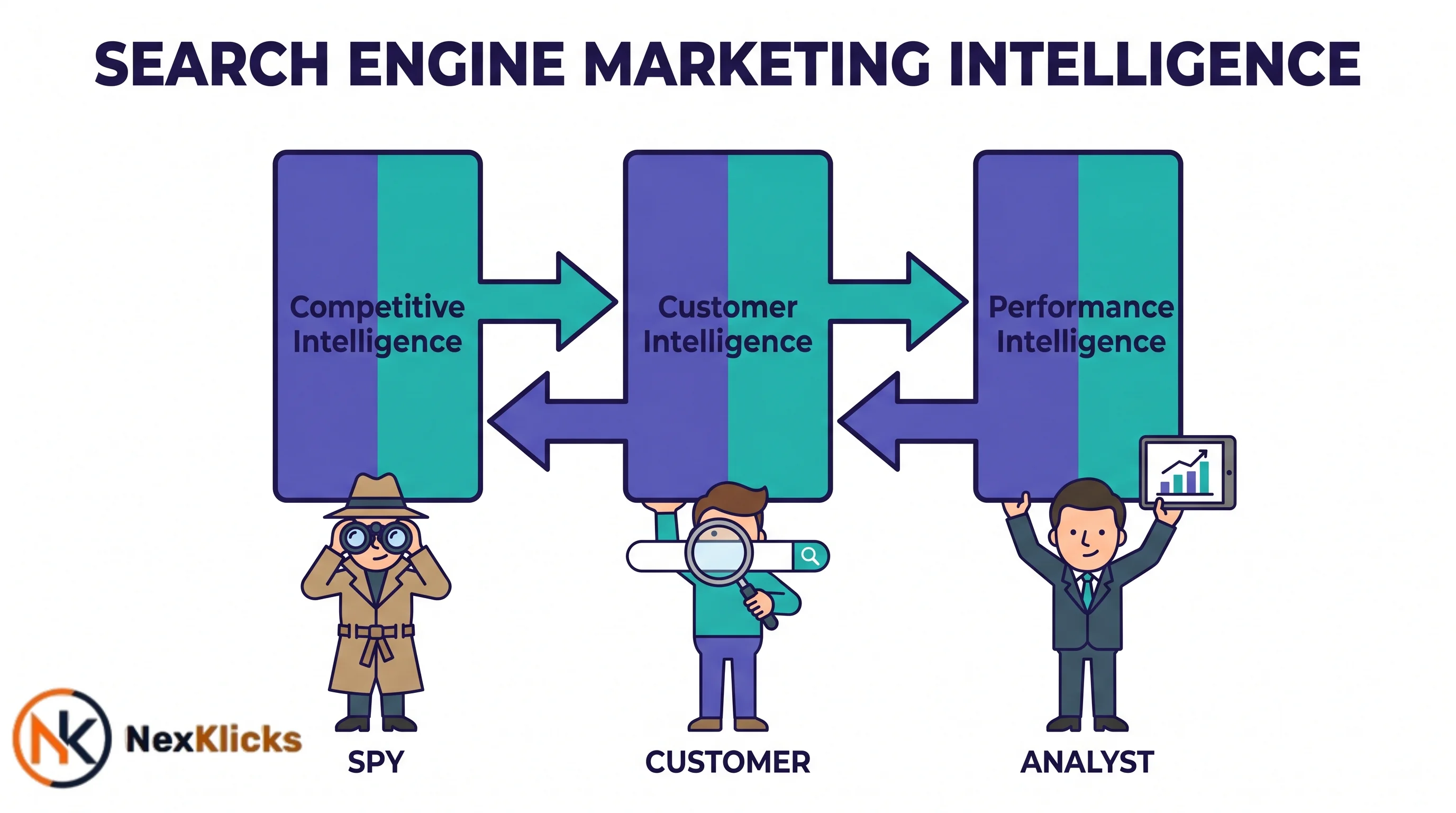
The 3-Pillar Framework — Competitive, Customer, and Performance Intelligence
Pillar 1 — Competitive Intelligence: What rivals are bidding on, how their ads are structured, and where they are winning in the auction. This is where competitor ad intelligence tools do their heaviest lifting.
Pillar 2 — Customer Intelligence: Search intent analysis, demographic signals, behavioral patterns, device usage, and geographic data down to DMA level.
Pillar 3 — Performance Intelligence: Return on ad spend, cost-per-acquisition, Quality Score trends, and attribution. This pillar keeps the system honest by tying activity to business outcomes.
Why Search Engine Marketing Intelligence Matters for U.S. Businesses in 2025
The Real Cost of Running SEM Campaigns Without Data Intelligence
Running Google Ads without SEM campaign insights is expensive in ways that don’t always show up clearly in a dashboard. Budget drains through irrelevant clicks. Quality Score improvement stalls because ad copy is misaligned with landing pages.
According to McKinsey and Company (2023), organizations that use data-driven marketing are 23 times more likely to acquire customers and 6 times more likely to retain them compared to competitors who don’t. That gap doesn’t come from spending more. It comes from knowing more and acting on it consistently.
How the U.S. Competitive Search Landscape Has Shifted
CPCs in high-intent U.S. verticals such as legal, finance, home services, and e-commerce have risen sharply. Google’s automation through Smart Bidding and Performance Max has reduced manual control, which means the quality of your keyword performance data and audience inputs now determines more of your outcome than manual bid adjustments ever did. Garbage inputs produce garbage algorithm outputs.
How Search Engine Marketing Intelligence Levels the Playing Field
Large competitors often ignore hyper-specific long-tail keyword strategy opportunities because individual search volumes look too small to justify attention. A local U.S. service business can find those gaps and own them profitably. A regional HVAC company in Texas might find that a national competitor dominates “HVAC repair” but ignores “emergency AC repair Austin TX” entirely, a gap that only SEM data insights reveal.
How often should a U.S. business run an SEM intelligence audit?
Weekly reviews cover keyword performance, impression share changes, and budget pacing. Monthly audits include keyword gap analysis refreshes, and audience segment review. Quarterly, reassess the full competitive landscape. This cadence turns one-off insights into a compounding institutional advantage.
Core Components of Search Engine Marketing Intelligence
Competitive Ad Intelligence — Decoding Your Rivals’ Paid Strategy
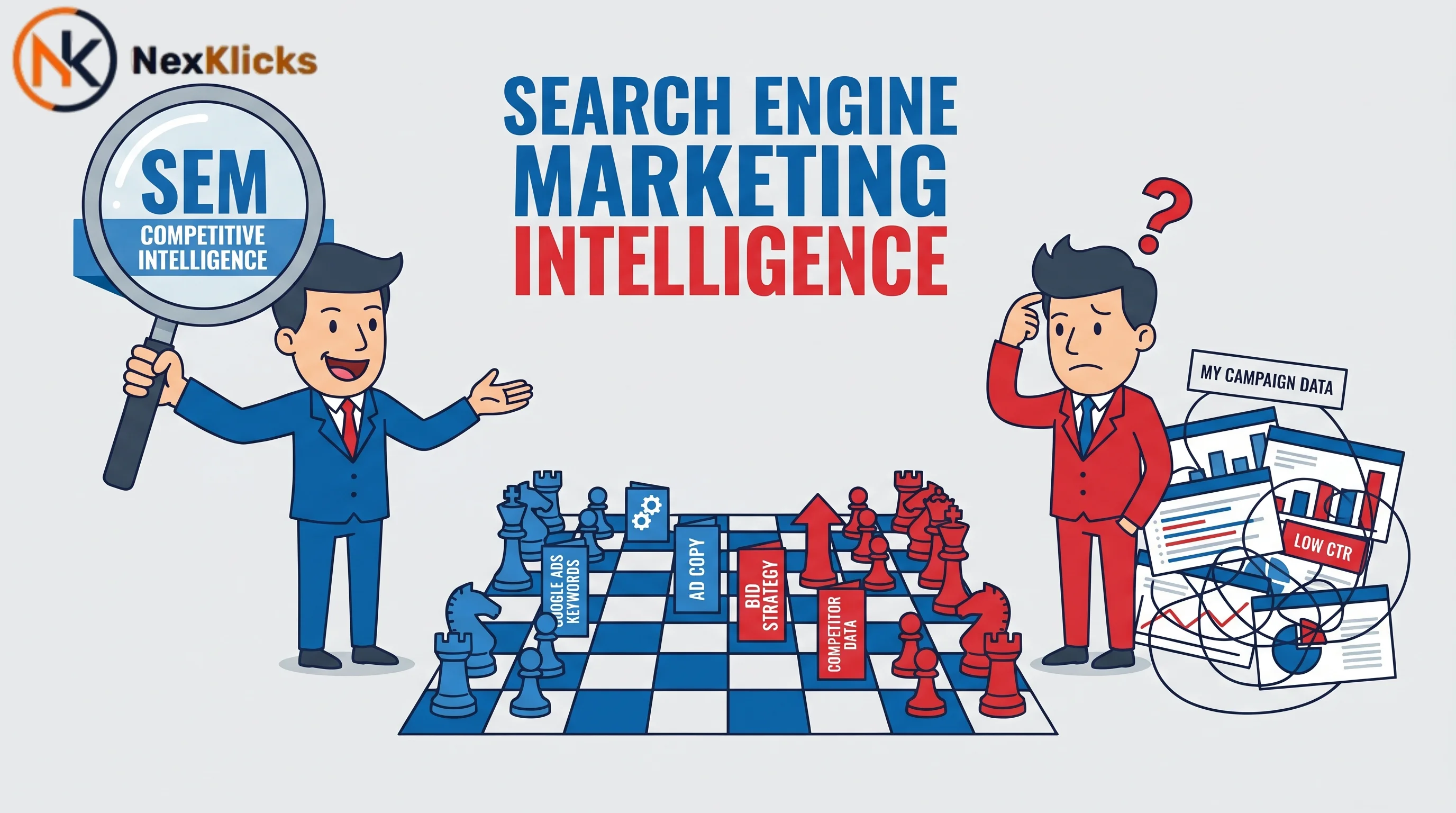
Competitor ad analysis starts with what headlines competitors use, what CTAs they test, and how their messaging changes seasonally. These patterns reveal a competitor’s unique selling proposition and, more usefully, their blind spots. A competitor leading with price will almost never also lead with speed or guarantee. That’s your opening. Tools at this stage include Google Ads Auction Insights, SpyFu, and Semrush Advertising Research.
For a deeper view of how competitors structure their entire content and keyword territory, running a competitor topical map analysis alongside your paid research gives you a fuller picture of where they are investing and where gaps exist.
How does Google Ads Auction Insights support competitor research?
Auction Insights shows how your campaigns compare against specific competitors across impression share, overlap rate, and position metrics. Available at no cost inside every Google Ads account, it reveals which competitors are scaling spend, entering new keywords, or retreating. Most third-party PPC competitive research tools cannot match its immediacy.
Keyword and Audience Intelligence — Finding High-Intent, Low-Competition Gaps
Keyword gap analysis for PPC finds terms where competitor ad density is low, intent is high, and your offer is a natural fit. Search intent targeting maps directly to campaign strategy. Informational queries need content, not conversion ads. Transactional queries need frictionless conversion paths with a single clear CTA.
Audience segmentation search ads add another dimension. Layering in-market segments, geographic bid modifiers, and device behavior on top of keyword targeting separates average campaigns from efficient ones.
Performance Intelligence — The Metrics That Actually Predict Profitability
Move beyond CTR and CPC. Focus on conversion rate, cost-per-acquisition, and customer lifetime value. Data-driven advertising decisions require data-driven attribution. Last-click models systematically undercredit upper-funnel keywords and lead to poor budget allocation over time. Google’s data-driven attribution model is the recommended default for most U.S. advertisers with sufficient conversion volume.
How Does Search Engine Marketing Intelligence Work?
To build a working SEM intelligence workflow, follow these steps:
- Export your Google Ads Auction Insights report every week.
- Pull competitor keyword and ad data from SpyFu or Semrush monthly.
- Map all active keywords to a funnel stage and intent label.
- Identify gaps where competitor ad density is low but intent is high.
- Create or adjust campaigns to capture those gaps.
Step 1 — Collect Competitor Ad, Keyword, and Landing Page Data
Paid search competitor research starts with three sources. Google Ads Auction Insights gives real-time overlap rates and impression share comparisons. Semrush Advertising Research gives estimated spend and ad copy history. SpyFu gives over 15 years of competitor Google Ads history per domain. Weekly snapshots for active competitors and monthly deep dives for broader market analysis is the right cadence for most U.S. SMBs.
Step 2 — Map Every Keyword to a Funnel Stage and Search Intent
Create an intent matrix with three rows: top-of-funnel, mid-funnel, and bottom-of-funnel. Assign each keyword a primary intent label and a corresponding keyword bidding strategy. Top-of-funnel terms suit Target Impression Share; bottom-of-funnel terms suit Target CPA or ROAS. Mid-funnel comparison keywords often carry lower CPCs and capture buyers earlier, yet most competitors over-invest at the bottom.
Step 3 — Analyze Competitor Landing Pages for Conversion Intelligence
Competitor keyword research extends to the landing page. What headline does the competitor use? Does it match their ad? How long is their form? Competitor landing page weaknesses are your Quality Score opportunities. A slow, generic competitor landing page with a high-friction form is an invitation to outperform them at a lower CPC simply by building a better post-click experience.
Step 4 — Build a Living SEM Intelligence Dashboard
Your marketing analytics dashboard should include competitor share-of-voice tracking, keyword gap analysis status, campaign KPIs, weekly budget pacing, and A/B test status. Google Looker Studio is free and connects directly to Google Ads. The goal is a dashboard you review in 20 minutes weekly and act on immediately.
Step 5 — Translate Insights Into Active Campaign Decisions
SEM campaign optimization strategy requires a decision framework. If a competitor dominates a keyword and your Quality Score lags behind theirs, assess whether to compete directly or find an adjacent gap. Brief your team using intelligence outputs. “Competitor X added 14 new ad variations this month, all leading with same-day service” is an actionable briefing. “We need to improve performance” is not.
7 Steps To Create A Search Engine Marketing Strategy
Step 1 — Define Business Goals and KPIs Before Opening Any Tool
Map business objectives to SEM KPIs. Lead generation needs a CPA target. E-commerce needs an ROAS target. Brand awareness needs an impression share target. For U.S. businesses, align KPIs to regional seasonality. A home services business in the Northeast has a different seasonal demand curve than one in the Southwest.
Step 2 — Conduct a Keyword Gap Analysis Against Your Top U.S. Competitors
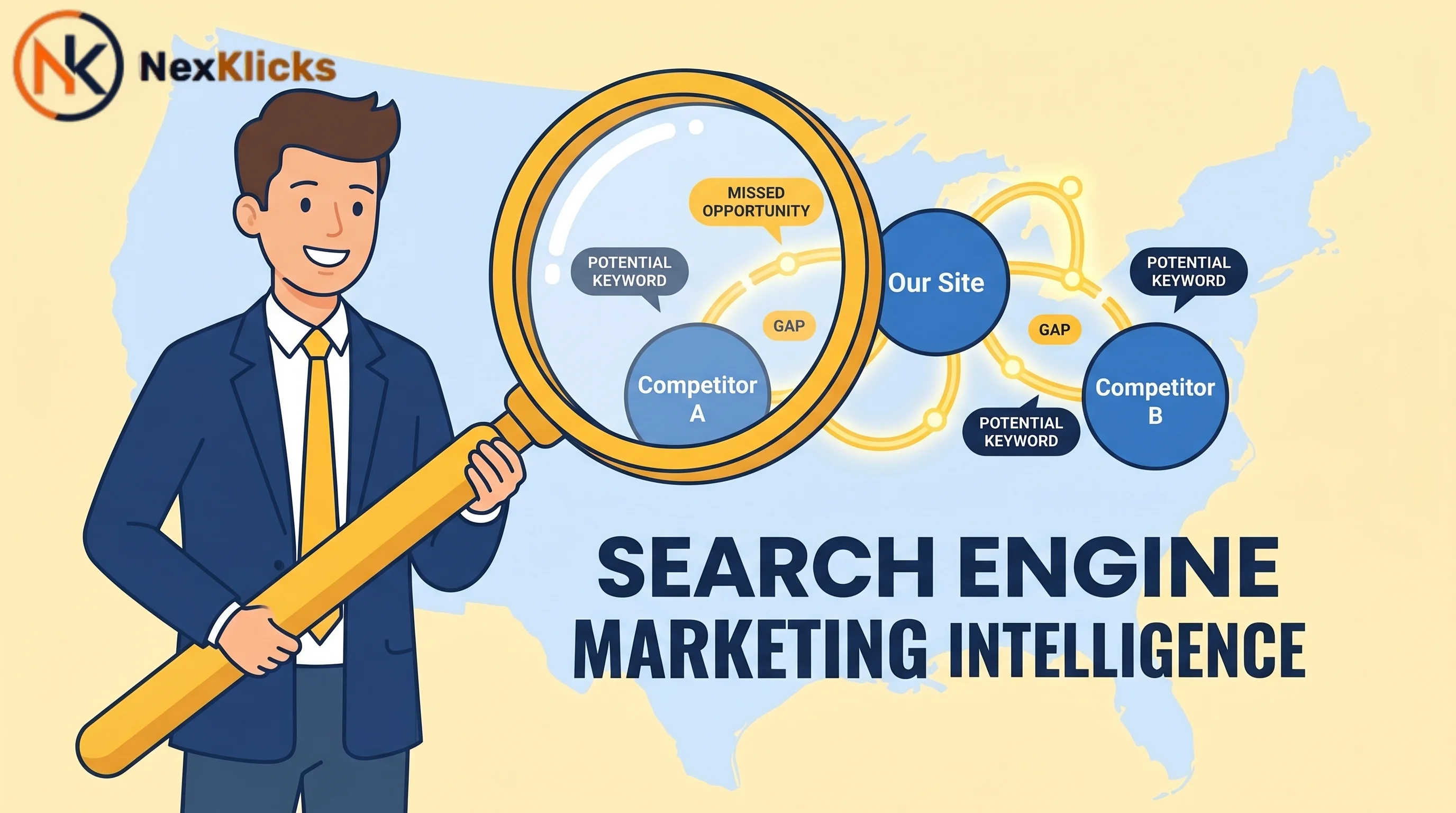
Run a keyword gap analysis in Semrush or SpyFu by entering two to three competitor domains. Prioritize three gap types: keywords competitors bid on that you haven’t considered, high-intent terms with low competitor ad density, and branded-adjacent terms you are missing. The output is a prioritized keyword opportunity list segmented by intent and estimated CPC.
For businesses integrating paid intelligence with broader growth goals, search engine marketing intelligence compounds its value when connected to a complete organic strategy, reinforcing the same keyword targets across both channels.
Step 3 — Segment Audiences by Intent, Geography, and Device Behavior
Audience behavioral targeting built on one broad campaign wastes budget. Build segments using Google Ads Audience Manager combined with first-party data. Let search behavior patterns data guide bid strategy optimization across devices and geographies, not assumptions.
Step 4 — Develop Ad Copy Informed by Competitor Creative Analysis
Use SpyFu ad history and Semrush Ad History to identify which competitor headlines have run consistently for six or more months. Consistency signals performance. Use that as a hypothesis for your own ad creative testing. In Responsive Search Ads, populate your asset library with angles built on the same customer intent as competitors, differentiated on one specific dimension: price, speed, guarantee, or authority.
SpyFu vs Semrush for SEM intelligence: SpyFu is better suited for deep competitor ad history because it holds over 15 years of Google Ads data per domain. Semrush works better when you need a comprehensive platform combining keyword gap analysis, ad research, and site auditing in one place. The key difference is depth of historical data versus breadth of integrated research tools.
Step 5 — Optimize Landing Pages Using Conversion Path Intelligence
Every ad group needs a dedicated or customized landing page with a headline that matches the ad copy. The five elements of a high-converting SEM landing page: aligned headline, clear offer, trust signals, a single CTA, and fast load time under three seconds. Competitor landing page analysis benchmarks your conversion rate against what the market already does.
Step 6 — Set Up Conversion Tracking and Attribution Modeling
Conversion tracking setup is non-negotiable before spending a dollar. Track purchases, form fills, calls, and chat initiations as separate conversion actions. Use Google’s enhanced conversions for improved accuracy in a privacy-constrained environment. Data-driven attribution is the right choice for campaigns with 50 or more conversions per month. Last-click attribution systematically undercredits upper-funnel keywords.
Step 7 — Build a Weekly and Monthly SEM Intelligence Review Cadence
Weekly review: keyword performance, impression share changes, competitor new ads spotted, budget pacing. Monthly deep dive: keyword gap refresh, landing page test results, audience segmentation search ads performance, and competitor spend shift analysis. Document every decision and its outcome. Teams that run this cadence for 90 days consistently build institutional knowledge that compounds against competitors who don’t.
Why Is A/B Testing Important For SEM?
Why A/B Testing Is the Fastest Way to Improve SEM Performance
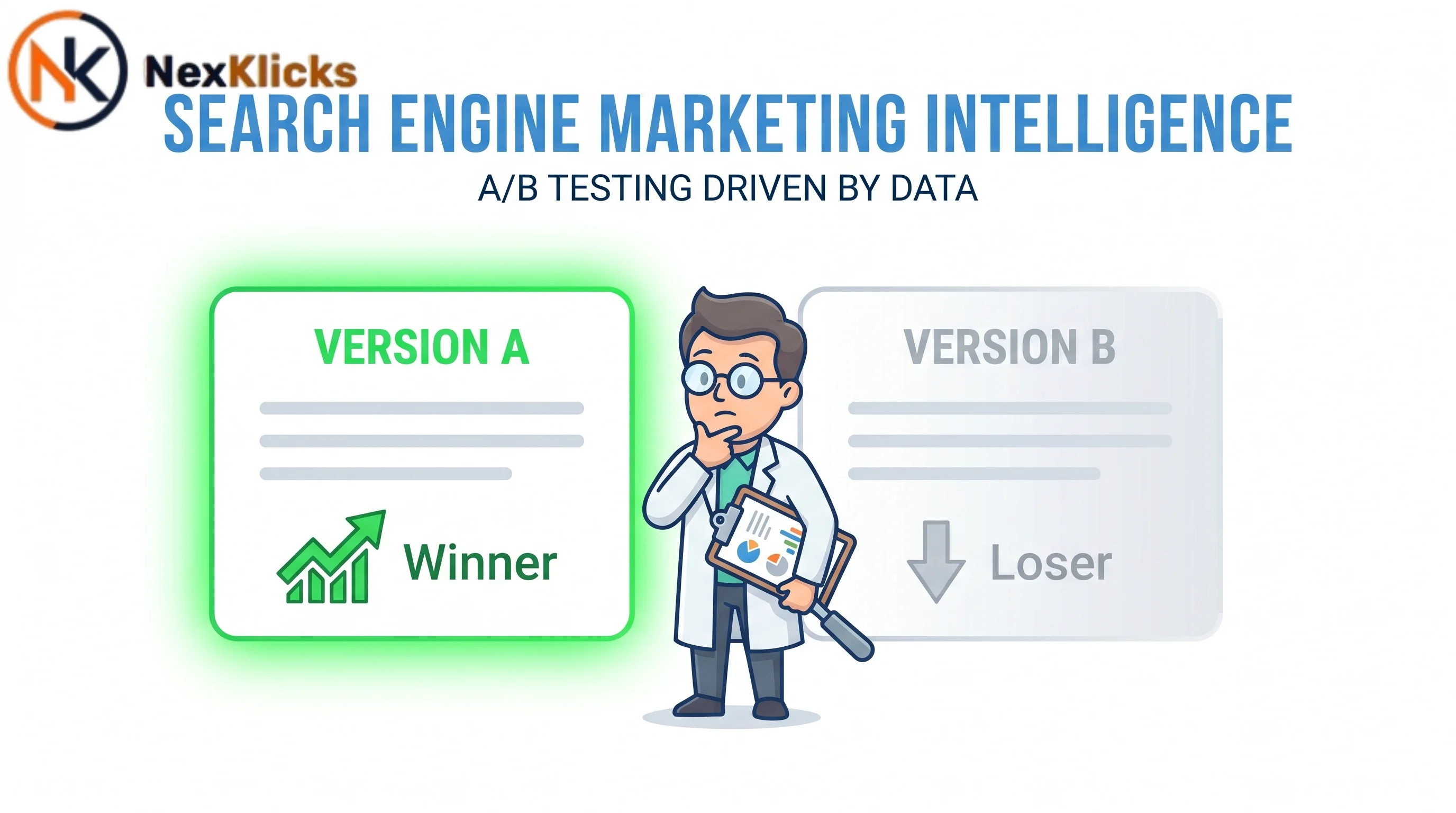
SEM without A/B testing is optimization by opinion. Google’s internal data shows RSA testing can improve CTR by 5 to 15 percent when headline combinations are systematically tested. Ad creative testing only works if you test what the data suggests, not random variations assembled without a hypothesis.
How to Design Smarter A/B Tests Using Search Engine Marketing Intelligence Data
Use competitive intelligence to form your test hypotheses. If competitor ads heavily use price anchoring and yours don’t, that gap is a testable hypothesis. Test one variable at a time: headline against headline, CTA against CTA. Never test multiple variables simultaneously, because the insight becomes uninterpretable.
What to Test First — Headlines, CTAs, Landing Pages, or Bid Strategies
Priority order for U.S. SEM campaigns: first headlines, then landing page CTA and offer, then audience segments, then bid strategy type. Headlines have the highest leverage because they determine CTR, which directly affects both traffic volume and Quality Score. Minimum traffic thresholds matter. A test with fewer than 100 conversions per variation is statistically underpowered.
How to Read A/B Test Results Within Your SEM Intelligence Framework
Use 95 percent confidence as your threshold and define a minimum practical effect size before the test starts. Statistical significance and practical significance are not the same thing. Winning test results feed directly back into your SEM campaign insights dashboard as validated competitive intelligence about what your specific audience responds to.
Search Intelligence Tools Every Marketer Should Know
Google Ads Auction Insights — The Free Native Intelligence Tool Most Marketers Overlook
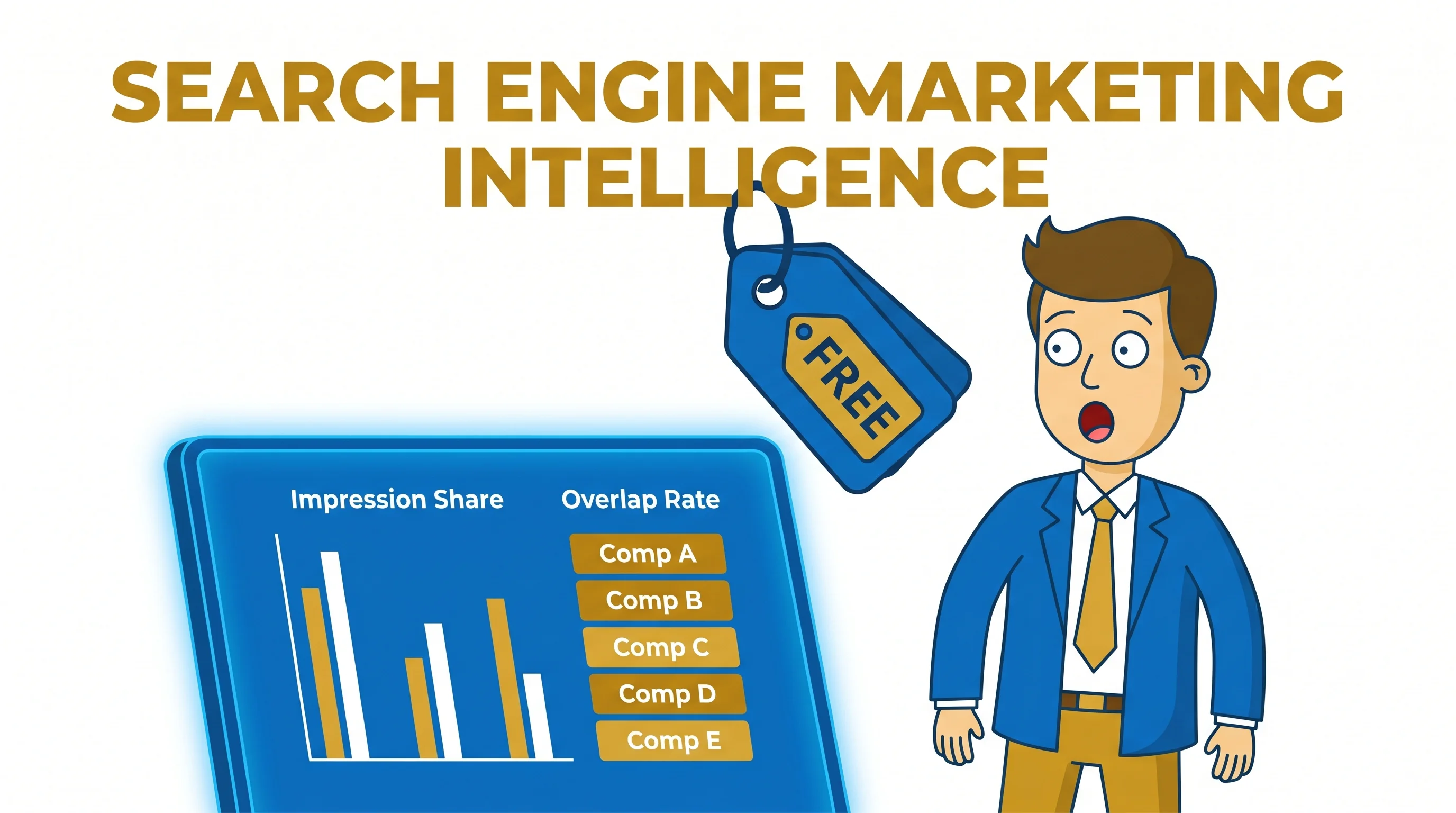
Google Ads Auction Insights shows impression share, overlap rate, position above rate, and outranking share against specific competitors at the campaign, ad group, and keyword levels. Most marketers look at it once and forget it. Used weekly, it reveals which competitors are increasing spend, entering new auctions, or pulling back. A competitor whose impression share drops 15 percent in a single week has likely paused campaigns or hit budget limits. That’s a window to gain ground at lower CPCs. This tool alone gives U.S. marketers a meaningful edge at zero additional cost.
Semrush — Comprehensive SEM and Competitor Intelligence
Semrush’s paid search analysis features include Advertising Research for competitor keywords, ads, and spend estimates, the Keyword Gap tool, and Ad History. Together, they let you build a complete competitor ad profile. For search engine marketing intelligence at scale, Semrush is the most complete single-platform option. U.S. small business budgets can access most core features at the Pro tier.
SpyFu — Deep Competitor Keyword and Ad History Analysis
SpyFu’s differentiator is history depth. More than 15 years of competitor Google Ads data per domain, including the most profitable keywords and every ad variation they have tested. Combine SpyFu’s historical depth with Auction Insights’ real-time data for a complete competitive picture.
Google Keyword Planner and Google Analytics — Your Free Intelligence Foundation
Search volume trends, bid range analysis, and geographic demand signals from Google Keyword Planner go beyond basic volume data. Connecting Google Analytics 4 to Google Ads creates a closed-loop system where ad-level data connects to session-level behavior and conversion outcomes. Search engine results page visibility metrics in GA4 identify which campaigns drive meaningful engagement versus superficial traffic.
How to Choose the Right SEM Intelligence Tool Stack for Your Budget and Goals
A tiered approach works well. Free stack: Auction Insights plus Keyword Planner plus GA4, covering most needs for businesses spending under $5,000 per month. Mid-budget stack adds SpyFu. Full stack adds Semrush. Automated bid management platforms and reporting tools all generate data, but more data is only useful if you have a process to act on it. Build the workflow first, then add tools.
Applying Search Engine Marketing Intelligence to Campaigns
Using Paid Search Data to Fuel Your Organic SEO and Content Strategy
SEM and SEO are complementary intelligence sources, not competing budget lines. Keywords that convert in paid search are worth targeting organically. High-performing ad headlines are strong inputs for title tags and meta descriptions. Paid click data reveals which content topics resonate before you invest in long-form SEO content, de-risking every content decision you make.
For local businesses, search engine marketing intelligence maps directly onto local SEO strategy, where paid and organic signals reinforce each other at the city and neighborhood level.
How to Build a Repeatable SEM Intelligence Workflow Your Team Can Execute Weekly
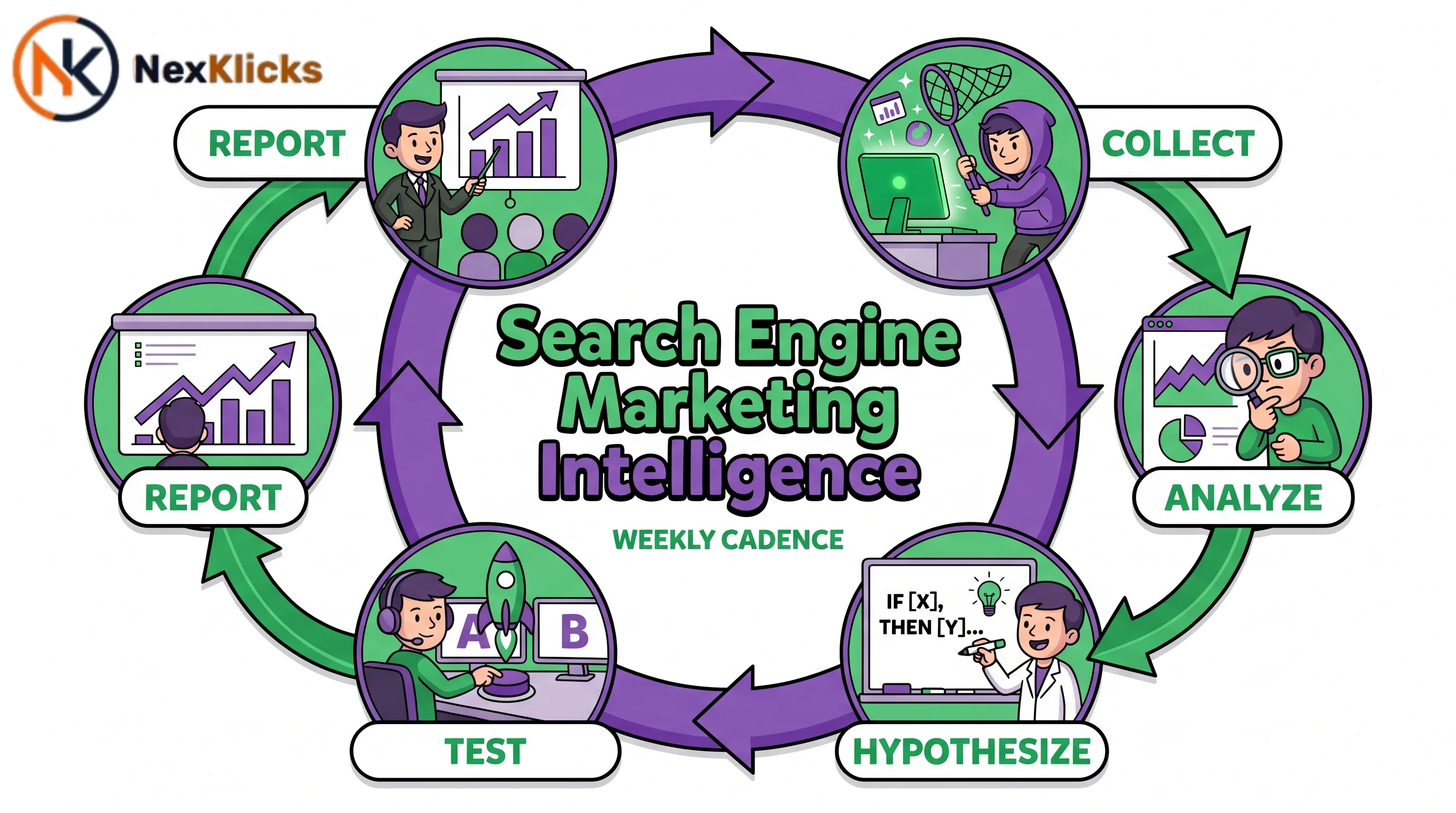
The weekly SEM intelligence loop: collect, analyze, hypothesize, test, and report. Assign clear role ownership across data pulling, analysis, and decision-making. The weekly brief has three sections: what changed, what it means, and what action follows before next week. Teams running this cadence for 90 days consistently outperform those relying on ad hoc reviews.
Real-World Example — Turning a Keyword Gap Into a Revenue-Generating Campaign
A mid-size Texas home services company uses competitor keyword research in SpyFu and finds the dominant national competitor bids on generic “HVAC repair” but ignores “emergency AC repair [city name]” across 11 cities. After confirming intent, building city-specific ads, aligning landing pages, and verifying tracking, the outcome is CPCs 40 percent lower and conversion rates 30 percent higher. SEM data insights find money already on the table.
Common Mistakes to Avoid When Using Search Engine Marketing Intelligence
Tracking Vanity Metrics Instead of Conversion and ROAS Data
High CTR and low CPC feel like wins but can mask campaign failure. A campaign with a 10 percent CTR and zero conversions is not a success. Audit current KPIs against actual business outcomes. ROAS improvement requires a baseline, which requires conversion tracking connected to revenue, not just clicks.
If you are also running organic campaigns alongside paid, the same discipline applies to avoid the SEO mistakes that silently drain your marketing budget that most small business owners repeat unknowingly.
Ignoring Search Intent and Targeting Keywords That Will Never Convert
Bidding on informational keywords with transactional ad copy wastes spend, drives up CPC through poor Quality Score, and delivers zero ROI. Use the intent matrix from your intelligence workflow to audit every keyword in your active campaigns regularly.
Treating SEM and SEO as Separate Strategies Instead of a Unified Growth Engine
The handoff most U.S. marketing teams miss: paid search keyword performance data never reaches the content team. The PPC manager knows which terms convert. The SEO team guesses at topics. A shared keyword intelligence document updated monthly fixes this at zero cost.
Collecting Data Without a Process to Act On It
Tool paralysis is subscribing to Semrush, SpyFu, and GA4 with no workflow to extract decisions from the data. The difference between a data-informed team and a data-drowning team is process. Build the weekly intelligence cadence before investing in additional tools.
Future Trends in Search Engine Marketing Intelligence
AI-Powered Predictive Bidding and What Automation Means for Your SEM Strategy
Google’s Smart Bidding and Performance Max use machine learning to adjust bids across thousands of signals in real time. This automation increases the importance of intelligence inputs. The algorithm is only as good as the conversion data, audience signals, and ad assets you feed it. Predictive keyword trends modeling and digital advertising intelligence platforms are emerging capabilities that accelerate execution for teams with a solid process already in place.
Privacy-First Data Collection and Ethical SEM in a Cookieless World
Third-party cookie deprecation has reshaped audience targeting. First-party data strategy is now the primary competitive advantage in paid search. According to Cisco’s 2023 Consumer Privacy Survey, 79 percent of U.S. consumers are concerned about how companies use their personal data. Trust is a competitive differentiator. Google’s enhanced conversions and server-side tagging maintain measurement accuracy in this environment.
How Generative AI Is Changing Competitor Ad Analysis and Keyword Forecasting
AI tools accelerate competitor ad analysis by enabling faster pattern recognition across thousands of ad variations. Google’s AI Overviews are changing SERP layouts in ways that affect both paid and organic visibility. U.S. marketers should be testing AI-generated ad copy variations and monitoring how AI Overviews affect click-through rates on their top keywords. Search engine results page visibility is no longer just about ad position.
Frequently Asked Questions about Search Engine Marketing Intelligence
Q: What’s the best free tool for SEM competitive intelligence?
A: Google Ads Auction Insights is the best free native option. It shows impression share, overlap rates, and competitor positioning in real time, directly inside your Google Ads account at no additional cost.
Q: How do I run a keyword gap analysis for PPC campaigns?
A: Enter your domain and two to three competitor domains into Semrush’s Keyword Gap tool or SpyFu’s competitor comparison. Filter by paid keywords and sort by estimated CPC to surface high-value gaps.
Q: Should I use the same keywords for both Google Ads and SEO?
A: Yes, especially for high-converting transactional terms. Paid click data validates which keywords drive real conversions before you invest in long-form organic content.
Q: Why does my Google Ads Quality Score keep dropping?
A: Usually misalignment between ad copy, keyword intent, and landing page content. Audit each ad group for message match and ensure the landing page directly addresses the search query behind each keyword.
Q: When should I add negative keywords to my PPC campaigns?
A: Review search term reports weekly and add negatives for any term generating 50 or more clicks with zero conversions over a meaningful sample window.
Conclusion
Search engine marketing intelligence is not a tool or a one-time tactic. It is a system built from three pillars, executed on a repeatable cadence, and designed to compound its own value over time.
The key takeaway: intelligence without a workflow is just data. The businesses winning U.S. paid search in 2025 are not necessarily spending the most. They are collecting the right signals, analyzing them on a structured schedule, and translating findings into specific campaign decisions every single week.
The one mistake to avoid above all others: confusing tool access with having a strategy. Semrush, SpyFu, and GA4 subscriptions produce nothing if there is no process for turning data into decisions.
Your next action is simple. Open Google Ads right now, navigate to Auction Insights at the campaign level, and identify your top three competitors by impression share overlap. That report is free, available today, and the starting point for every intelligence-driven decision that follows.
This guide outlines how U.S. businesses leverage search engine marketing intelligence to transform paid search data into a competitive advantage. It covers a 3-pillar framework, keyword gap analysis, A/B testing, and essential SEM tools, from free options like Google Ads Auction Insights to platforms like Semrush and SpyFu.
Last update: June 2026

Leave a Reply