
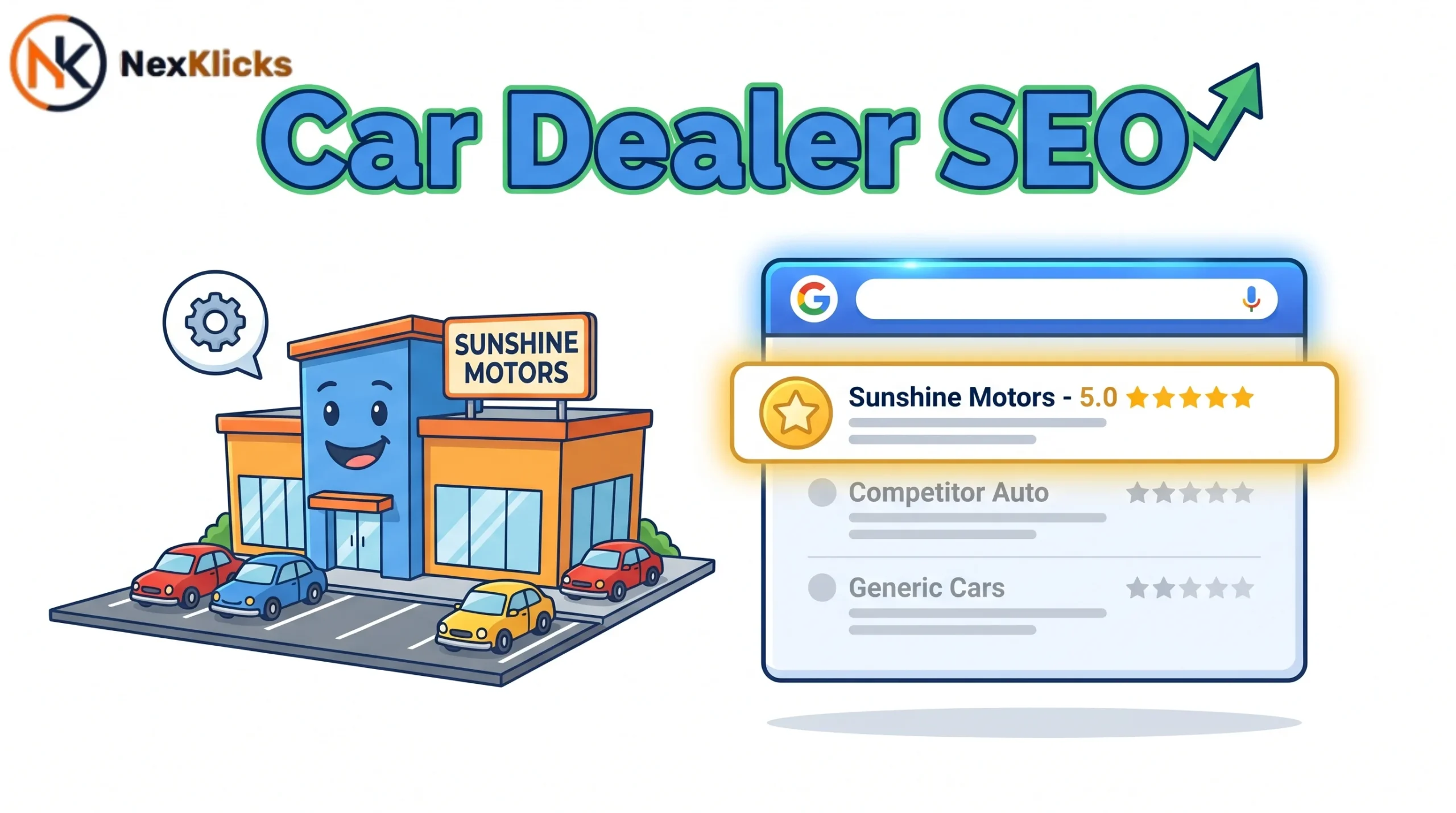
While you were reading this sentence, a local buyer just Googled “Toyota dealer near me” and clicked your competitor.
That one search cost you a potential $40,000 sale. Multiply that by hundreds of searches every single day in your city, and the math gets brutal fast.
Car dealer SEO is the difference between a dealership that fills its lot with buyers and one that bleeds budget on ads with nothing to show. This guide breaks down exactly how automotive search optimization, local search rankings, Google Business Profile, and dealership keyword targeting work together so your dealership shows up first, every time.
What Is Car Dealer SEO? Car dealer SEO is the process of optimizing a dealership’s website, Google Business Profile, and online presence so local buyers find you first on Google. It combines on-page content, technical website health, and local signals to drive qualified traffic without paying for every click.
What Is Car Dealer SEO and Why It Decides Who Gets the Sale
Car dealership SEO isn’t just about stuffing keywords onto a webpage. It’s a system. When done right, it positions your dealership in front of buyers at every stage of their journey, from “what’s the most reliable used truck” to “Ford dealer open Sunday near me.”
The top Google result receives 28% of all clicks. Second-page results get less than 1%. That gap is where dealerships win or lose revenue.
According to Cox Automotive, the average car buyer spends 14 hours researching online before stepping into a showroom. If your site doesn’t appear during those 14 hours, a competitor earns the visit instead. The cost of ignoring automotive search engine optimization isn’t abstract. It shows up in your monthly sales numbers.
How Google Evaluates Dealership Websites in 2026
Google uses E-E-A-T, standing for Experience, Expertise, Authoritativeness, and Trust, to judge whether your dealership’s website deserves a top ranking. For car dealers, “experience” means demonstrating real-world knowledge: staff bios, customer stories, vehicle walk-around content, and honest service transparency. “Trust” means consistent information across every platform, fast-loading pages, and legitimate reviews.
In 2026, Google AI Mode is reshaping how buyers find dealerships. AI-generated answer boxes now appear above traditional results for queries like “best car dealer near me,” pulling content from Google Business Profile listings, reviews, YouTube videos, and authoritative automotive sites. If your dealership isn’t structured to feed those AI answers, you’re losing zero-click visibility before a buyer even reaches the organic results.
Thin content and duplicate vehicle listing pages using syndicated OEM descriptions are being actively devalued. Google can detect copy-paste inventory write-ups across dozens of dealer sites, and it ranks unique, locally-specific content higher every time.
The Difference Between SEO for New vs. Used Car Dealers
This is a distinction almost no SEO guide addresses, and it matters.
New car dealers operate under OEM constraints. Manufacturer co-op agreements sometimes restrict what you can say in ad copy, and brand-specific keyword strategies must align with those rules. Your primary keyword targets will center on brand names: “Ford dealership Houston” or “Toyota certified pre-owned Denver.”
Used car dealers have more flexibility and more risk. The keyword opportunity is broader, covering makes, models, price ranges, and conditions. But higher inventory turnover means vehicle detail pages expire constantly, creating duplicate content problems if descriptions aren’t managed carefully. Independent dealers also have a local SEO advantage franchise groups often miss: they can move faster, publish more authentic community content, and build hyperlocal signals that larger groups struggle to coordinate.
The buyer journey also differs. A new car buyer often knows the brand and is comparing trim levels or financing terms. A used car buyer is comparing vehicles across makes, models, and price points. Those different journeys require different keyword strategies and different content pages.
What Is SEO for Car Dealerships?
SEO for car dealerships is the combination of three interconnected disciplines working together. Ignoring any one of them limits what the other two can achieve.
On-Page, Off-Page, and Technical SEO Explained Simply
Quick Comparison
| Pillar | What It Covers | Dealership Example |
|---|---|---|
| On-Page SEO | Content, titles, headings, meta descriptions | Optimizing a “Used Honda CR-V Houston” page |
| Off-Page SEO | Backlinks, reviews, citations, mentions | Earning a link from a local news feature |
| Technical SEO | Speed, mobile-friendliness, structured data | Compressing vehicle gallery images for faster load |
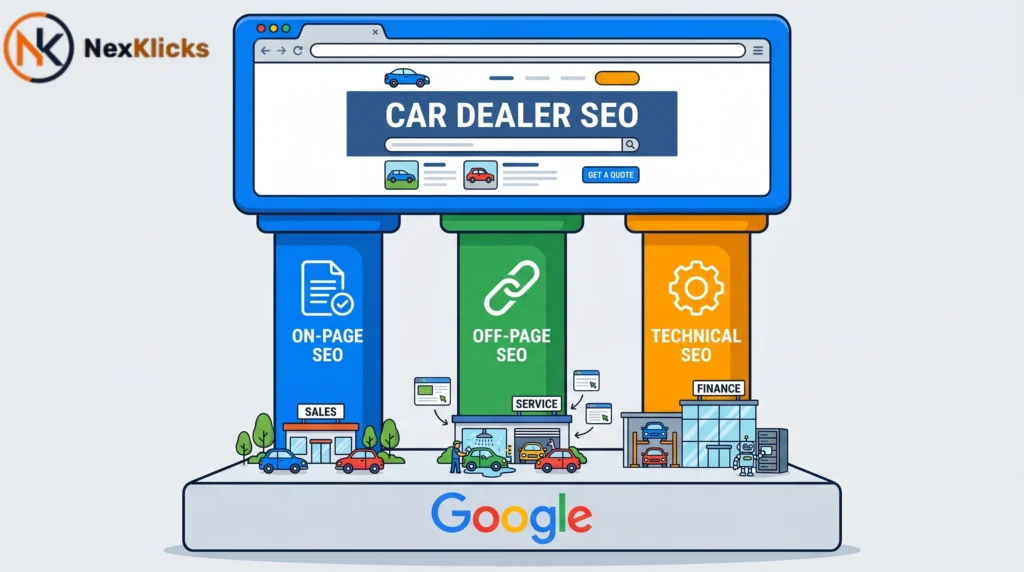
Most dealerships focus only on on-page SEO and miss the compounding power of technical and off-page work. A beautifully written inventory page that loads in 8 seconds on mobile and has zero backlinks pointing to it will still underperform a faster, well-cited competitor page with average writing.
How Car Buyer Search Behavior Maps to Your SEO Strategy
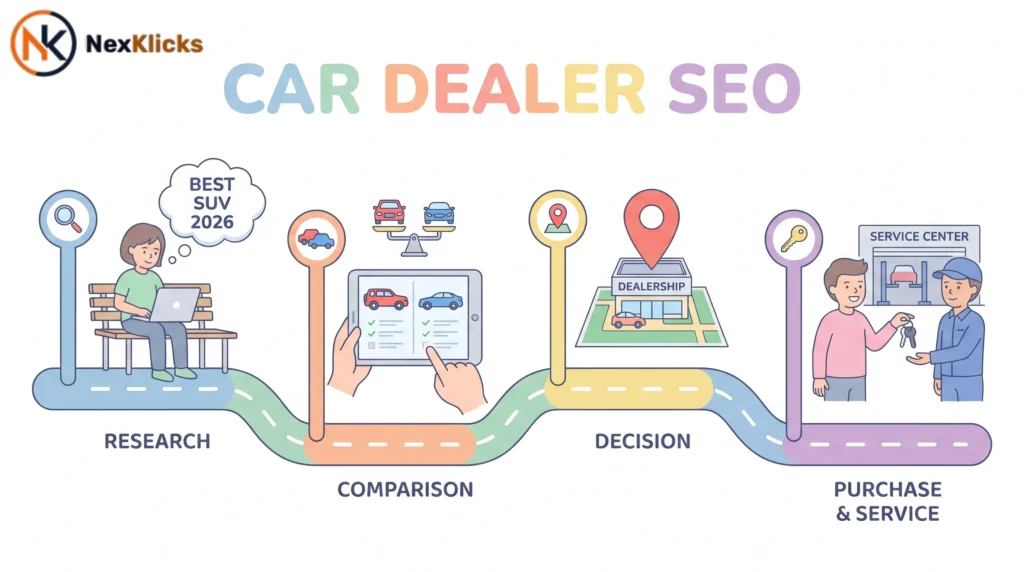
Buyers don’t start searching with “buy a car today.” They start weeks earlier with research questions. Your content must meet them at every stage.
Stage 1 is awareness. Buyers search for “best family SUV 2026” or “most reliable used trucks.” Blog posts and buying guides capture this traffic. Stage 2 is consideration. They’re comparing: “Toyota Camry vs Honda Accord” or “certified pre-owned vs used.” Comparison pages win here. Stage 3 is the decision. They search “Toyota dealer near me” or “used car lots in Denver,” and your local landing pages combined with your Google Business Profile must appear. Stage 4, often ignored, is post-purchase. “Oil change near me” and “brake service Honda” are fixed ops visibility searches that generate year-round service revenue from existing customers.
64% of buyers say they’d purchase without a test drive if they received enough information online. Your content fills that gap, or your competitor’s does.
How Search Engines Work for Automotive Queries
How Google’s Local Pack Works for Dealership Searches
“Car dealerships near me” generates over 823,000 monthly search volume queries in the US. The Google local 3-pack captures 33% of all clicks for those local queries, making it more valuable for many dealerships than ranking first organically.
The local pack and organic search traffic rankings use separate algorithms. You can rank well organically and still be absent from the map pack, or appear in the map pack without strong organic rankings. Both require separate strategies.
Google determines local pack placement using three signals: relevance, meaning how well your listing matches the search; distance, meaning how close your dealership is to the searcher; and prominence, meaning how well-known and reviewed your business is online. “Near me” queries use the searcher’s real-time location, not a fixed city, so a buyer two miles from your lot should see you, provided your prominence signals are strong enough to compete.
What Google’s AI Mode Means for Car Dealer Visibility in 2026
This is the section most SEO guides skip entirely, and skipping it in 2026 is expensive.
Google AI Mode generates answer summaries directly in search results for queries like “best used SUV dealers near Denver.” These summaries pull from GBP data, customer reviews, YouTube content, Reddit discussions, and websites Google considers authoritative. Zero-click searches are increasing for dealership queries, meaning buyers get partial answers without ever clicking through to a website.
That sounds like a threat. It’s actually an opportunity. If your dealership is cited inside an AI-generated answer, you receive visibility without needing to click. The practical steps to earn that citation include maintaining a complete and active Google Business Profile, publishing structured FAQ content on your site, building consistent NAP consistency across all platforms, and earning mentions on automotive directories that Google treats as trusted sources.
According to Google’s own local search data, structured data markup increases the chance of content being pulled into AI-generated answers significantly. Implement FAQ schema, Vehicle schema, and LocalBusiness schema across your key pages. Write in clear, direct sentences that answer one question per paragraph. That’s the format AI summarizers prefer.
Keyword Research for Car Dealerships: How to Find What Buyers Actually Search
High-Intent vs. Research-Phase Keywords
Quick Comparison
| Research Keywords | High-Intent Keywords |
|---|---|
| “best used SUV under $20k” | “used Honda CR-V near me” |
| “how to negotiate car price” | “Ford dealer open Sunday” |
| “certified pre-owned vs used” | “Toyota dealership Houston TX” |
| “most reliable pickup trucks 2026” | “buy used Chevy Silverado Denver” |
Targeting only high-intent keywords misses roughly 70% of the buyer journey. Buyers spend far more time in the research phase than the decision phase. A dealership that publishes genuinely useful buying guides attracts early-stage shoppers and stays top of mind when those shoppers are ready to act.
Brand, Model, and Location-Specific Keyword Targeting
Automotive keyword research starts with a simple matrix: Brand multiplied by Model multiplied by Location multiplied by Intent equals your content roadmap.
“Ford dealership near me” pulls over 823,000 monthly searches. “Toyota dealer” pulls a similar volume. “Honda dealership” pulls around 550,000. At the city level, “car dealerships in Houston” gets 8,100 monthly searches, and “used car lots Denver” gets 3,600.
The real wins, especially for independent dealers, come at the neighborhood and zip code level. Targeting “used car dealer Katy TX” or “certified pre-owned trucks Thornton CO” puts you in front of buyers searching with high local intent against far less competition than city-level terms. Use the SEMrush Keyword Magic Tool or Google Keyword Planner to validate local search volumes before building pages.
Service and Fixed Ops Keywords Most Dealers Ignore
Service department dealer blog SEO is consistently underused. “Oil change near me” pulls 10,000 to 50,000 monthly searches depending on the market. “Brake service,” “tire rotation near me,” and “check engine light meaning” drive consistent year-round traffic, unlike seasonal vehicle sales.
Dealerships that publish blog content twice a month see a 60% improvement in SEO ranking compared to those that publish nothing. Each service keyword deserves its own dedicated landing page, not just a mention in the footer.
You can validate local search volumes for any of these keyword combinations using the SEMrush Keyword Magic Tool.
On-Page SEO for Car Dealerships: Optimizing Every Page That Can Rank
Inventory Page Optimization (VDP and SRP Pages)
A VDP, or Vehicle Detail Page, is the individual listing page for a specific vehicle. An SRP, or Search Results Page, is a category-level page showing multiple vehicles by make, model, body type, or price range. These are the highest-converting pages on any dealership website, and they’re usually the most neglected from an SEO standpoint.
On-page SEO for car dealerships starts here. Every VDP needs a unique title tag using the formula: [Year Make Model] for Sale in [City] | [Dealership Name]. Every SRP needs category-level optimization targeting phrases like “used Honda SUVs Houston” or “certified pre-owned trucks under $30k Denver.”
The duplicate content problem is severe on inventory sites. Syndicated OEM descriptions appear identically across dozens of dealer sites. Google sees them as thin, non-unique content and ranks them accordingly. Adding even 100 words of unique editorial content, something mentioning local roads, local financing, or specific vehicle history, differentiates your listing and signals originality.
Vehicle schema markup tells Google exactly what your page contains: make, model, year, price, mileage, availability. Implemented correctly, it makes your listings eligible for rich snippets in search results, increasing conversion rate optimization before a buyer even clicks.
How to Optimize a Vehicle Detail Page
To optimize a VDP for search, follow these steps:
- Write a unique title tag: [Year Make Model] for Sale in [City] | [Dealership Name].
- Add 100 to 150 words of unique editorial description to the listing.
- Implement Vehicle schema markup using JSON-LD format.
- Include make, model, price, mileage, and availability in the meta description.
- Link internally to the relevant SRP and a related service page.
Title Tags, Meta Descriptions, and Schema Markup for Vehicle Listings
Service page title tags follow a different formula: [Service Type] in [City] | [Dealership Name]. Meta descriptions should stay under 155 characters, include a price range or availability cue, and end with a soft call to action.
Schema types that matter for dealerships include LocalBusiness, AutoDealer, Vehicle, Service, and AggregateRating. AggregateRating schema pulls your review score directly into Google search results as a star display, which improves click-through rate even before rankings improve.
How to Build City and Region Landing Pages That Actually Rank
Dealership landing pages targeting “[city] car dealership” are among the highest-value SEO assets you can build, and competitors consistently underdevelop them.
Each location page needs at least 500 words of unique, locally relevant content. That means referencing nearby landmarks, mentioning specific neighborhoods, and filtering inventory to show vehicles available in that area. A thin page with three sentences and an inventory widget does not rank.
Dealership website optimization across multiple locations requires careful internal linking. Each location page should connect to your inventory SRPs, your service pages, and your contact page. Multi-location dealers must avoid pointing identical content at multiple city pages. That triggers keyword cannibalization, where your pages compete against each other and neither ranks well.
Technical SEO for Dealership Websites
Mobile-First Indexing and Core Web Vitals for Auto Sites
60% of automotive digital marketing searches happen on mobile devices. Google uses mobile-first indexing for all sites, meaning it evaluates your mobile experience to determine your rankings, even for desktop searches.
Automotive website performance is frequently damaged by large vehicle photo galleries, heavy inventory widgets, and third-party scripts from finance calculators or chat tools. Every unnecessary script delays your page load and penalizes your Core Web Vitals scores.
The three Core Web Vitals that matter: LCP, or Largest Contentful Paint, measures how fast the main content loads. INP, or Interaction to Next Paint, measures responsiveness. CLS, or Cumulative Layout Shift, measures visual stability. Target a Google PageSpeed Insights score above 75 on mobile.
Convert all vehicle photos to WebP format. That single change reduces image file sizes by 25 to 35% without quality loss. For a full walkthrough of mobile performance issues that quietly kill search rankings, the mobile SEO checklist covers exactly what to audit and in what order.
Site Architecture and Internal Linking for Topical Authority
This is the strategy that separates dealerships with 50 ranking pages from dealerships with 5. Topical authority means Google recognizes your site as a comprehensive, interconnected resource on automotive topics, not just a directory of inventory listings.
The silo structure groups content into clusters: a Brand Hub Page links to Model Pages, which link to Inventory Listings, which link to Supporting Blog Posts, which link back to the Hub. Every page reinforces every other page’s authority. This is how you can execute proper car dealer seo at scale, building compounding authority rather than isolated page wins.
Every page on your site should receive at least two contextual internal links with descriptive anchor text. Breadcrumb navigation helps both users and search bots understand your page hierarchy. A flat architecture, where every page links only from the homepage, actively hurts topical authority on large dealer sites.
Fixing Duplicate Content Issues Common on Dealership Inventory Sites
Duplicate content on inventory sites originates from three main sources: syndicated OEM descriptions, copy-paste vehicle write-ups, and URL parameter issues created by inventory filter tools.
Canonical tags consolidate page authority without requiring you to delete inventory pages. Dealerships that have grown their sites quickly often make more SEO mistakes than they realise. The full breakdown of SEO mistakes small business owners make is worth a read before you do a full site audit.
For filtered URLs like “/inventory?make=toyota&body=suv,” a canonical tag tells Google which version to index and rank. Use SEMrush Site Audit to crawl your site and surface duplicate content issues. Noindex directives belong on thank-you pages, filtered inventory URLs, and internal search result pages. Those pages waste crawl budget and dilute your site’s overall authority.
Local SEO Is Still King (Maybe Even More So)
How to Fully Optimize Your Google Business Profile as a Dealer
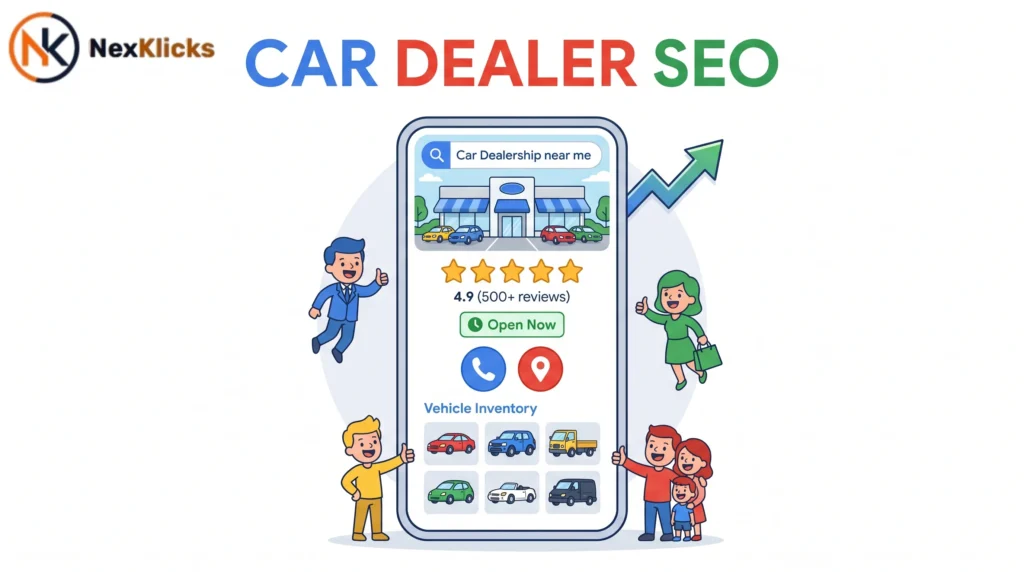
A complete Google Business Profile can boost in-store visits by 70%. That’s not a marginal improvement. It’s the single fastest lever most dealerships have available right now.
Complete every field: business name, address, phone number, website URL, and hours, including holiday schedules. Set your primary category to “Car Dealer” and add secondary categories for Used Car Dealer, Auto Parts Store, and Car Repair if applicable. Upload a minimum of 25 high-quality photos covering your exterior, showroom, service bay, inventory, and staff.
Publish Google Posts weekly. New inventory arrivals, seasonal service promotions, and financing specials all qualify. Pre-populate your Q&A section with your own frequently asked questions before customers submit random ones. The Products and Services section should list every make, model, and service type you offer, each with its own short description.
NAP Consistency, Local Citations, and Automotive Directories
NAP consistency, meaning your Name, Address, and Phone number matching identically across every online platform, is a foundational local citation building signal. A single mismatched phone number across platforms is enough to suppress your Google Maps dealership ranking.
Priority citation sources for dealerships include Google, Yelp, Cars.com, AutoTrader, CarGurus, DealerRater, and Facebook Business. Automotive-specific directories carry extra authority: NADA, Edmunds Dealer Listings, and Autobytel all pass strong local signals to Google. Use BrightLocal to audit your existing citations and identify inconsistencies.
Use BrightLocal’s Citation Tracker to audit your existing listings and surface every NAP inconsistency before it costs you map pack visibility.
How to Use Customer Reviews to Dominate Local Pack Rankings
Review quantity and recency both factor directly into Google’s local pack ranking algorithm. 81% of people used Google to research local businesses before visiting them. A dealership with 400 reviews averaging 4.6 stars consistently outranks one with 80 reviews averaging 4.9 stars.
Build a review generation system: send a post-sale email and SMS within 48 hours requesting a Google review. Respond to every review, positive and negative. Responses signal active engagement to Google and demonstrate professionalism to future buyers reading through your reviews. Multi-platform review strategy across Google, DealerRater, and Cars.com builds the widest trust signal footprint.
Review keywords matter too. When buyers mention specific models, neighborhoods, or staff names in reviews, those keywords influence which queries your GBP appears for. You can’t control what people write, but you can encourage specificity by thanking buyers for mentioning details in your responses.
Off-Page SEO and Link Building for Car Dealerships
Local Sponsorships and Community Links That Build Real Authority
Car dealership backlinks from local sources carry more weight than generic guest posts on unrelated websites. Google’s local algorithm reads community involvement as a trust signal.
Sponsoring a local Little League team, school event, or charity 5K typically earns a backlink from an organization’s website. Chamber of Commerce memberships, Better Business Bureau listings, and local business association directories all link to members. Regional news coverage of your dealership, whether for a record sales month, a community donation, or a major local hire, builds automotive domain authority in a way no purchased link can replicate.
How to Earn Backlinks Through PR, Partnerships, and Press Mentions
Off-page SEO for dealers scales fastest when you create content that earns links passively. A “Cost of Driving in Houston 2026” data report, a used car buying guide, or a local automotive market analysis gives regional blogs and news sites something worth linking to.
HARO, or Help a Reporter Out, is a free service that connects journalists with expert sources. Respond to automotive journalist queries with specific, data-backed answers, and you earn high-authority media mentions.
Cross-promotion partnerships with local auto insurance agencies, car washes, and body shops create mutual linking opportunities that benefit both businesses’ local search visibility. If you want a deeper breakdown of what actually works at the off-page level, the guide on off-page SEO tactics covers link acquisition strategies that apply directly to local service businesses.
Car Dealership SEO Best Practices and 4 Advanced Tips for 2026
Building a Content Hub That Connects Blog, Inventory, and Service Pages
This is the strategy that separates a dealership ranking for 50 keywords from one ranking for 500. Car dealership SEO best practices in 2026 aren’t about publishing one-off blog posts. They’re about building interconnected content hubs where every piece reinforces every other piece.
A content hub for Honda might look like this: a pillar page titled “Complete Guide to Buying a Honda in Denver” links to a Honda Civic review, which links to a CR-V inventory SRP, which links to a Honda oil change service page, which links back to the pillar. Each page sends authority signals to the others. The hub builds topical authority faster than any isolated publishing strategy.
Plan a three-month content calendar around one brand hub at a time. Month one: publish the pillar page and two cluster posts. Month two: add two more cluster pages and optimize internal links. Month three: build external links to the pillar and publish supporting service pages.
This is also where car dealer seo delivers compounding returns. The longer your hub structure matures, the more Google treats your site as the definitive local resource for that brand and market.
Using Video, Instagram, and Social Signals to Reinforce SEO
Google indexes YouTube and Instagram content in local search results. A walk-around video titled “2024 Toyota Tacoma for Sale in Phoenix | [Dealership Name]” can appear in Google’s video carousel above organic results. Instagram Reels featuring inventory are increasingly surfaced in automotive search results in 2026.
Reddit participation in local subreddits and automotive communities builds car inventory SEO brand mentions that Google treats as third-party trust signals. You don’t need to advertise. Answer questions, share honest advice, and mention your dealership when relevant. TikTok vehicle showcase videos build brand awareness and drive organic traffic for dealerships through referral rather than search, which still benefits overall domain authority signals.
How to Track SEO ROI for a Car Dealership Using Google Analytics and SEMrush
Dealer principals don’t want ranking reports. They want revenue numbers. Frame your automotive content marketing reporting around metrics that connect to the sales floor.
Set up GA4 conversion goals for form submissions, phone call clicks, direction requests from your GBP, and VDP page views from organic search. Use SEMrush Position Tracking to monitor keyword rankings weekly across your target locations. Google Search Console is your fastest source of quick wins: find queries generating high impressions but low clicks, then improve the title tags and meta descriptions for those pages.
The KPIs that translate to a dealer principal: organic sessions by month, local pack impressions, VDP views from organic traffic, and phone calls attributed to organic search. Connect those to units sold and service revenue orders, and SEO becomes a conversation about profit, not rankings.
Advanced Tip 1: Optimize for Google AI Mode with Structured Content
Add FAQ schema to every service page and inventory category page. Google AI Mode pulls directly from structured Q&A content when generating answers. Write one clear answer per paragraph. Aim to get your dealership cited on authoritative automotive sites like Edmunds, Cars.com, and Car and Driver because AI-generated answers pull heavily from those trusted sources.
Advanced Tip 2: Build a Hyperlocal Landing Page Strategy
Create dedicated pages for specific neighborhoods, zip codes, and suburbs within your metro area. “Serving Katy, Sugar Land, and Pearland” is one page covering three high-intent communities. These hyperlocal pages target longer-tail search ranking for car lots queries where Google favors geographic relevance over domain authority, giving smaller dealers a real competitive window.
Advanced Tip 3: Leverage Manufacturer Co-Op SEO Budgets
Most franchise dealers don’t know that OEM co-op marketing funds can be applied toward SEO agency services and content production. Document your SEO costs clearly, aligned with your manufacturer’s digital standards, and submit for co-op reimbursement. The strategy remains local-first. The funding doesn’t have to come entirely from your own budget.
Advanced Tip 4: Use DealerSocket and CRM Data to Inform SEO Topics
Pull your top ten most common customer inquiry types from DealerSocket. Those are your best blog and FAQ topics. Map your actual sold inventory data to local auto dealer keyword targeting demand, and you’ll find keyword opportunities your competitors are guessing at while you’re using real sales data. Your BDC question logs are a long-tail keyword goldmine.
FAQs and Resources
Q: What is automotive SEO?
A: Automotive SEO is the process of optimizing a dealership’s website and online presence to rank higher on Google, and car dealer SEO specifically focuses on local search signals, inventory pages, and buyer intent keywords that drive showroom visits.
Q: Is SEO dead or evolving in 2026?
A: SEO is evolving fast in 2026, with Google AI Mode and zero-click answers reshaping how buyers find dealerships, making car dealer SEO more structured and intent-driven than ever before.
Q: What is the 80 20 rule of SEO?
A: 80% of your organic traffic comes from 20% of your pages, so for dealerships that means your top-performing city landing pages, VDPs, and GBP listing do the heavy lifting while the rest of the site supports them.
Q: How much does a car salesman make on a $30,000 car?
A: Most car salespeople earn 20 to 25% commission on front-end gross profit, which on a $30,000 car typically translates to $300 to $600 per unit depending on the dealership’s pay plan and negotiated margin.
Q: Why does your car dealership need local SEO?
A: Because 92% of buyers research online before visiting a lot, and without car dealer SEO, your dealership is invisible to local buyers at the exact moment they are ready to act.
Conclusion
Car dealer SEO in 2026 is not optional for dealerships competing in mid-size and suburban markets. The buyers are online before they ever call your number or pull into your lot. The one mistake that costs dealers the most is treating SEO tactics in isolation, fixing a title tag here, adding a few photos to GBP there, without connecting those actions into a compounding system.
Build the content hub. Optimize the technical foundation. Generate reviews consistently. Show up in AI-generated answers with structured data. Start with your Google Business Profile today because it’s the fastest win available, and it feeds every other signal in this strategy.
This guide breaks down the complete car dealer SEO strategy for 2026, covering local pack rankings, Google Business Profile optimization, technical fixes, content hubs, and AI search visibility, so your dealership stops losing clicks to competitors and starts converting organic traffic into real leads.
Last update: June 2026

Leave a Reply