

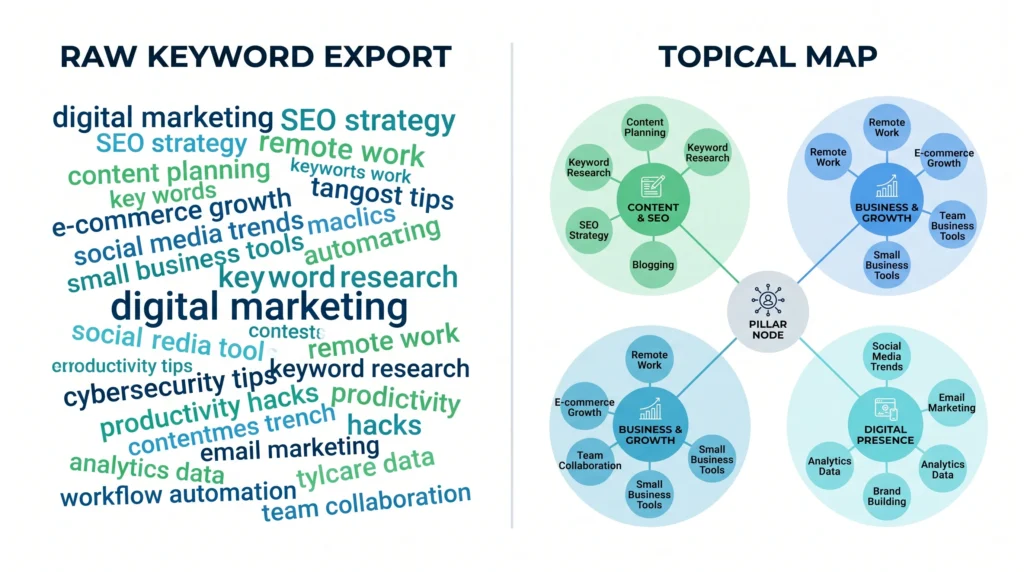
Every time you try to get topical map of competitor SEO, you run into the same wall: you export thousands of keywords, open a spreadsheet, and have no idea what to do next. The data is there. The structure isn’t.
Most articles explain what a topical map is. You already know that. What you probably can’t find is a clear, tool-backed process for pulling apart a competitor’s content architecture and turning it into something actionable. That’s the gap this article closes.
Your competitors have already spent years doing content planning. Their cluster structure, their pillar pages, their internal link patterns. All of it is sitting in plain sight if you know where to look. When you get topical map of competitor SEO, you’re not starting from zero. You’re starting from proven demand.
What is a competitor topical map in SEO? A competitor topical map is a structured overview of the topic clusters, content silos, and keyword groupings that make up a rival site’s content strategy. It shows which subjects they’ve built authority around, which subtopics they’ve covered thoroughly, and where their gaps are. Reverse-engineering one gives you a content roadmap built on real search demand.
Why Trying to Get Topical Map of Competitor SEO Is Worth the Effort
Keyword research tools show you what people search for. A competitor’s topical map shows you what actually worked well enough to build on.
There’s a meaningful difference. According to Semrush’s State of Content Marketing 2023 Report, 45% of marketers say competitive research is their most effective tactic for content planning, yet only 11% use topic clustering tools regularly. That gap exists because most people stop at keyword exports. They never cluster, never visualise, never map the architecture behind the rankings.
When a competitor ranks across dozens of keyword variations inside a single topic, that’s not luck. It’s deliberate cluster building. Their pillar page earns authority. Their supporting posts pass signals back up. Google recognises the site as a subject matter resource and rewards the whole cluster, not just individual pages.
Or maybe I should say it this way: you’re not just trying to copy their keywords. You’re trying to understand the structural decisions that made those keywords rank in the first place.
What most guides skip is that a competitor’s topical map also reveals their content gaps, the subtopics they’ve avoided, the questions they’ve half-answered. Those gaps are your real opportunity.
How to Get Topical Map of Competitor SEO Using Tools
This is the process. Follow it in order.
Step 1: Pull the full URL list from Ahrefs Site Explorer
Open Ahrefs Site Explorer, enter your competitor’s domain, then navigate to “Top Pages” filtered by organic traffic. Export all URLs with traffic above 50 visits per month. This filters out thin pages and one-off rankings that don’t reflect deliberate content investment.
You now have the pages on which their topical map is actually built.
Step 2: Identify the top keyword for each URL
Still in Ahrefs, pull the “Organic Keywords” report for the competitor domain. Export with the URL column included. For each URL, note the keyword driving the most traffic. This becomes the topic label for that page inside your working map.
Step 3: Cluster by parent topic in Semrush
Import your keyword list into Semrush’s Keyword Manager. Use the Cluster function to group keywords by semantic similarity. Semrush groups keywords that frequently appear in the same search results pages, which is a reliable proxy for topical proximity.
Each cluster that emerges represents a topic the competitor has deliberately built out. The size of the cluster tells you how deep they’ve gone.
Step 4: Crawl the site structure with Screaming Frog
Run Screaming Frog on the competitor domain. Under “Crawl Analysis,” look at the URL folder structure and the internal link map. This reveals how they’ve organised their silos architecturally, which subfolder paths map to which topic clusters, and which pages receive the most internal link equity.
Export the internal links report and filter for pages with the highest number of inbound internal links. Those are almost certainly their pillar pages.
Step 5: Map clusters to a visual structure
Take your clustered keyword groups and your Screaming Frog architecture data. Cross-reference them. Build a spreadsheet or use a free tool like Miro with three columns: Pillar Topic, Supporting Subtopics, Pages Covered. This is the competitor’s topical map in working form.
To get topical map of a competitor SEO in 5 steps:
- Export top-traffic URLs from Ahrefs Site Explorer
- Pull the primary keyword per URL from the Organic Keywords report
- Cluster keywords semantically using Semrush Keyword Manager
- Crawl site architecture and internal links with Screaming Frog
- Cross-reference clusters with crawl data to identify pillars and supporting content
Before running this process, make sure your own keyword research foundation is solid. Understanding how to evaluate keyword difficulty and intent will help you prioritise which competitor clusters are actually worth targeting.
Reading the Map: What the Data Is Actually Telling You
Pulling the data is the mechanical part. Interpreting it correctly is where most people go wrong.
Cluster Depth vs. Cluster Breadth in Competitor Topical Authority Analysis
A competitor might have 40 articles on a topic or just 4. Neither number tells you much on its own. What matters is the ratio of supporting content to pillar content inside each cluster.
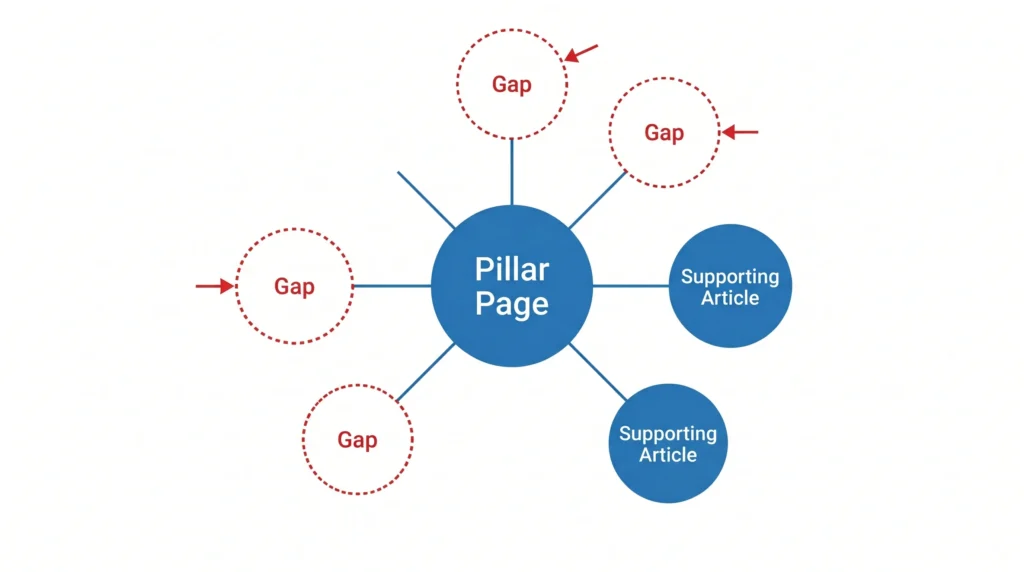
A cluster with one pillar and 12 supporting articles shows deliberate, deep investment. A cluster with six pillar-level pages and almost no supporting content suggests they’ve spread thin without committing, which is a structural gap you can exploit by going deeper on the same topic.
Look specifically for clusters where they have a strong pillar but thin supporting coverage. These are your highest-value targets. Build a more complete cluster, earn topical authority faster, and you can outrank their pillar by surrounding it with content it can’t compete against.
Spotting Gaps in Your Competitor Keyword Cluster Mapping
I’ve seen conflicting data on how to define a content gap. Some sources say it’s any keyword the competitor ranks for that you don’t. Others define it as a topic cluster they’ve built where you have zero presence. My read is that the second definition is more strategically useful.
A single keyword gap is a tactical opportunity. A full cluster gap is a structural one. Structural gaps compound over time because topical authority in a cluster tends to lift all the pages inside it, not just one.
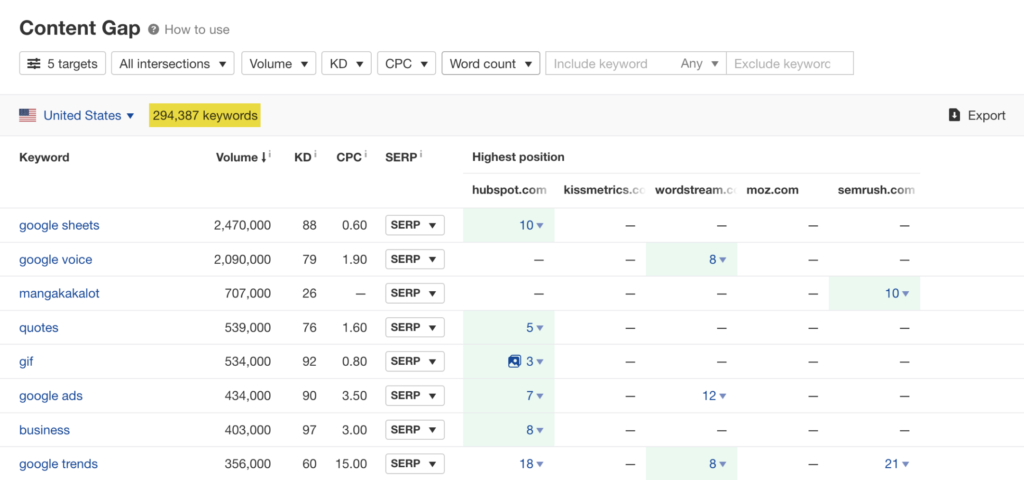
In Ahrefs, run the Content Gap tool. Enter your domain and two or three competitor domains. Set the filter to show keywords where at least two competitors rank, but you don’t. Export this list, then run it through Semrush clustering to find which clusters those keywords belong to.
That’s your prioritised gap list.
Topical Map SEO Tool Comparison: Which Combination Works Best
Different tools do different things well. No single tool gives you the complete picture when you’re trying to get topical map of competitor SEO.
Quick Comparison
| Tool | Best For | Key Benefit | Limitation |
|---|---|---|---|
| Ahrefs Site Explorer | URL and keyword extraction | Most accurate traffic data | Clustering requires manual work |
| Semrush Keyword Manager | Semantic clustering | Automated cluster grouping | Cluster quality varies by niche |
| Screaming Frog | Site architecture mapping | Reveals internal link structure | Slow on large sites, crawl cap on free version |
| Miro or Google Sheets | Visualising the final map | Free, flexible, shareable | No automation, fully manual input |
Some experts argue that Semrush’s Topic Research tool alone is enough to reverse-engineer a competitor’s map. That’s valid in broad, high-volume niches where Semrush has dense data. But in technical or lower-volume niches, Screaming Frog’s architecture data fills critical gaps that keyword tools miss entirely. The key difference is that keyword tools show you what a competitor ranks for crawl tools show you how they’ve structured the site to earn those rankings.
Once you’ve mapped the competitor’s off-page authority patterns, it’s also worth reviewing what off-page SEO tactics they’re using to support those clusters. Link equity distribution across a topical silo tells you which clusters they’re actively investing in versus which ones are ranking on content alone.
How to Turn a Competitor’s Topical Map Into Your Content Plan
Getting the map is one thing. Using it without simply copying is where the real strategy begins.
Prioritising Which Competitor Keyword Clusters to Target First
Not every gap in a competitor’s topical map is worth filling. Score each cluster you’ve identified against three criteria: search volume inside the cluster, your existing content overlap with that topic, and the commercial relevance to your business goals.
Clusters where all three align are your first quarter of work. Clusters with high volume but low commercial relevance are traps. They’ll bring traffic that doesn’t convert and dilute your topical focus at the same time.
Quick note: a cluster doesn’t need to be large to be worth building. In specialist niches, a cluster of eight to ten tightly related articles can establish clear topical authority faster than a sprawling 40-page cluster on a broad subject. Depth beats breadth for new cluster builders.
Building Content Around a Competitor Content Gap Analysis Without Copying
Look, if you’re in a situation where a competitor has built a strong cluster and you’re starting from zero, here’s what actually works. Don’t replicate their structure. Improve on their depth. Find the supporting subtopics they skipped, the questions their articles half-answer, the related terms their content never addresses directly.
A competitor might have a strong pillar on “content auditing” with five supporting articles. Check their comment sections, relevant Reddit threads, and Quora discussions around those articles. Real user questions your content didn’t resolve are your content brief.
That’s not a keyword gap. That’s a quality gap. And quality gaps are harder for competitors to close quickly once you’ve filled them with something better.
For a practical example of how content mistakes compound at the site level, the common SEO mistakes small business owners make guide covers several patterns that show up repeatedly in weak topical clusters and useful context before you start building.
Common Mistakes When Reverse-Engineering a Competitor’s SEO Topical Map
Most people who attempt this process make the same set of errors.
The first is treating every competitor URL as a strategic signal. Not every page on a competitor’s site is part of their intentional topical structure. E-commerce sites especially have thousands of category, filter, and tag pages that inflate URL counts without representing real content investment. Filter your exports to blog posts, guides, and resource pages only.
The second mistake is mapping clusters by folder structure alone. A site might have a /blog/ folder with 200 posts covering 15 different topics with no internal clustering logic at all. Folder structure is one signal, not the whole picture. Always cross-reference with keyword clustering before drawing conclusions about their strategy.
The third is skipping the internal link analysis entirely. Internal links are how a site tells Google which pages are authoritative within a cluster. A competitor might have 30 articles on a topic, but if 28 of them link to one central resource, that resource is their pillar. Missing this means you’ll target their supporting posts, thinking they’re pillars. Understanding how multiple links to the same page affect SEO will help you interpret their internal linking patterns accurately. Topical authority is built by organizing content into clear clusters and connecting related pages through strong internal links. As explained in the Ahrefs blog on topical authority, this structure helps distribute link equity and improves search visibility within a niche.
Voice Search and AEO: Quick Answers
Q: What’s the best free way to get topical map of competitor SEO?
A: Export their top pages from Ahrefs’ free tier, cluster by topic manually in a spreadsheet using URL folder paths and page titles as guides, then cross-reference with Google’s related searches for each topic. It’s slower but produces a usable map without a paid subscription.
Q: How do I find which topic clusters a competitor has built authority in?
A: Use Ahrefs Site Explorer to filter their top pages by traffic, then group URLs by subject. Clusters where they rank multiple pages on the same topic signal deliberate authority building, not accidental rankings.
Q: Should I target the same topical clusters as my competitor?
A: Only if there’s clear search demand and commercial relevance for your site. Targeting a competitor’s clusters without those two filters leads to traffic that doesn’t serve your business goals and weakens your own topical focus.
Q: Why does my competitor rank for hundreds of keywords in one topic?
A: Topical authority. When Google recognises a site as a thorough resource on a subject, it tends to rank that site’s pages across the full range of related queries. Building a complete cluster, not just a single page, is how that authority develops.
Q: When should I start building a new topic cluster instead of expanding an existing one?
A: Expand existing clusters first until you have at least five to seven pages with clear topical coherence. Starting new clusters too early splits your authority signals and slows ranking momentum across both directions simultaneously.
What to Do With Your Competitor’s Map Starting This Week
You don’t need to map every competitor cluster before you start writing. Pick one cluster where your competitor has clear topical authority, run the five-step process above for that topic alone, and identify the three to five supporting articles they’ve missed.
Write those articles first. Link them to each other and to your existing content. Then build the pillar. This bottom-up approach is slower to plan but faster to rank because you’re building the supporting structure before the pillar needs to earn authority on its own.
The one mistake to avoid at this stage: don’t start with the highest-volume cluster your competitor owns. Start with the one where their execution is weakest. Volume is a distraction if the competition is too strong to break into. Find the cluster where they’ve planted a flag but not built a fortress.
Your competitor’s topical map is not a blueprint to copy. It’s a starting point for building something more complete. If you want to see how Nexklicks applies this process for real clients, the case studies show the before-and-after in detail.
This guide covers tool-assisted methods for reverse-engineering a competitor’s topical map using Ahrefs, Semrush, and Screaming Frog. It does NOT address building a topical map from scratch or local SEO content strategy.
This works best for SEO specialists and content strategists working on established websites with at least some existing content. It won’t help if your site is brand new with zero domain authority or if your competitor has fewer than 50 indexed pages.
Last updated: June 2026


Leave a Reply