
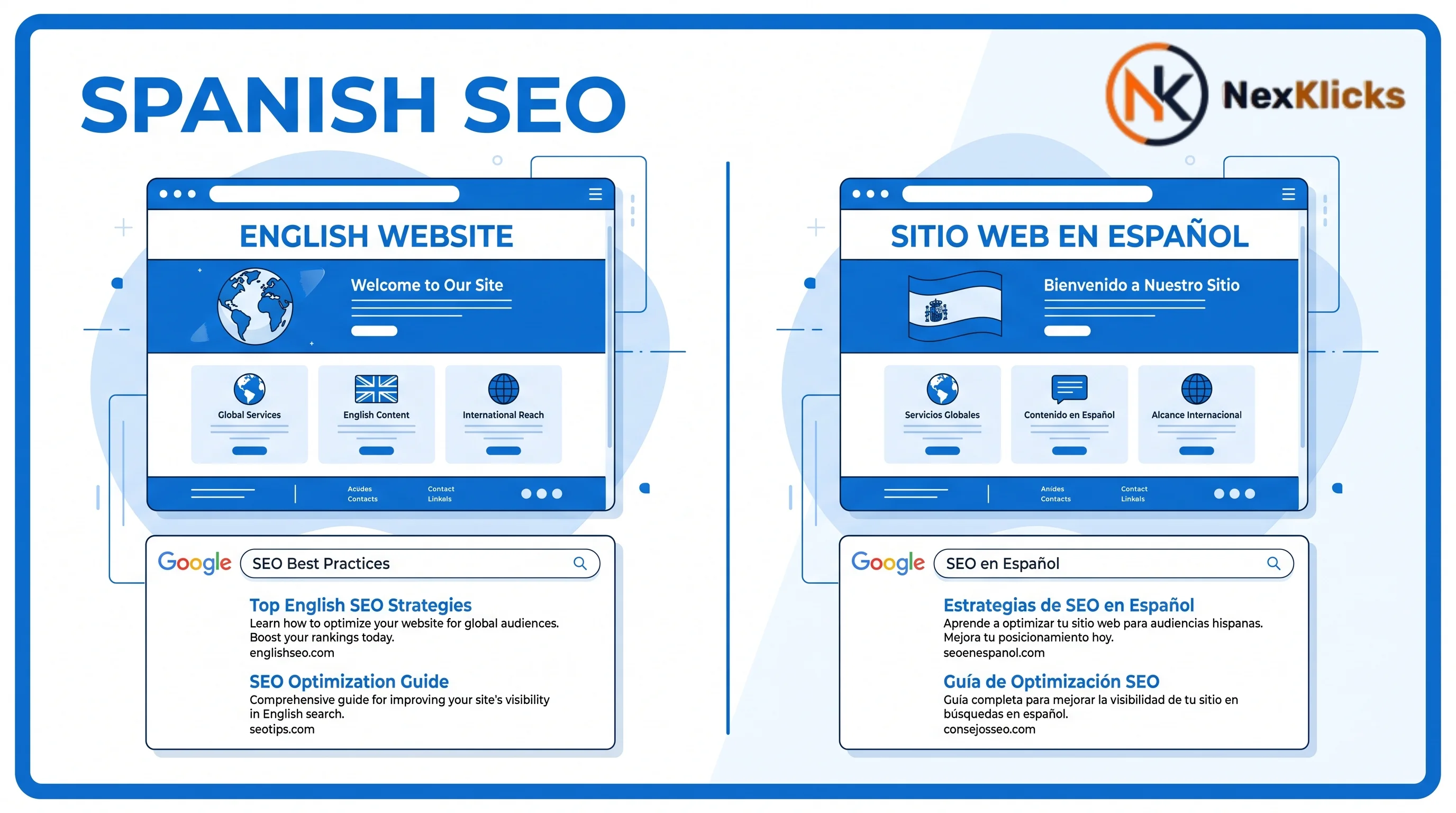
Forty percent of consumers say they will never buy from a website that isn’t in their language. If your business isn’t investing in Spanish SEO, you’re invisible to more than 42 million Spanish speakers in the United States alone. That’s not a niche audience. That’s a market worth trillions of dollars, and most brands are leaving it entirely untouched.
This guide covers spanish seo from the ground up: keyword research, localization strategy, hreflang tags, Spanish link building, and the technical details that actually determine whether Google ranks your Spanish content. Built specifically for US businesses targeting Spanish-speaking markets and Hispanic digital marketing, this is not a generic multilingual overview. Every section addresses what your current English SEO playbook simply cannot answer.
Spanish SEO refers to the process of optimizing a website and its content to rank in search engines for Spanish-language queries. It covers keyword research, localization, technical configuration, and link building. It applies to any Spanish-speaking audience, not just users in Spain.
What is Spanish SEO?
Spanish SEO is the practice of optimizing a website’s content, structure, and authority so it ranks in search engines for Spanish-language content queries. It’s easy to assume this just means translating your existing site or doing SEO work targeted at Spain. Neither assumption is accurate, and both lead to wasted budget.
Spanish SEO covers any Spanish-speaking audience: US Hispanic communities, Mexico, Colombia, Argentina, and every other market where Spanish is the primary search language. The scope is wider than most marketers realize.
It also involves layers that general English SEO doesn’t prepare you for: regional Spanish dialects, cultural localization SEO, hreflang technical configuration, and building authority with Spanish-language backlinks from regionally relevant sources. These aren’t optional extras. They’re what separates a Spanish content strategy that ranks from one that sits invisible in Google’s index.
Spanish SEO vs. General International SEO: What Makes It Unique
Spanish is the second most spoken language in the United States and the fourth most widely spoken globally. Unlike French or German, which have relatively centralized standard forms, Spanish varies dramatically across more than 20 countries. Regional language variations in vocabulary, grammar, and informal search phrasing mean that a keyword strategy built for Madrid will underperform in Miami, and vice versa.
Google holds over 90% of the search engine market share across virtually all Spanish-speaking markets, which simplifies the platform side. But that single constant doesn’t reduce the complexity of everything else.
Why Does Spanish SEO Matter? (Market Size, Revenue, and Search Data)
The numbers make the case clearly. According to the US Census, more than 42 million people aged five and older speak Spanish at home in the United States. As of January 2024, Spanish was the second most frequently used language in web content globally. And according to CSA Research (2020), 76% of Spanish online shoppers prefer buying in their native language, while 40% say they will never purchase from a site in another language.
US Hispanic buying power has crossed $2 trillion. The Latinx population pays attention to online ads at a rate roughly 20 percentage points higher than the general US population. These are not soft demographic signals. They are direct indicators of commercial intent and brand receptivity.
Businesses that ignore search engine optimization in Spanish are not just missing traffic. They’re missing qualified buyers who are actively searching and actively spending.
Spanish SEO matters because the US Hispanic market represents one of the fastest-growing consumer segments in the country. According to CSA Research (2020), 40% of consumers will never purchase from a website in a language other than their own. With over 42 million Spanish speakers in the US and $2 trillion in buying power, failing to optimize for Spanish-language search means losing conversion-ready traffic to competitors who do.
The US Hispanic Market Is a Digital Growth Opportunity
Hispanic digital marketing isn’t a future consideration. It’s a present one. Hispanic internet usage in the US is growing faster than the general population, and mobile-first behavior is dominant within this demographic. That means page speed, mobile UX, and responsive design aren’t just good practices for your Spanish pages. They’re conversion requirements.
Brands that communicate in Spanish earn measurably stronger loyalty and trust. Spanish user search intent often reflects a desire to engage with brands that understand cultural context, not just those who’ve run their homepage through a translation tool.
How is Spanish SEO Different from English SEO?
The foundational principles are identical: keyword research, quality content, backlinks, and technical optimization. The execution is where everything diverges.
Spanish market digital maturity varies significantly by region. In many Latin American markets, online shopping is still developing. Transactional keywords like “buy now” or “order online” carry far lower search volume than their English equivalents. Targeting those terms with the same aggression you’d use in the US English market will produce poor results.
Spanish consumer behavior also differs in ways that aren’t immediately visible. Some US-born Hispanic users conduct their searches in English even though they prefer consuming content in Spanish. That’s not a contradiction. It’s a behavioral pattern shaped by education, platform habits, and the fact that English-language search infrastructure has historically been more developed.
Platform behavior differs too. In Latin America, MercadoLibre rivals Amazon for e-commerce discovery. YouTube often outperforms Google for product research in certain markets. A strategy that assumes Google search is the only relevant channel will miss real opportunities.
Spanish SEO differs from English SEO primarily in execution, not principle. According to SEO specialists with Latin American market experience, transactional search behavior is less developed in many Spanish-speaking markets, meaning keyword strategies must account for lower commercial intent volume. Cultural trust signals, platform preferences, and regional vocabulary all shape how Spanish-speaking audiences search and convert differently from English-speaking ones.
What US Marketers Get Wrong When Entering Spanish-Speaking Markets
Three mistakes appear repeatedly. First, assuming that Spanish-speaking audience behavior in the US mirrors behavior in LATAM. Second, using English-market conversion benchmarks to evaluate Spanish-market campaign performance. A lower conversion rate on your Spanish pages doesn’t mean the strategy is failing. It may mean the market is at a different stage of digital maturity. Third, expecting a WordPress translation plugin to handle the SEO work. It won’t, and the next section explains exactly why.
There Are Several Spanish Dialects and Cultures: Your Keyword Strategy Must Reflect That
There are more than 477 million native Spanish speakers spread across 20-plus countries. Regional Spanish dialects don’t just affect pronunciation. They affect vocabulary, grammar, and the specific words people type into search engines.
The word “torta” means cake in Colombia and sandwich in Mexico. The word for car is “carro” in much of Latin America, “coche” in Spain, and “auto” in Chile and Argentina. Use the wrong term in your Spanish keyword research, and you’re targeting a word your audience doesn’t search. Even within Spain, there are distinct regional languages: Catalan, Galician, and Basque, each carry their own search patterns and cultural contexts.
For US-based businesses, this gets even more granular. Mexican-American, Puerto Rican, Cuban-American, and Central American communities each carry distinct vocabulary patterns and Spanish search behavior that surface in their queries.
Cultural localization SEO isn’t a soft concept. It’s a measurable ranking factor. The wrong word in the wrong region means zero impressions, regardless of how well the rest of your on-page SEO is executed.
How to Identify Which Spanish Dialect to Target
Start with your existing data before making any assumptions. Pull your organic traffic Spanish segmentation in Google Analytics and filter by geography and language settings. Then open Google Search Console and review the actual queries that are already bringing users to your site. Look at which language those queries are written in.
If your service area is a specific US city with a large Mexican-American population, LATAM Spanish with Mexican regional vocabulary is the correct starting point. If you’re targeting broadly across all Spanish-speaking regions, LATAM-neutral Spanish, which avoids country-specific slang and regionally exclusive vocabulary, reaches the widest audience without alienating subgroups.
Match the dialect to the market. Don’t guess.
How To Do Spanish-Language SEO: A Step-by-Step Framework
Here is the practical execution layer. Each step builds directly on the last, and skipping any of them creates gaps that compound over time.
To execute a Spanish SEO strategy, follow these steps:
- Verify whether your audience actually searches in Spanish using Google Analytics and Search Console.
- Conduct Spanish keyword research using SEMrush or Ahrefs with regional language settings.
- Publish manually translated Spanish HTML pages, not plugin-translated versions.
- Translate and optimize all metadata, including titles, descriptions, and alt text.
- Use subdirectory URL structure for Spanish content.
- Implement hreflang tags correctly in your site’s head or sitemap.
Getting your Spanish SEO right starts well before content. Run a full international SEO audit to confirm your URL structure, hreflang, and localization are aligned before you publish a single page.
Step 1: Verify Whether Your Audience Actually Searches in Spanish
This is the step competitors skip entirely, and it’s where many Spanish SEO investments go wrong before they begin.
Open Google Analytics and segment your traffic by language. Look at what language your existing visitors have set in their browser. Then cross-reference that with Google Search Console. Filter your queries and look at what language the actual search terms are written in. If the majority of your Spanish-speaking visitors are submitting queries in English, a full Spanish content build may not be your highest-leverage move at this stage.
If a user’s browser is set to English but their IP places them in a Hispanic-majority zip code, they almost certainly search in English. That doesn’t mean Spanish content has no value for them. It means your keyword research needs to account for bilingual behavior, not assume Spanish-only search patterns.
Validate before you build. The data is already in your tools.
Step 2: Spanish Keyword Research: Tools, Regional Variants, and Search Volume
Spanish keyword research requires more than switching Google Keyword Planner to a different language. It requires a fresh research process built around how your specific target audience actually searches.
Open SEMrush or Ahrefs and change the target country and language settings to Spanish. Do not start with your English keyword list. Start with the product, service, or topic, and research it as if you were a native speaker in your target region.
Use Google Trends to compare regional variants side by side. Search “carro,” “auto,” and “coche” within the same tool and see which term dominates in your target geography. Use AnswerThePublic with the language set to Spanish to surface question-based queries your audience is already asking. These are often long-tail opportunities with lower competition and high intent.
Pay attention to diminutive variations. In many Spanish-speaking cultures, diminutives are used in everyday language and in search. “Zapatillas” and “zapatos” can represent meaningfully different search volumes depending on the region. Always compare volume against competition for each variant before committing to a target keyword.
Step 3: Manual Translation vs. Plugin Translation vs. AI: What Google Actually Crawls
This is the most consequential technical misunderstanding in Spanish language website optimization, and no competitor article addresses it directly.
When you install a translation plugin like GTranslate on a WordPress site, the plugin translates the visible text on the front end of the page. What it does not do is rewrite the HTML that Google’s crawler reads. When Googlebot visits your page, it sees English source code. The Spanish text the user sees in their browser simply does not exist in the page’s crawlable markup.
Google crawl Spanish pages correctly only when the Spanish content is actually written into the HTML of a real, separately published page. A plugin-translated page cannot be ranked as a Spanish page because, from Google’s perspective, it is not one.
AI translation tools have improved significantly and can accelerate the content production process. But AI-generated translations still require review by a fluent Spanish speaker, particularly for tone, cultural appropriateness, and keyword accuracy. The output needs to sound natural to a native speaker, not like a technically accurate but stilted machine translation.
The only SEO-valid approach is to publish genuine, manually written, or professionally reviewed Spanish HTML pages hosted at a proper URL structure.
Step 4: Onsite Copy, Metadata, and Spanish Special Characters
Once your Spanish pages are published as real HTML, every on-page element needs to be fully translated and optimized. That means meta titles, meta descriptions, heading tags, body copy, image alt text, button labels, navigation items, and form field labels. Any English element on a Spanish page sends a mixed signal to both Google and your user.
Spanish metadata optimization requires particular attention to special characters. Tildes, acute accents like é and á, and diaereses like ü are not cosmetic. They change meaning. “Tácito” means implicit. “Taco” means taco. Missing an accent in your metadata doesn’t just look unprofessional. It changes what the word means and can make your content irrelevant to the query you’re targeting.
Spanish-accented characters also occupy slightly more pixel width in some systems than standard ASCII characters. Since Google measures meta title and description length in pixels rather than character count in many configurations, this can affect how your metadata displays in search results. Test your translated metadata in a SERP preview tool before publishing.
Step 5: Site and URL Structure for Spanish Content
Use subdirectories, not subdomains, for your Spanish content. The structure yoursite.com/es/ consolidates domain authority more effectively than es.yoursite.com. With a subdomain, you’re essentially splitting your site’s authority into two separate entities. A subdirectory keeps all of that authority under one root domain.
Quick Comparison: Subdirectory vs. Subdomain for Spanish SEO
| Option | Best For | Key Benefit | Limitation |
|---|---|---|---|
Subdirectory (/es/) | Most businesses | Consolidates domain authority | Requires careful internal linking |
Subdomain (es.site.com) | Large enterprise sites with separate teams | Easier independent management | Splits domain authority |
Country-code TLD (.mx, .es) | Country-specific targeting | Strong geo-targeting signal | High maintenance cost, separate authority |
Subdirectories are the recommended default for bilingual SEO because they keep link equity unified and are easier to maintain at scale.
Avoid language-switching popups that appear automatically based on browser language detection. These interrupt user experience and often misfire, redirecting English-speaking users in Latin American locations to Spanish pages they didn’t request. Use a clear, persistent language toggle instead and let the user choose.
Ensure your internal linking structure connects English and Spanish pages cleanly. Each Spanish page should have a corresponding English counterpart, and the relationship between them should be made explicit through hreflang.
Step 6: Hreflang Tags: How to Signal Language and Region to Google
Hreflang implementation is the technical bridge between your Spanish content and the right audience. These attributes tell Google which version of a page to serve to which user based on their language preference and geographic location.
Without hreflang, Google may treat your English and Spanish pages as duplicate content and choose to rank one over the other, or penalize both. With hreflang configured correctly, Google understands that these pages serve different audiences and ranks them independently.
The tag hreflang="es-US" targets Spanish-speaking users in the United States. The tag hreflang="es-MX" targets users in Mexico. If you want to target all Spanish speakers regardless of country, hreflang="es" covers the broader language without geographic restriction.
If you haven’t done a full site audit yet, a proper technical SEO audit will surface hreflang errors alongside every other structural issue holding your rankings back.
According to the Ahrefs Hreflang Guide, hreflang errors are among the most common and consequential technical SEO mistakes on multilingual websites, with a detailed implementation walkthrough.
Hreflang tags must be placed in the <head> section of each page or included in your XML sitemap. Errors in the syntax, missing reciprocal tags, or incorrect language codes cause Google to ignore the attributes entirely. Audit your hreflang implementation with SEMrush’s site audit tool or Ahrefs’ technical audit to confirm it’s working as intended.
You Can’t Simply Translate Your English Keyword Research: Here’s What to Do Instead
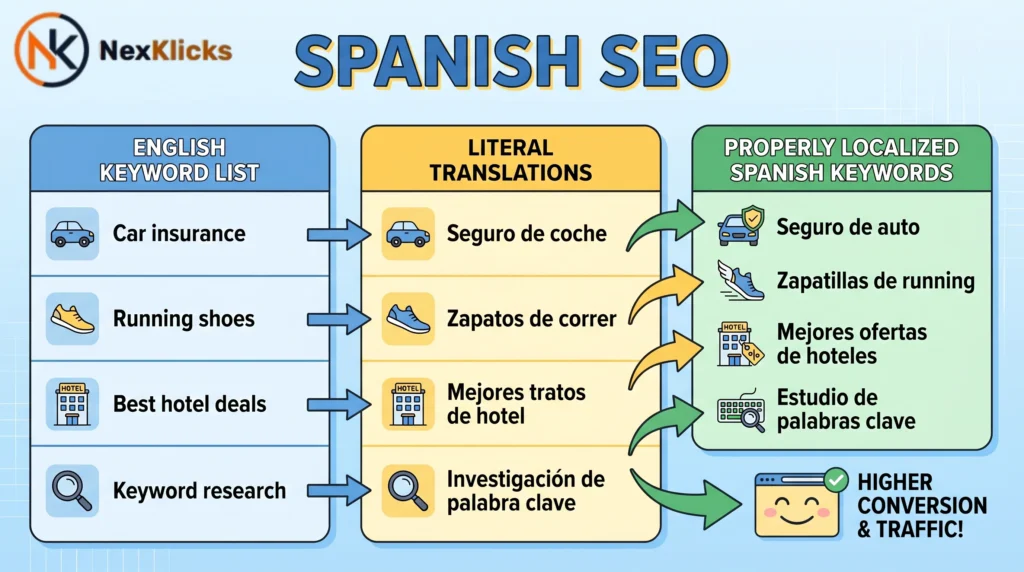
Direct keyword translation is one of the most common and costly mistakes in multilingual SEO for spanish markets. It feels like a logical shortcut. It produces consistently poor results.
The problem is that English keyword phrases are built around how English speakers think and speak. When you translate those phrases literally, you often end up with words that are technically correct but that no native Spanish speaker would naturally type into a search engine. The translated phrase may have zero search volume. It may exist but attract a completely different audience than you intended.
Keyword localization means starting fresh. Open your keyword research tools with regional settings configured for your target market, identify the terms and phrases your specific audience actually uses, and build your keyword list from there. Seasonality is another factor that direct translation ignores entirely. Many Latin American countries are in the Southern Hemisphere, which means seasonal search trends run opposite to those in the US. Holidays, cultural events, and purchasing cycles also differ by country.
Localize the meaning, not just the words. A successful LATAM content strategy is built around how the audience actually thinks, not how an English speaker would phrase the same idea in a translated form.
Spanish-Language Link Building: How to Build Authority in Hispanic Markets
Spanish link building follows the same foundational logic as English link building. Links from credible, topically relevant sources signal to Google that your content is trustworthy. The difference is where those links need to come from and how you earn them.
For Latino SEO optimization, the links that carry the most weight are those from sites whose traffic originates in your target Spanish-speaking region. A backlink from a high-authority English publication does not send the same regional relevance signal as a link from a respected Spanish-language outlet in your market.
Practical tactics for building Spanish-language backlinks:
Submit your site to Spanish-language business directories and local listings that your target audience actually uses. Write guest posts for reputable Spanish-language blogs and industry publications. Partner with US Hispanic content creators and influencers who can generate authentic brand mentions and links. Conduct manual outreach to Spanish-language websites that have mentioned your brand without linking back. Use SparkToro to identify which specific publications and platforms your Spanish-speaking audience reads, so you’re targeting link sources with verified audience overlap.
The same fundamentals that govern English link building apply here for a broader breakdown of what works; see this guide on off-page SEO tactics.
One important warning: paid link schemes and private blog networks are more prevalent in Spanish-language SEO markets than in English ones. The short-term gains are not worth the risk of a manual penalty, which can take months to recover from.
SparkToro Audience Research Tool proves which specific publications and websites your Spanish-speaking target audience actually reads, enabling precise link building outreach.
Tracking and Monitoring Performance of Your Spanish SEO Campaign
Running a bilingual SEO campaign without tracking it separately from your English campaign is like running two businesses out of the same bank account. You can’t tell which one is profitable.
In Google Search Console, filter your queries by the Spanish-language terms you’re targeting and monitor impressions, clicks, and average position over time. In Google Analytics, segment your organic traffic Spanish visitors by language and geography. Look specifically at session behavior and conversion rates for Spanish-language users, not aggregate site metrics.
Tracking a Spanish SEO campaign requires separating Spanish-language performance data from overall site metrics. According to SEO practitioners, the most useful signals come from Google Search Console query filtering by Spanish-language terms, Google Analytics language segmentation, and conversion tracking isolated to Spanish-speaking user sessions. Without this separation, Spanish SEO performance is invisible inside broader traffic numbers.
Use SEMrush or Ahrefs with regional and language filters to track your Spanish Google ranking positions for each target keyword. Rankings in Mexico and rankings in the US for the same keyword can differ substantially. Track them by market.
If your Spanish pages are generating traffic but not conversions, the problem is almost never the keyword targeting. It’s usually the on-page experience: a CTA that wasn’t translated, a form that defaults to English, or a page load time that fails mobile users. Hispanic US audiences are predominantly mobile-first. A page that loads slowly on mobile will lose them before they read a single sentence.
Set a 90-day review cycle for your Spanish SEO performance. Search engine optimization in Spanish builds momentum over time. Month-one results don’t reflect the strategy’s actual ceiling.
Common Spanish SEO Mistakes That Kill Rankings (and How to Avoid Them)
These are the errors that consistently prevent Spanish content from ranking, regardless of how strong the rest of the strategy is.
Using a translation plugin and expecting Google to rank it. The HTML is still in English. Google cannot rank a page for Spanish queries when the source code contains no Spanish content. This mistake costs businesses months of wasted effort before they realize why nothing is working.
These are the same patterns covered in SEO mistakes small business owners make across every niche — Spanish markets simply amplify the cost of each one.
Translating keywords literally without localization. A word-for-word translation of your English keyword list produces terms that either have zero search volume or attract the wrong audience entirely. Multilingual website structure and proper keyword research are separate processes.
Targeting all Spanish speakers as one audience. A Mexican-American user in Los Angeles, a Spaniard in Madrid, and a Colombian in Bogota are not the same searcher. Their vocabulary, search habits, and consumer expectations differ. Treating them identically produces content that resonates with none of them.
Ignoring hreflang. Without hreflang tags, Google treats your English and Spanish pages as duplicate content. This suppresses rankings on both versions and wastes the authority you’ve built across the domain.
Skipping metadata translation. Meta titles and descriptions in English on Spanish pages send conflicting signals to Google and reduce click-through rates from Spanish-speaking searchers who see an English snippet in their results.
Black-hat link building from irrelevant sources. This is a more common practice in Spanish-language markets than in English ones, and it carries a higher penalty risk as Google’s algorithms have improved at detecting it.
Not tracking conversions separately. Traffic growth without isolated conversion data tells you nothing actionable. You need to know whether Spanish-speaking visitors are completing the actions that matter, not just whether they’re arriving.
When to Collaborate with a Trustworthy Spanish SEO Agency
Multilingual SEO done correctly requires three things simultaneously: native-level language fluency, regional cultural knowledge, and technical SEO expertise. Finding all three in one in-house team member is rare. Finding all three in a coordinated in-house team without prior experience in Spanish-speaking markets is rarer still.
You need a spanish seo partner when your plugin-translated site isn’t generating impressions in Spanish queries, when your Spanish pages are driving traffic but converting poorly, when you don’t have a native or fluent Spanish speaker reviewing your content, or when you’re entering a new regional market with different dialect and cultural patterns than you’ve targeted before.
When evaluating a Spanish SEO agency, look for a bilingual team with demonstrable experience in US Hispanic or LATAM campaigns, transparent white-hat link building practices, and clear reporting that separates Spanish keyword rankings and conversions from overall site metrics. Ask for case studies that show Spanish-market-specific results, not just general SEO outcomes.
Red flags include promises of rapid ranking results, link building sourced from unrelated directories, no clear methodology for dialect targeting, and agencies that treat Spanish SEO as a translation project rather than a market-specific strategy.
A credible agency starts with an audit of your existing Spanish content and technical configuration, identifies the dialect and regional targeting that matches your business, and builds a phased roadmap. They don’t just translate your English pages and call it done.
If you’re ready to stop guessing and start building a Spanish SEO strategy that actually ranks, Nexklicks Agency offers a full Spanish SEO audit and strategy consultation. The audit identifies exactly where your current setup is failing and what needs to change to generate real results in Spanish-speaking markets. Reach out to the Nexklicks team to get started.
FAQ: Spanish SEO
Q: What’s the best tool for Spanish keyword research?
A: SEMrush and Ahrefs are the strongest options. Set the target country and language to your specific Spanish-speaking market before pulling data. Google Keyword Planner also works when the language is switched to Spanish.
Q: How do I set up hreflang for a Spanish website?
A: Add hreflang attributes to the <head> of each page or include them in your XML sitemap. Use hreflang="es-US" for US Spanish and hreflang="es-MX" for Mexican Spanish. Every page must include a reciprocal tag pointing back to its counterpart.
Q: Should I use a subdomain or subdirectory for my Spanish pages?
A: Use a subdirectory structure like yoursite.com/es/. It consolidates domain authority more effectively than a subdomain and is the recommended approach for most businesses doing bilingual SEO.
Q: Why does my plugin-translated site not rank in Spanish?
A: Translation plugins render Spanish text visually but leave the underlying HTML in English. Google crawls the HTML, not the visual output. The crawler sees an English page and ranks it accordingly. Only manually published Spanish HTML pages are crawlable as Spanish content.
Q: When should I hire a Spanish SEO agency instead of doing it in-house?
A: When your team lacks a native or fluent Spanish speaker, when your Spanish pages aren’t generating impressions despite technical setup, or when you’re entering a regional market with different dialect patterns than you’ve previously targeted.
Conclusion
Spanish SEO is not a translation project. It’s a full market entry strategy that requires fresh keyword research, genuine Spanish HTML content, correct technical configuration, and regionally relevant link building. The single biggest mistake you can make is assuming your English SEO playbook scales directly into Spanish-speaking markets by running it through a plugin or a translation tool.
The key takeaway is straightforward: Google cannot rank what it cannot crawl, and it cannot crawl plugin-translated content as Spanish. That one insight alone will save you months of wasted effort and missed opportunity in a market worth trillions of dollars.
The next action is to open Google Analytics and Google Search Console today and check whether your existing audience actually searches in Spanish. That data determines everything that comes next. Don’t invest in content before you have the answer.
Spanish SEO is not a translation task; it is a full localization and technical strategy for reaching Spanish-speaking users with the right keywords, pages, and signals. Use real Spanish HTML, localized keyword research, and clean technical setup so your content can rank and convert in US Hispanic and LATAM markets.
Last update: June 2026


Leave a Reply