
You’ve probably already tried building links in-house. Maybe you hired a VA to do outreach. The emails went out. Nothing came back. Or you bought a package from a provider that promised 20 high-DA links in two weeks, and what you got was a folder of irrelevant, low-traffic placements that made you nervous every time Google ran an update.
That’s the actual starting point for most people searching for this topic. Not curiosity. Frustration.
Backlink outsourcing is not complicated in theory. In practice, it fails when people don’t know what they’re buying, who to trust, or what a realistic outcome looks like. This guide answers all three.
What Backlink Outsourcing Actually Means (And What It Doesn’t)
Backlink outsourcing refers to the practice of hiring an external provider, whether a freelancer, a white-label agency, or a managed link-building service, to acquire backlinks on your behalf through outreach, content placement, or digital PR. The provider handles the prospecting, pitching, relationship management, and reporting. You receive the links.
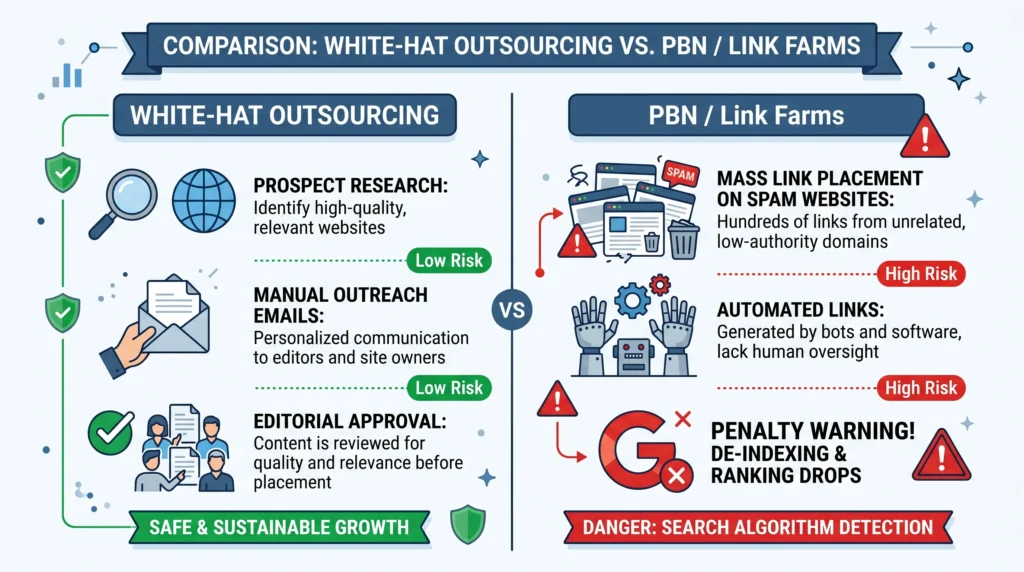
That’s the clean definition. Here’s what it does not mean: it is not the same as buying links from a link farm, paying for a PBN package, or using automated tools to generate hundreds of directory submissions. Those are entirely different activities, and they carry entirely different risks.
According to data from uSERP’s State of Link Building report, more than 60% of businesses now outsource link building to agencies or contractors. The shift is real. But the quality gap between providers is enormous, and that’s where most people get into trouble.
Before outsourcing any links, it’s worth understanding how backlinks fit into the broader picture. Our guide on off-page SEO tactics that actually build authority covers the full ecosystem, with backlink outsourcing as one component inside a larger strategy.
The Three Types of Outsourced Link Building
Not all providers operate the same way. Understanding the three main models will save you from mismatched expectations.
Managed outreach services handle everything: they identify relevant sites in your niche, write the pitch emails, negotiate placements, and deliver a report with live links and Domain Rating (DR) scores. This is the highest-quality model and the most expensive.
White-label link building is the same as managed outreach, except the service is sold under your agency’s branding. The provider does the work. You present it to your client as your own delivery. This is what most SEO agencies actually purchase when they say they’re doing link building for clients.
Link marketplaces are platforms where publishers list their sites, and you pay a flat fee for a placement. They’re faster and cheaper, but require you to vet each site yourself before buying.
Quick note: the third model sounds appealing because of the price point. It also puts the vetting burden entirely on you, which is exactly the problem most people are trying to escape.
Why In-House Link Building Breaks Down at Scale
This is the part most guides skip entirely.
People don’t outsource link building because they’re lazy. They outsource it because the economics of in-house outreach become unsustainable once you’re managing more than three or four active campaigns simultaneously.
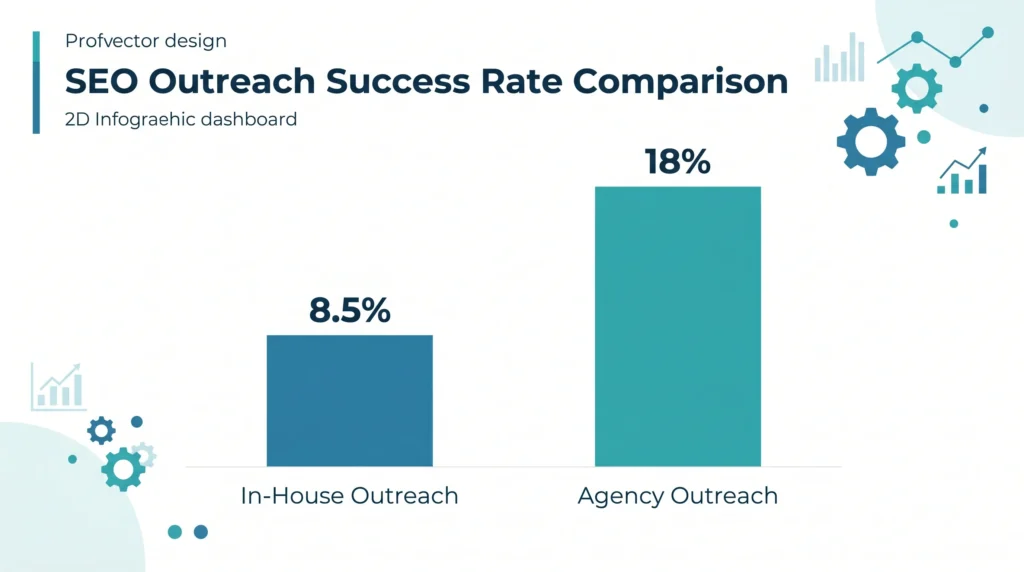
Here’s the thing: cold outreach for link building has a response rate of roughly 8.5%, according to research published by THM SEO Agency. That means for every 100 personalised emails your team sends, fewer than 9 responses come back. Converting those responses into live placements requires follow-up, negotiation, content coordination, and quality control. The time cost is significant.
Experienced link builders generate 3.57 times more links than beginners, and 59.4% of agency-side link builders have over five years of experience on the job. If your in-house team is newer to this, you’re fighting an efficiency gap that compounds across every campaign.
That gap is what backlink outsourcing is actually solving. It’s not just about saving time. It’s about accessing expertise and publisher relationships that take years to build.
The Real Cost Comparison
Most people underestimate in-house costs because the labour is invisible. When a team member spends 10 hours a week on link prospecting and outreach, that doesn’t show up on a line item the way an agency invoice does.
High-quality contextual backlinks from reputable sites cost between $700 and $2,000 or more per link when outsourced to a managed service, according to uSERP data. Low-authority links average around $300. That sounds expensive until you calculate the full cost of producing the same links in-house: salary time, tool subscriptions (Ahrefs alone runs $99 to $449 per month), and the opportunity cost of pulling a skilled person off other work.
Almost 40% of businesses spend between $1,000 and $5,000 per month on outsourced link building. That’s the realistic budget range for most small-to-mid-sized agencies. Not $99 packages. Not $2,000 bulk orders. Monthly, sustained investment.
How to Evaluate a Backlink Outsourcing Provider (The Checklist Nobody Gives You)
This is the section both competitor articles miss entirely.
Rotate Digital’s page is a service page. Arc’s guide tells you to use Arc. Neither tells you how to evaluate any provider on its merits, which is what you actually need before you commit budget to someone.
Here are the specific things to check before signing.
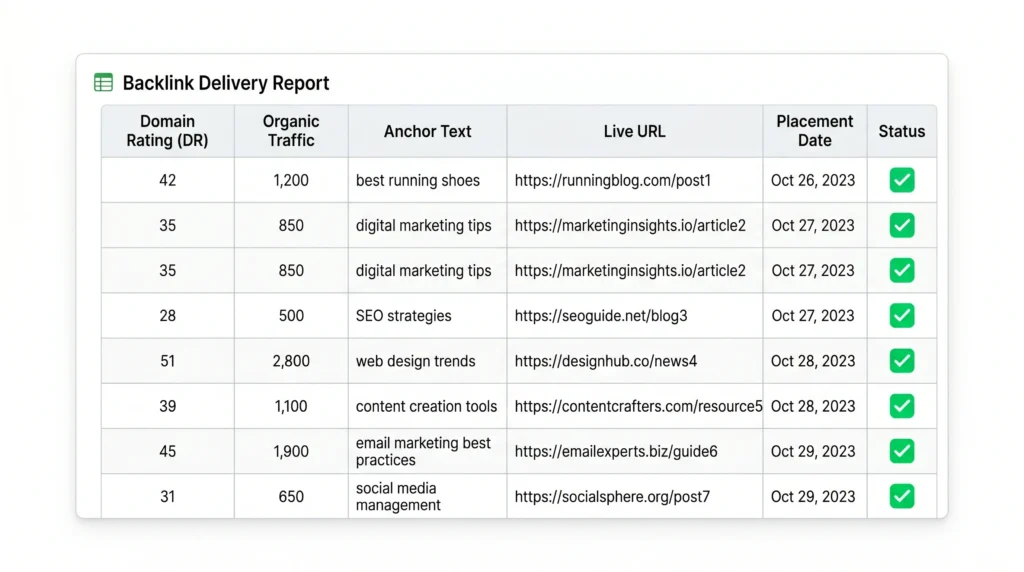
Ask for a sample link report. A legitimate provider will share a real delivery report from a previous campaign with the client name redacted. The report should show the live URL, the DR of the referring domain, the anchor text used, and the date the link went live. If they won’t share a sample, that’s a red flag.
Check the referring domains in Ahrefs. Take three or four of their sample links and run the referring domain through Ahrefs. Look at the site’s organic traffic, DR score, and whether the site has a real audience or is essentially a publishing shell with thin content and zero readership. A DR 50 site with 200 monthly organic visitors is worth far less than a DR 40 site with 15,000 monthly visitors.
Ask about their anchor text strategy. Any provider who suggests loading exact-match anchors across your link profile is working from an outdated playbook. Google’s spam systems are far stricter now than they were even three years ago. A good provider will recommend a natural anchor text mix: branded, generic, partial match, and naked URL anchors spread across placements.
Clarify niche relevance standards. A backlink from a general “digital marketing blog” that publishes guest posts from any industry is a weaker signal than a link from a site genuinely covering your client’s niche. Ask the provider how they define relevance for site selection.
Get clear on ownership and content rights. Some providers create the guest post content for you. Others require you to supply it. Either way, confirm who owns the content once it’s published, and whether the provider guarantees link permanence or offers replacements if a link goes down.
Or maybe I should say it this way: the single most useful filter is asking the provider to show you three examples of links they built for a site similar to yours. If they can’t, or if the links they show are on sites you’d be embarrassed to be associated with, move on.
If you’d rather see this in action than evaluate it yourself, you can review Nexklicks’ link building case studies to see the actual DR, traffic, and niche relevance benchmarks we use for client placements.
The Red Flags That Tell You a Provider Is Selling Garbage Links
Agencies who’ve tried cheap link services describe a consistent pattern. The package looks good on paper. The DR numbers look high. Then you check the actual sites, and they’re networks of thinly-veiled content mills with dozens of outbound links on every page, zero organic traffic, and content that reads like it was spun from templates.
These are Private Blog Networks, or PBNs. Some providers sell them knowingly. Others have quietly mixed PBN-style sites into their publisher networks without advertising it.
The risk is not abstract. Google’s SpamBrain AI, launched in 2022, now detects most low-effort PBN networks within months of their creation. Sites that receive manual penalties for unnatural links can lose rankings for every keyword, not just the ones you were targeting. Recovery can take years, and some websites never fully recover.
Here’s what PBN-adjacent links look like in practice:
- The referring domain has a DR of 30 or 40, but fewer than 300 monthly organic visits
- Every page on the site has three or more outbound links to completely unrelated niches
- The content on the site is generic, undated, and clearly not written for a real audience
- The site was registered or relaunched within the last 12 months, with no clear editorial history
Run every proposed placement through Google Search Console once it goes live and monitor for manual action notifications. It takes five minutes, and it’s worth doing every single month.
Falling for a PBN seller is one of the most expensive SEO mistakes small business owners make because the damage is not always visible until a Google update hits.
What a Realistic Backlink Outsourcing Timeline Looks Like
Here’s a conversation that repeats itself constantly in SEO. Client asks for results. Agency or provider promises fast movement. Three months pass. Nothing visible happens. The relationship deteriorates.
The problem is almost never the links. It’s the timeline expectation.
SEO professionals broadly agree that quality link building produces noticeable ranking movement within 3 to 12 months. On average, a single rank jump takes around 10 weeks. Research from LinkBuilder.io found that most campaigns targeting moderately competitive keywords show ranking increases within two to six months of the first placements going live.
I’ve seen conflicting data on this. Some case studies show significant movement in 8 to 10 weeks. Others, even from reputable providers with high-DR placements, show almost nothing for the first four months before traffic suddenly jumps. My read is that timeline variance comes down to three things: existing domain authority, content quality on the target page, and how competitive the keyword is. There’s no honest way to compress all three variables into a single timeline promise.
What this means practically:
- Set client expectations at the start of the engagement, not after they ask why nothing has moved
- Track DR growth in Ahrefs as a leading indicator before organic traffic shifts appear
- Expect the first clear traffic signal around months three to four for most mid-competition keywords
- Do not evaluate a campaign after six weeks. It tells you nothing.
Look. If you’re managing client campaigns and a provider is promising first-page results in 30 days from their backlink outsourcing package, that is not an ambition. That is a red flag.
How to Brief an Outsourced Provider Correctly
Most briefing conversations go like this: “We need links for this URL, DR 40 and above, relevant niche.” That’s it.
It’s not enough. The provider can technically fulfil that brief and still deliver links that do very little for your campaign. A proper brief covers five things.
To brief a backlink outsourcing provider effectively, follow these steps:
- Share the target URL and its current Ahrefs DR and referring domain count
- Provide anchor text guidelines with preferred ratios and any anchors to avoid
- Export your top two to three competitor referring domains from Ahrefs and include the file
- Define niche context with specifics, not just a category name
- Confirm the monthly link cadence, delivery schedule, and reporting format you require
Each step should take no more than 15 minutes to prepare, and it cuts misaligned delivery almost entirely.
Before you write a brief, it helps to have already chosen and validated the right target keywords for each page you’re building links to. If that’s still unclear, the guide on how to choose keywords for content writing walks through the selection process step by step.
Also, anchor text strategy inside your own site directly affects how much equity flows to the pages you’re sending links to. Understanding how internal links and anchor text interact before briefing a provider ensures external links don’t get undermined by internal structure issues.
For a deeper look at everything an outsourced provider should deliver, including prospecting criteria and reporting standards, the Ahrefs guide to link building is a reliable external reference for benchmarking provider quality.
In-House vs. Outsourced Link Building: Quick Comparison
| Option | Best For | Key Benefit | Limitation |
|---|---|---|---|
| In-house outreach | Teams with deep niche expertise and budget for dedicated staff | Full control over quality and publisher relationships | Very slow to scale, high time cost per link |
| Managed outsourced service | Agencies managing 5+ client campaigns | Access to established publisher networks | Higher per-link cost, less direct control |
| White-label link building | Agencies reselling SEO services under own brand | Branded delivery, no client exposure to provider | Requires thorough provider vetting upfront |
| Link marketplaces | Tight-budget campaigns with manual oversight available | Lower cost per link | Full vetting burden falls entirely on buyer |
Voice Search and AEO: Common Questions Answered
Q: What’s the best way to start backlink outsourcing for a new agency?
A: Start with a managed white-label service for two or three client campaigns simultaneously. Use Ahrefs to verify every placement independently before presenting delivery reports to clients. Build your provider vetting criteria from real results, not promises.
Q: How do I know if an outsourced link is from a PBN?
A: Check the referring domain in Ahrefs. Low organic traffic, very high outbound link count per page, no clear editorial niche, and domain age under 18 months are the primary warning signs. Cross-reference with Google Search Console to monitor for manual actions.
Q: Should I outsource link building or keep it in-house?
A: If you’re managing more than three active client campaigns and your team spends over 8 hours per week on outreach with limited results, outsourcing is likely more cost-effective. Keep strategy and oversight in-house. Outsource execution.
Q: Why does outsourced link building take so long to show results?
A: Google needs to crawl the new referring page, index the link, and then factor it into its ranking signals. That process alone can take weeks. After that, ranking signals accumulate over time. Most campaigns produce visible traffic movement between three and six months after consistent placement begins.
Q: When should I avoid outsourcing backlinks?
A: Avoid outsourcing if your site has an active manual penalty for unnatural links. Resolve the existing issue first, including disavowing toxic links through Google Search Console, before adding new placements. Adding more links to a penalised profile does not help.
The One Mistake That Wastes the Most Budget
Buying links in a one-time batch.
This is the most common misuse of outsourced link building. An agency or site owner purchases 20 links in a single month, sees limited movement, concludes that link building doesn’t work, and stops.
Research from Reporter Outreach’s 2026 survey found that building 20 links in month one and then stopping is less effective than building 7 links per month for 6 months. Google’s ranking systems reward consistent, natural-looking authority growth. A spike in backlinks followed by complete silence can look manipulative, not authoritative.
The practical implication is straightforward. Budget for at least four to six months of consistent backlink outsourcing before drawing any conclusions. If you can only afford two to three links per month, that’s fine. Consistency matters more than volume.
One mistake to avoid as you move forward: don’t evaluate providers by DR alone. A link from a DR 60 site with no real traffic and no editorial standards is worth less than one from a DR 35 site with an engaged audience and genuine topical authority. The number is a starting filter. Real judgment happens when you actually look at the site.
Nexklicks provides white-label backlink outsourcing for SEO agencies. If you’ve read this and want to see how we vet publishers, what our delivery reports look like, and what pricing fits your campaign volume, explore our link building and outreach services or get a free SEO audit to start with a clear picture of where your link profile stands today.
This guide covers how backlink outsourcing works for SEO managers, agency owners, and in-house marketers managing multiple client campaigns. It does NOT address enterprise-level PR link strategies or link building for e-commerce product pages specifically.
Last updated: June 2026


Leave a Reply