
Most founders and strategy leads who search for this already know the theory. TAM, SAM, SOM. Competitive landscape. SWOT. The problem isn’t understanding the terms. The problem is sitting down to actually build one and realising the generic templates online tell you what to do, but nothing about how to do it well enough to convince anyone.
According to Harvard Business Review, over 75% of venture-backed startups fail due to poor market understanding. Not poor products. Poor market understanding. A structured market assessment analysis is what closes that gap between a promising idea and a fundable, executable business case.
Here is how to build one that holds up in a boardroom.
What Is a Market Assessment Analysis?
Market assessment analysis is the structured process of evaluating whether a target market is worth entering, how large the opportunity is, what competitive forces are at play, and what conditions need to be true for a business to succeed there. It combines quantitative sizing with qualitative strategic insight, producing a decision-ready output rather than just a data dump.
Or maybe I should say it this way: it is not a research report. It is an argument, backed by data, that a specific opportunity exists and that your business is positioned to capture it.
A market assessment differs from a market analysis in one important way. Market analysis is typically backward-looking, describing what a market looks like today. Market assessment is forward-looking, asking whether this market is right for you, right now, given your resources, timing, and competitive position.
Why Standard Templates Fail, and What to Do Instead
Look, if you’ve already downloaded a market analysis template from a business school website or a strategy blog, you’ve probably noticed the same thing: it’s a series of boxes to fill in. Industry size. Key players. Customer segments. You fill them in, and what you get back is a document that looks complete but convinces nobody.
The reason is structural. Most templates treat each section as independent. Market size goes in one box. Competitive landscape goes in another direction. But investors and senior decision-makers aren’t reading boxes in isolation. They’re looking for a coherent story: here is the opportunity, here is why it’s real, here is why it’s winnable, here is what could go wrong.
What most guides skip is the synthesis layer. Raw data isn’t insight. The value of a market assessment comes from what you conclude, not what you find.
Before you build your assessment, it’s worth understanding which keywords your target customers actually use when they search for your category. Getting that right early shapes everything from your market boundary definition to your TAM calculation. The Nexklicks guide on choosing the right keywords for content writing covers a practical approach to this that translates directly into market research inputs.
Three common mistakes at this stage:
- Citing the total addressable market without explaining what fraction is actually reachable given your distribution model and budget
- Listing competitors without explaining how customer switching behaviour actually works in the category
- Treating market size as static when the most interesting markets are in transition
Step-by-Step: How to Conduct a Market Assessment Analysis
To conduct a market assessment analysis, follow these steps:
- Define your market boundaries precisely
- Size the opportunity using TAM, SAM, and SOM
- Profile the customer with behavioural depth, not just demographics
- Map the competitive landscape and identify structural gaps
- Assess market conditions and entry timing
- Synthesise findings into a strategic recommendation
Each step is detailed below.
Step 1: Define Your Market Boundaries
This is where most assessments quietly go wrong.
Defining your market too broadly inflates opportunity and makes sizing meaningless. Defining it too narrowly misses adjacent threats and opportunities. The right boundary is the set of customers who have the problem you solve AND who could realistically become your customers within your planning horizon.
A practical rule: if you cannot name the top five competitors fighting for the same customer with a similar solution, you’ve probably defined your market too broadly.
Action: Write one sentence that defines your market. Include: the customer profile, the problem being solved, and the delivery mechanism. If that sentence has more than 30 words, refine it.
Step 2: Size the Market Using TAM, SAM, and SOM
Market sizing is not about finding the biggest number. It is about finding the credible number.
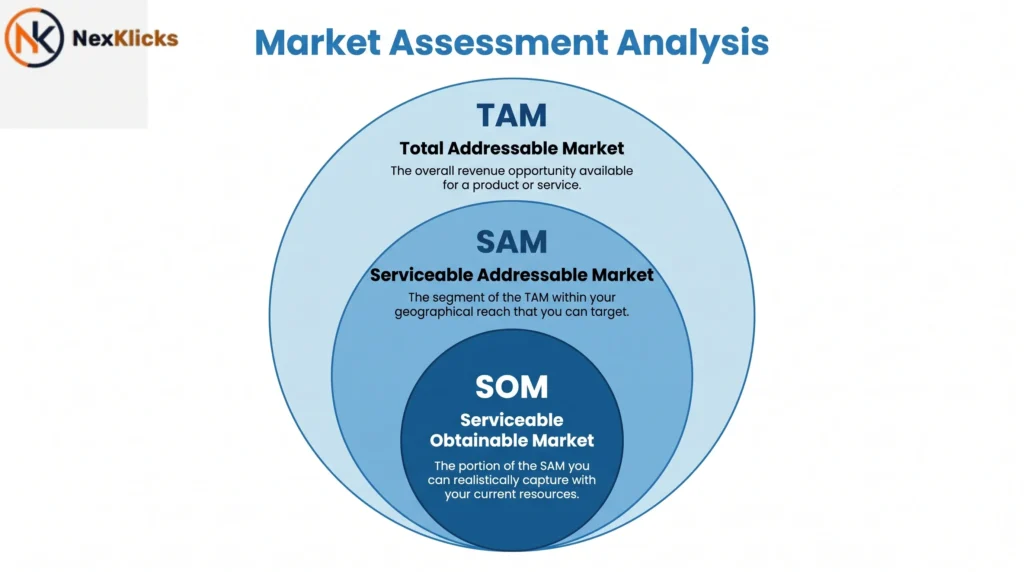
TAM (Total Addressable Market): The full global or national revenue opportunity if you captured 100% of the relevant market. Use Statista or IBISWorld to pull sector-level figures. Cite the source and year.
SAM (Serviceable Addressable Market): The portion of TAM you can realistically reach given your geography, distribution model, and product scope. This is where most teams get sloppy. If your product only works for B2B companies with over 50 employees in English-speaking markets, say that.
SOM (Serviceable Obtainable Market): What you can actually capture in years one to three, given your resources, sales capacity, and competitive position. This is the number investors actually interrogate.
One insight that surprises most people doing this for the first time: a smaller, faster-growing SAM is usually more attractive than a larger, stagnant TAM. A $500M market growing at 22% annually is a better investment case than a $5B market growing at 2%.
I’ve seen conflicting guidance on whether to use top-down or bottom-up sizing. Some frameworks insist on top-down first. My read is this: use both, and if they produce materially different results, that gap itself is worth examining. It usually means your market boundary definition needs tightening.
Step 3: Build a Behavioural Customer Profile
Demographics alone are a starting point, not a profile. Knowing your target customer is “35-50 year old male professionals in the US” tells you almost nothing about how they make purchasing decisions, what triggers action, and what prevents switching.
What to build instead:
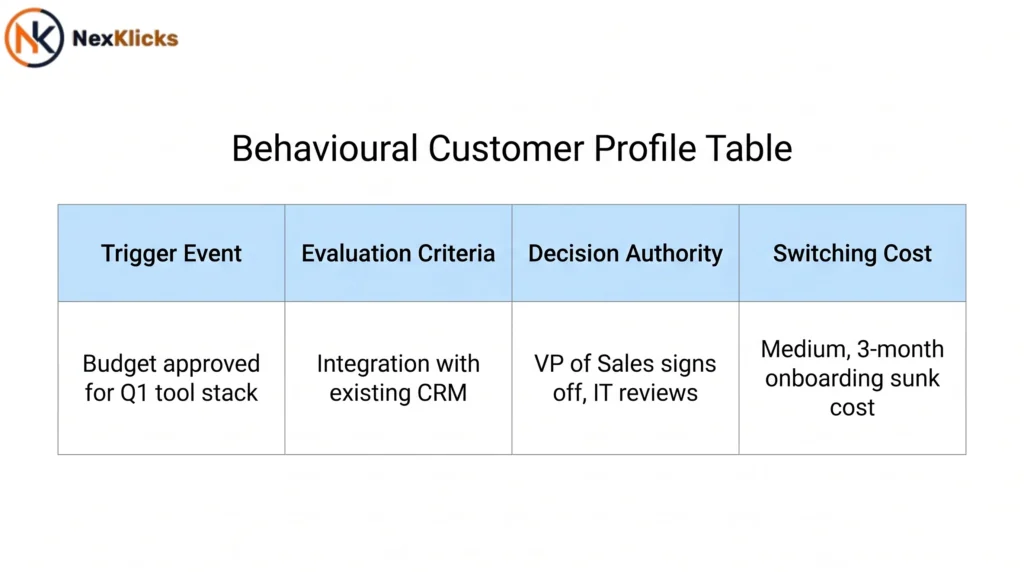
- Buying triggers: what specific event causes someone to start looking for a solution?
- Evaluation criteria: what do they compare, and in what order?
- Switching costs: what would they have to give up to choose you?
- Decision authority: who signs off, who influences, who blocks?
Users who’ve run focus groups or customer interviews before this stage consistently report that the behavioural layer changes their product roadmap. Not the demographics. The behaviour.
Quick note: if you don’t yet have customers to interview, use SEMrush Market Explorer’s audience analysis features to surface intent signals from search behaviour. It won’t replace primary research, but it closes the gap.
Step 4: Map the Competitive Landscape
This section has a structural problem in almost every market assessment I’ve reviewed. Companies list competitors and their features. That is not competitive analysis. That is a product comparison sheet.
Real competitive landscape mapping asks:
What jobs are customers hiring solutions to do, and how well does each competitor do that job?
A competitor is not just a company in the same category. It is any alternative the customer might choose, including doing nothing, building internally, or using a workaround.
The framework that works:
| Competitor | Customer Job Targeted | Core Differentiator | Structural Weakness | Switching Cost |
|---|---|---|---|---|
| Direct Competitor A | [job] | [differentiator] | [weakness] | High / Medium / Low |
| Direct Competitor B | [job] | [differentiator] | [weakness] | High / Medium / Low |
| Indirect Alternative | [job] | [differentiator] | [weakness] | High / Medium / Low |
| Status Quo / Do Nothing | [job] | Familiarity, zero cost | No ROI improvement | Very High |
Tools like Crayon and Similarweb have materially changed how fast you can populate this table. Crayon tracks competitor positioning changes, pricing page updates, and messaging shifts in near real-time. Similarweb gives you traffic share, audience overlap, and channel breakdown without needing insider access to anyone’s analytics dashboard.
One underused technique here is mapping a competitor’s full topical footprint, not just their product pages. Understanding what content they rank for tells you a great deal about how they position themselves and where they ignore customer questions. The Nexklicks guide on how to get a topical map of a competitor’s SEO shows exactly how to do this.
Some strategists argue that competitive mapping should come before customer profiling, on the basis that competitors already reveal who the customer is. That’s valid for mature markets where competition is well-established. But if you’re entering an emerging or fragmented category, customer profiling first gives you a cleaner lens for evaluating which competitors are actually relevant.
Step 5: Assess Market Conditions and Entry Timing
Opportunity size and competitive position tell you the what. Market conditions tell you the when.
Five conditions worth assessing:
- Regulatory environment. Is the market subject to incoming regulation that could constrain entry or, alternatively, create demand? (GDPR created an entirely new market for compliance tooling.)
- Technology readiness. Does the infrastructure exist for your solution to work at scale, or are you waiting on upstream adoption?
- Macroeconomic tailwinds or headwinds. Is the category growing because of broader economic trends, or despite them?
- Customer readiness. Are buyers educated enough to evaluate your solution without an extensive sales education cycle?
- Supply chain and talent availability. Can you actually build and deliver at the pace the market requires?
That changes everything. A perfect market at the wrong moment is just an expensive lesson.
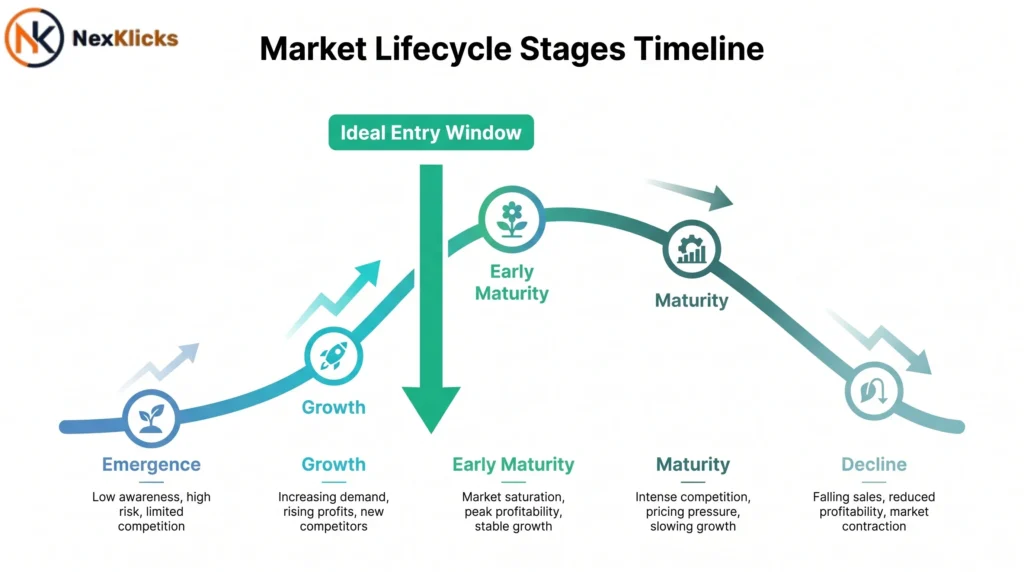
Entry timing matters as much as entry strategy. Being too early is expensive. Being too late means fighting for a share in a crowded market with entrenched players. The window you’re looking for is a market that’s past the “education phase” but before it consolidates around two or three dominant players.
Step 6: Synthesise Into a Strategic Recommendation
This is the section that most assessments either rush through or skip entirely. It’s also the section that determines whether your document gets acted on.
A synthesis is not a summary. A summary restates what was found. A synthesis draws a conclusion and defends it.
Structure your synthesis around three questions:
- Is this market worth entering? (Based on size, growth, and structural attractiveness.)
- Can we win here? (Based on competitive position, differentiation, and resource requirements.)
- When and how should we enter? (Based on timing, market conditions, and sequencing.)
Each answer should be a direct statement, not a “it depends.” If the answer genuinely depends on a variable, name the variable and state what outcome would change your recommendation.
How to present your market assessment analysis to investors or boards:
Most guides stop at building the assessment. They skip the presentation layer entirely. Here is what experienced investors actually want to see, in order:
- The one-line market definition and why it’s bounded correctly
- The SOM with the assumptions laid out explicitly, not buried in an appendix
- The single most dangerous competitive threat and why you can survive it
- The conditions that would make this market not worth entering, showing you’ve stress-tested your own thesis
Showing the bear case proactively is counterintuitive. It also builds more credibility than any amount of optimistic projections.
If your assessment is feeding into a broader digital growth plan, the Nexklicks search engine marketing intelligence framework is a strong companion resource. It covers how to translate market data into paid and organic search strategies, which is typically the next decision after an entry recommendation is approved.
Quick Comparison: Market Assessment vs. Related Frameworks
| Framework | Best For | Key Benefit | Limitation |
|---|---|---|---|
| Market Assessment Analysis | Entry decisions, investor pitching | Combines sizing, competition, and timing in one output | Requires primary and secondary research investment |
| Market Analysis | Understanding current market conditions | Fast to produce, widely understood | Backward-looking, no strategic recommendation |
| SWOT Analysis | Internal strategy sessions | Simple, collaborative | Too internally focused, ignores market dynamics |
| Porter’s Five Forces | Structural industry attractiveness | Rigorous competitive framing | Doesn’t address market sizing or timing |
| Jobs-to-Be-Done Research | Product development, positioning | Deep customer insight | Not suited for top-level market opportunity assessment |
Market assessment analysis vs. market analysis: Market assessment is better suited for go/no-go entry decisions because it includes a forward-looking strategic recommendation. Market analysis works better when you need to understand current conditions quickly without requiring a full investment recommendation.
Tools That Make This Faster Without Making It Worse
Three tools that legitimately accelerate the process without hollowing out the rigour:
Statista is the fastest way to pull cited, sourced market size figures across nearly every industry vertical. Use it for TAM figures and to find supporting statistics for your narrative. Always note the publication year; market data ages quickly.
IBISWorld provides sector-level reports with five-year forecasts, competitive concentration data, and cost structure breakdowns. It’s not cheap, but for formal investor documents, it’s the most defensible source for industry-level claims.
SEMrush Market Explorer gives you traffic share by competitor, audience demographics, and keyword intent data. It won’t replace qualitative research, but for quickly understanding how much organic demand exists and who is capturing it, it’s faster than any manual research process.
One caveat: tools surface data. They don’t do the thinking. The competitive insight, the synthesis, and the strategic recommendation, those still require a human who understands the business context.
Once your market entry strategy is approved and execution begins, the content and SEO layer becomes critical. A technical SEO audit ensures the digital infrastructure behind your market entry is built to capture the organic demand your assessment identified.
Voice Search and Direct Answer Section
Q: What’s the best way to start a market assessment analysis?
A: Start by defining your market boundary precisely in one sentence, naming the customer, the problem, and the delivery mechanism. Then size TAM, SAM, and SOM separately using industry databases like Statista or IBISWorld before any competitive research.
Q: How do I find reliable market size data?
A: Use Statista for cross-industry figures, IBISWorld for sector-level depth, and government trade databases for regulated industries. Always cite the year. Market data older than three years should be treated as directional only.
Q: Should I conduct primary or secondary research first?
A: Secondary research first. It gives you a baseline to test with primary research, prevents you from asking customers questions you could answer with publicly available data, and makes your interviews more focused and productive.
Q: How long should a market assessment take?
A: A credible assessment for a single market entry decision typically takes two to four weeks, depending on data availability and whether primary research is included. Rushing it below one week usually produces a document that survives the first serious question in a meeting.
Q: When is a market assessment not worth doing?
A: When the business is already operating in the market, and the question is optimisation rather than entry. At that point, customer research and performance analytics provide more actionable insight than a market assessment framework.
The One Mistake That Kills Otherwise Good Assessments
Treating the assessment as the deliverable instead of the decision as the deliverable.
A market assessment exists to answer one question: should we enter this market, and if so, how and when? Every section should serve that question. If a section doesn’t move you closer to that answer, it’s padding.
The documents that get acted on are the ones that end with a clear recommendation, explicit assumptions, and defined conditions under which the recommendation would change. The documents that get filed are the ones that present eighteen pages of research and then say, “The market presents both opportunities and challenges.”
Pick a side. Defend it. That’s what the work is for.
Conclusion
A market assessment analysis is not a research exercise. It is a decision-making tool. The steps are straightforward: define the market, size it honestly, profile the customer behaviourally, map competition with structural rigour, assess timing, and synthesise into a defensible recommendation.
The one mistake to avoid on your way out: don’t let the document grow to fill the time you have. The best assessments are tight, specific, and opinionated. They make a claim and back it up.
Your next step is to define your market boundary in one sentence. If you can’t do that clearly, everything downstream will drift.
This guide covers market entry assessment for commercial strategy and investment contexts. It does NOT address public sector procurement assessments, environmental market assessments, or financial market assessments, which follow separate regulatory frameworks.
Last updated: July 2026

Leave a Reply