
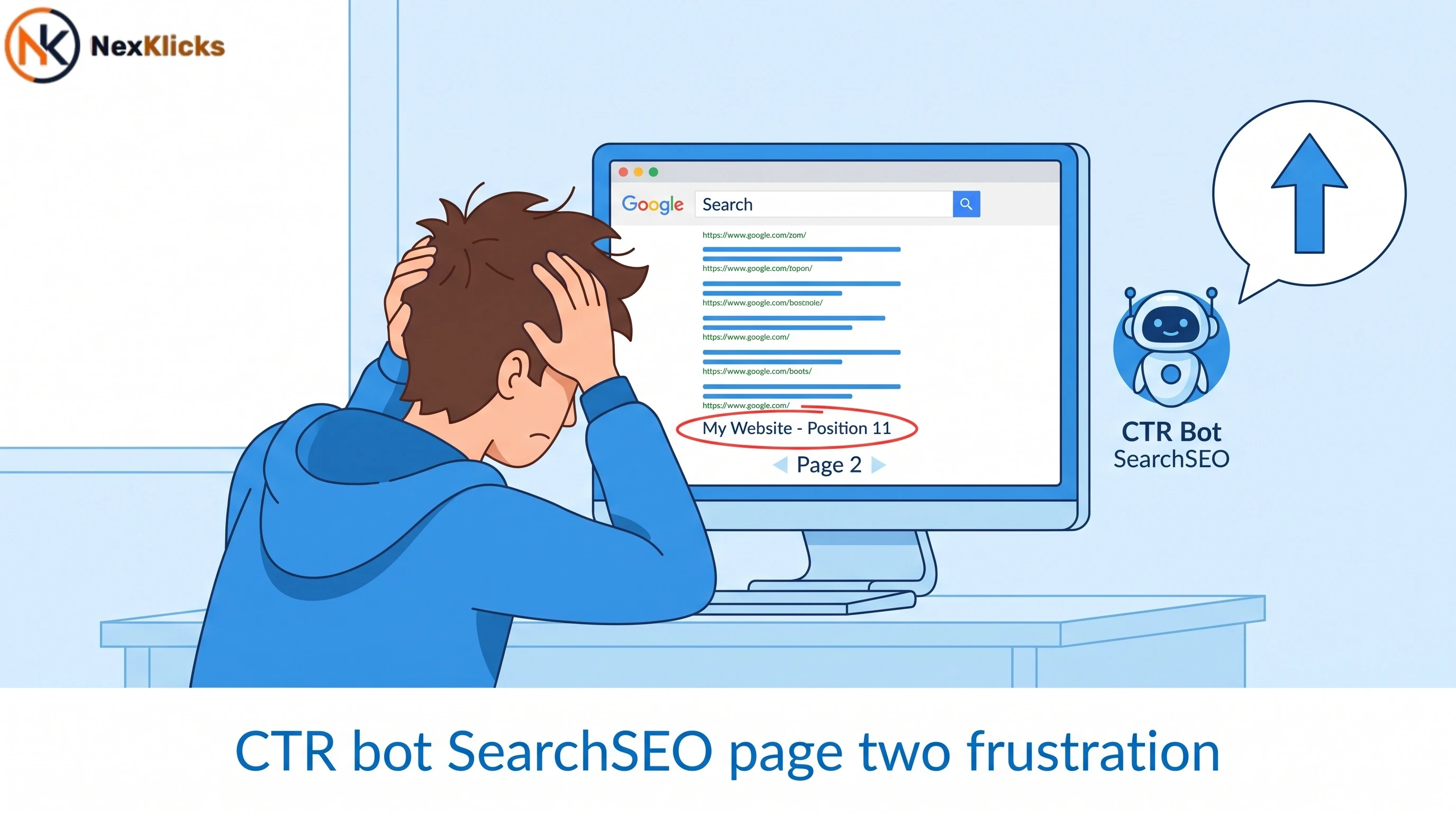
You have probably tried everything. You optimized your pages. You built backlinks. But your site is still stuck on page two. Now you have heard about a CTR bot SearchSEO tool that promises to fix that by sending fake clicks from Google. Sounds interesting. But is it actually safe? Does it even work?
In this guide, you will learn exactly what SearchSEO does, how click-through rate optimization works as an organic search signal, what the real risks are, and whether this tool is worth your money. No fluff. Just the full picture.
A CTR bot SearchSEO tool is a click-through rate simulator that sends automated search traffic to your website from Google. It mimics real user behavior by searching your target keyword, finding your page, and clicking on it. The goal is to send stronger engagement signals to Google to improve your organic rankings.
How the SEO Community Discovered CTR as a Potential Ranking Lever
The idea that Google watches how users interact with search results is not new. According to research published by Rand Fishkin via SparkToro, click-through rate is considered a significant behavioral signal that can influence Google search rankings. Google’s systems are known to monitor user engagement patterns on SERPs.
That discovery sparked real interest in tools that could simulate those signals artificially.
Why Brands and Freelancers Are Actively Searching for CTR Manipulation Tools
Most SEOs who search for a CTR bot for SEO are not looking for shortcuts out of laziness. They have optimized the work. They have optimized their pages and built links. But the rankings still sit on page two. At that point, organic CTR improvement tools start to look attractive.
What This Guide Will and Won’t Tell You
This guide explains exactly how CTR bot SearchSEO works, what it costs, what the real risks are, and how it compares to alternatives. It does not promise results. It gives you the full picture so you can decide for yourself.
What is CTR Manipulation?
CTR manipulation is the practice of artificially increasing the click-through rate of a webpage in Google search results. According to Rand Fishkin’s widely cited research, Google treats user engagement signals like clicks, dwell time, and bounce rate as potential ranking inputs.
This means sending more simulated clicks to a page could, in theory, tell Google that users find it more relevant than competing pages.
Defining Click-Through Rate in the Context of Google Search Rankings
Click-through rate is the percentage of users who see your page in search results and actually click on it. If 100 people see your listing and 5 click, your CTR is 5 percent. Google tracks this number through Chrome, Google Search Console, and its own search infrastructure.
How Click-Through Rate Affects Google Rankings
Higher CTR signals relevance. When users consistently pick your result over others, Google takes notice. This is the core logic behind CTR manipulation software. If the signal is real enough, the ranking should follow.
The problem is that not all signals are created equal. Organic clicks from real users carry more weight than simulated ones.
The Gray Area: Why CTR Manipulation Sits Between White Hat and Black Hat SEO
This is not a clean-cut black hat SEO practice. Most practitioners call it gray hat, somewhere between fully safe and clearly forbidden. Nobody is hacking Google’s servers here. The issue is that you are still trying to game a signal Google designed to be entirely organic.
Real-World Examples of CTR Manipulation and What Outcomes Were Reported
SEO communities like Reddit and BlackHatWorld have shared mixed results. Some users report temporary ranking lifts of several positions within a few weeks. Others report no measurable change. A smaller group reports ranking drops, likely due to detection. No tool guarantees success.
What is SearchSEO?
SearchSEO is an online platform that provides an organic traffic bot and CTR simulation services. According to its positioning, it sends automated clicks to your website through real or proxy-based browser sessions that mimic genuine search behavior.
The platform targets your chosen keywords, finds your page in Google results, clicks through, and spends time on the page before leaving. The goal is to improve your keyword ranking improvement signals over time.
SearchSEO at a Glance: Platform Overview for First-Time Users
SearchSEO is a web-based search traffic simulator built for SEOs who want to influence their organic rankings through behavioral signals. You set a target keyword, a target URL, and campaign parameters. The platform handles the rest.
The Core Technology Behind SearchSEO’s Click Simulation System
SearchSEO uses a network of browsers or proxies to perform searches, find your page, and simulate a visit. The session includes dwell time on-page to make it look like a real user read your content.
Is SearchSEO a Legitimate Business Tool or a Black Hat SEO Service?
SearchSEO operates in a legal gray zone. The company offers a paid service that marketers choose to use at their own risk. It does not claim to guarantee rankings, and its terms typically place responsibility on the user.
How SearchSEO Positions Itself in the U.S. SEO Software Market
SearchSEO targets SEO consultants, small business owners, and digital agencies in the U.S. and globally. It competes with other CTR manipulation tools like SerpClix by offering a more automated approach with less manual setup.
What is the Difference Between a Traffic Bot and a CTR Bot?
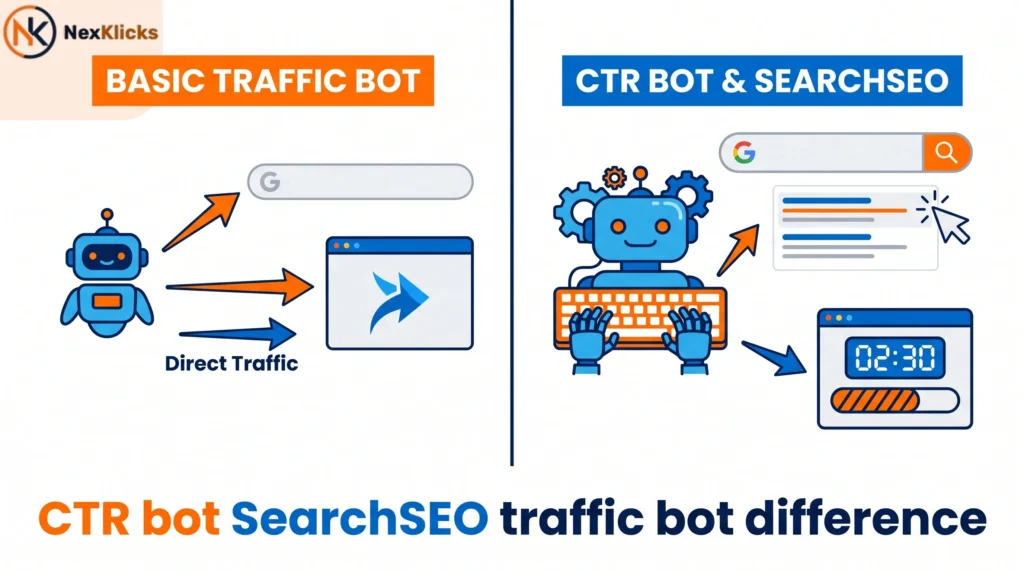
A traffic bot sends visitors to your website directly, bypassing Google entirely. A CTR bot goes through the full search process: it searches your keyword on Google, finds your listing in the results, and clicks on it.
According to SEO practitioners, only the CTR bot method generates the kind of SERP click simulation signals that could influence organic rankings, because Google only registers the engagement when the click comes from its own search results page.
What a Basic Traffic Bot Does
A basic fake traffic bot inflates your session numbers in Google Analytics or similar tools. It does not interact with Google Search at all. This kind of bot boosts vanity metrics but has no known impact on organic rankings.
How CTR Bots Specifically Target Google Search Result Interactions
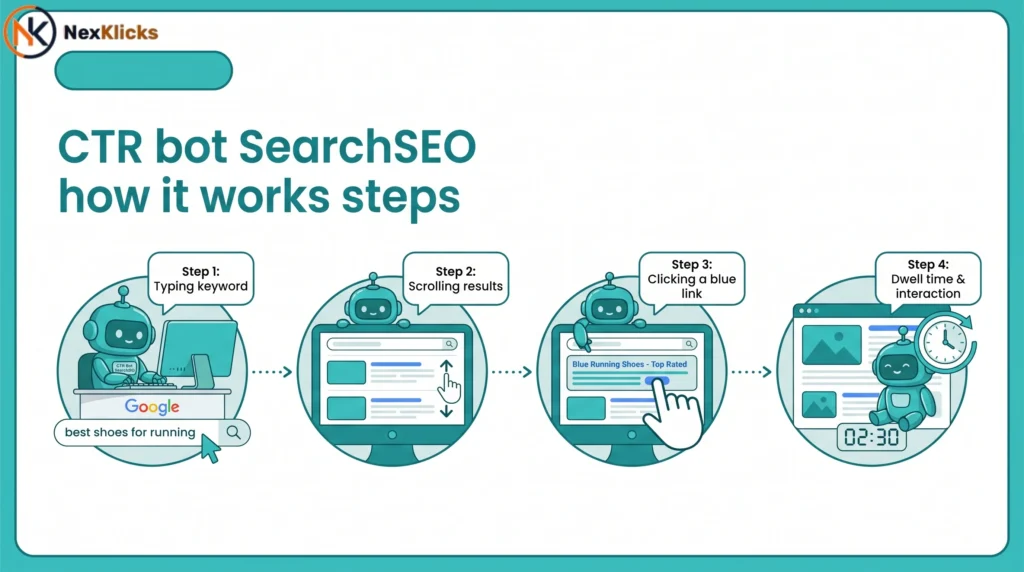
A search engine traffic bot like SearchSEO performs the actual search on Google, scrolls through the results, clicks your listing, and stays on your page for a set amount of time. This sends organic traffic signals that Google can theoretically read as genuine user interest.
Why Using the Wrong Tool Can Hurt Rankings Instead of Helping Them
Using a basic traffic bot when you want CTR improvements is a waste of money at best. At worst, it can create suspicious traffic patterns that attract attention without providing any ranking benefit.
Practical Side-by-Side: Traffic Bot Behavior vs. CTR Bot Behavior on a SERP
| Feature | Traffic Bot | CTR Bot |
|---|---|---|
| Searches Google | No | Yes |
| Clicks from SERP | No | Yes |
| Simulates dwell time | No | Yes |
| Affects Search Console data | No | Potentially yes |
| Ranking signal potential | None | Possible |
How CTR Manipulation Works in SEO
Step-by-Step: What Happens From Keyword Search to Simulated Click to Dwell Time
To run a CTR bot SearchSEO campaign, follow these steps:
- Sign up for SearchSEO and create a new campaign.
- Enter your target keyword and your page URL.
- Set your geo-targeting location, device type, and daily click volume.
- Launch the campaign and monitor Google Search Console for CTR changes.
- Adjust session depth and dwell time settings based on early data.
The Role of Bounce Rate and Dwell Time Signals in Google’s Ranking Algorithm
Dwell time signals refer to how long a visitor stays on your page after clicking from Google. Bounce rate manipulation involves making sure the simulated visitor does not immediately leave. SearchSEO attempts to control both, instructing its sessions to scroll and stay for a set duration.
How SearchSEO Builds Realistic User Sessions to Avoid Detection
SearchSEO routes traffic through different IP addresses and browser profiles to reduce fingerprinting. Sessions vary in length and behavior to avoid repeating identical patterns that Google might flag.
How to Read Your Google Search Console Data to See If CTR Manipulation Is Working
Open Google Search Console and go to the Search Results report. Filter by your target keyword. Look for an increase in the impressions-to-click ratio over the campaign period. If CTR rises but rankings do not follow within four to six weeks, the signal may not be strong enough, or Google may have discounted it.
If you’re unsure how to interpret the numbers, this guide on Google Search Console clicks vs sessions can help. It explains what each metric means and how they relate to each other.
Services Provided by SearchSEO
SearchSEO’s Core Service: Organic Search Traffic Simulation
The primary offering is an organic search traffic simulation. You pay for a set number of clicks per day or month, and SearchSEO delivers them through its network.
Advanced Targeting Options: Keywords, Locations, Devices, and Session Depth
SearchSEO allows geo-targeting by country or region, which is important for U.S.-focused campaigns. You can also choose between desktop and mobile sessions and set how deeply the simulated visitor browses your page.
Reporting and Analytics: What SearchSEO Shows You After Campaigns Run
Campaigns include basic reporting dashboards. You can see how many clicks were delivered and compare that against your Google Search Console data independently.
Customer Support and Onboarding for New U.S. Users
SearchSEO offers email and ticket-based support. Onboarding is mostly self-serve through documentation and FAQs.
Benefits of SearchSEO
The Speed Advantage: Getting Ranking Signals Without Waiting for Links
Link building takes months. A CTR manipulation strategy can send signals within days of launching a campaign. For competitive niches where link velocity is slow, that speed difference is meaningful.
Campaign Flexibility That Lets You Test One Keyword at a Time
You can isolate a single keyword and test whether CTR volume affects its ranking. This makes SearchSEO useful as an experimentation tool, not just a bulk tactic.
Budget-Friendly Entry Point Compared to Full-Scale SEO Campaigns
Compared to hiring a link building agency or running paid ads, SearchSEO’s entry-level pricing is lower. This makes it accessible to freelancers and small business owners.
Use Case Scenarios Where SearchSEO Delivers the Most Practical Value
SearchSEO is most useful for pages sitting between positions 8 and 15, where a small CTR boost might push them to page one. It is less effective for brand new pages with no existing rankings.
The Downsides of SearchSEO
The Google Detection Risk: How Algorithms Identify Unnatural Click Patterns
Google uses machine learning to identify patterns in search behavior automation. If clicks come from the same IP ranges, follow identical session patterns, or spike unnaturally for a keyword with low search volume, Google can discount or penalize the signal. This is the single biggest risk of using any organic traffic bot.
No Guarantee of Rankings: What SearchSEO’s Own Terms Say About Results
SearchSEO does not guarantee rankings. Its terms of service place all risk on the user. If Google penalizes your site, SearchSEO is not responsible.
The Ethical Concern: How CTR Manipulation Affects the Broader Search Ecosystem
Search engine manipulation shifts results away from the most genuinely useful pages. While one site benefits, users searching that keyword may get a less relevant result. This is why Google actively works to detect and discount artificial signals.
Dependency vs. Strategy: Why CTR Bots Rarely Work as a Standalone Tactic
If you stop running campaigns, rankings that depended on artificial CTR often drift back. Bot-generated traffic is not a strategy by itself. It works best as a short-term lift while you build real authority through content and links.
Building real authority through content and links remains the most reliable long-term strategy. If you are unsure where to start, reviewing proven off-page SEO tactics can help you build a foundation that doesn’t depend on artificial signals.
Reported Negative Experiences From the SEO Community Worth Knowing
Some users in SEO forums have reported ranking drops after running CTR campaigns aggressively. The most common pattern is a short gain followed by a correction, suggesting Google detected and reversed the signal.
SearchSEO Pricing Plans
SearchSEO Pricing Tiers Broken Down
SearchSEO offers multiple pricing tiers based on monthly click volume. Entry plans cover a smaller number of daily clicks, while higher tiers support larger campaigns across multiple keywords.
Note: Exact pricing should be verified directly on SearchSEO’s website, as plans change regularly.
What Each Pricing Plan Realistically Gets You in Terms of Click Volume
Lower-tier plans are suitable for testing one or two keywords. Mid-tier plans work for small agencies managing a handful of client campaigns. Premium plans offer higher daily click volumes and broader targeting options.
How to Calculate Whether SearchSEO’s Cost Makes Sense for Your SEO Budget
Compare the monthly cost of SearchSEO against what a ranking improvement would earn you in organic traffic value. If moving from position 11 to position 5 for your keyword would bring in an extra 200 monthly visitors worth two dollars each in ad value, the math may work in your favor.
Refund Policy and Commitment Terms: What to Check Before Buying
Review SearchSEO’s refund and cancellation terms carefully before subscribing. Some CTR tool subscriptions auto-renew. Check whether unused click credits carry over between months.
SearchSEO vs. Alternative CTR Manipulation Tools
SearchSEO vs. SerpClix: SearchSEO is better suited for users who want full automation because it handles click delivery without manual setup. SerpClix works better when you want real human clickers completing the search sessions, which may produce more convincing signals. The key difference is automation vs. human execution.
Quick Comparison
| Tool | Best For | Key Benefit | Limitation |
|---|---|---|---|
| SearchSEO | Automated CTR campaigns | Hands-off delivery | Bot traffic, detection risk |
| SerpClix | Human-powered clicks | More realistic sessions | Slower, higher cost per click |
| Microworkers | DIY CTR experiments | Full control | Time-intensive, inconsistent |
SerpClix operates on a real human clicker model, which means actual people complete the search sessions rather than automated browser scripts.
Evaluating CTR Tools on Three Criteria: Safety, Scalability, and Results
Safety is lowest with fully automated bots. Scalability is highest with platforms like SearchSEO. Results vary across all options and are never guaranteed.
Which CTR Manipulation Tool Makes the Most Sense for a U.S. SEO Campaign?
For a U.S.-focused campaign, geo-targeting accuracy matters most. SearchSEO supports U.S. traffic targeting. SerpClix also allows location filtering. Choose based on your budget and risk tolerance, not on which tool promises the most.
How to Use a CTR Bot Responsibly, If You Choose to Proceed
Setting Realistic Expectations Before Launching a CTR Campaign
A CTR campaign is not a ranking guarantee. Treat it as a signal test. Set a fixed budget, run for 30 days, and measure results in Google Search Console before committing further.
If you are still weighing whether to proceed, reading more about how CTR bot SearchSEO tools fit into a broader SEO strategy can help you set more realistic campaign expectations before spending a dollar.
Which Types of Sites and Keywords Are Lower Risk for CTR Experimentation
Low-competition, long-tail keywords carry less risk. New or unestablished domains have less to lose than established sites with existing rankings and revenue.
How to Monitor Google Search Console During a CTR Bot Campaign
Check your Search Results data weekly. Watch for CTR changes on your target keyword. Also, watch for any manual action notifications in the Coverage or Security reports. If Google flags anything, pause the campaign immediately.
Exit Strategy: How to Wean Off CTR Bots While Preserving Rankings
Do not stop campaigns abruptly. Reduce click volume gradually over four to six weeks while increasing your content publishing and link building activity. This gives real organic signals time to pick up where the artificial ones leave off.
Interesting Facts About CTR
Position-by-Position CTR Benchmarks on Google in 2026
Position one on Google typically receives between 25 and 35 percent of all clicks for a given keyword. The second spot drops to around 15 percent, and by the tenth result, average CTR falls below two percent. These benchmarks vary by keyword type and SERP features.
How Rich Snippets, Schema Markup, and Featured Snippets Influence CTR Organically
Adding schema markup to your pages can generate rich results, which visibly stand out in the SERP and can increase CTR without any manipulation. This is a safer and more sustainable alternative to using a Google CTR bot.
The Relationship Between Brand Searches, CTR, and Domain Authority Growth
Sites that attract more branded searches tend to see higher CTR across all their keywords. Building brand recognition directly improves the organic CTR signals Google measures, without any artificial help.
What Rand Fishkin’s CTR Experiments Revealed About Google’s Sensitivity to Clicks
Fishkin’s experiments showed that coordinated clicks from real people could move rankings. But the effect was often temporary. This suggests Google weighs click quality and consistency over raw volume.
The Legal and Terms of Service Angle: What SearchSEO Users in the U.S. Need to Know
Does Using SearchSEO Violate Google’s Webmaster Guidelines?
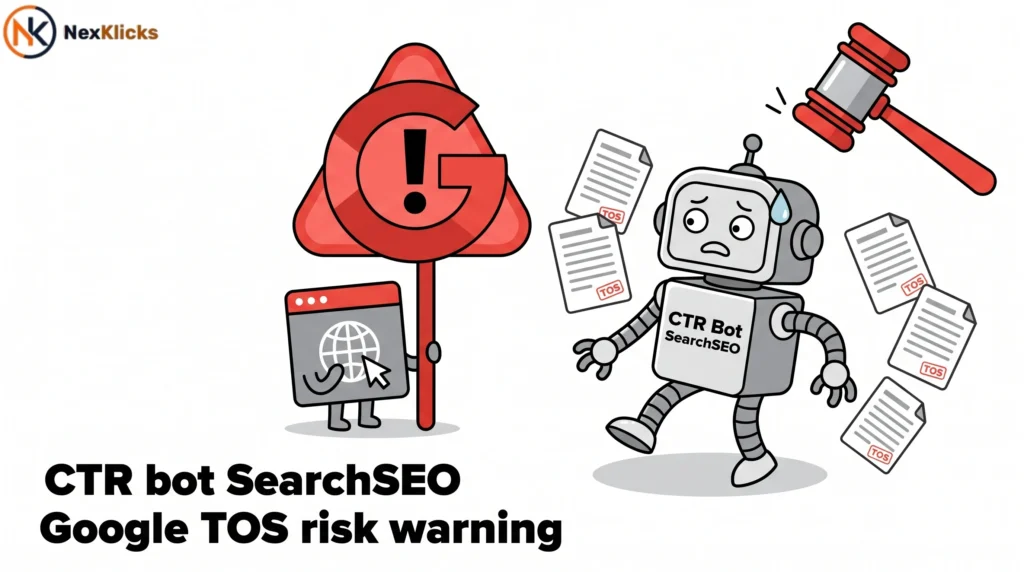
Yes. Google’s guidelines explicitly prohibit manipulating search signals, including click behavior. Using a CTR manipulation tool violates these guidelines, which means Google can demote or deindex your site if it detects the behavior.
What Happens to Your Google Ads Account If Your Site Gets Flagged for Manipulation?
Google Ads accounts linked to a site that receives a manual action can be reviewed and suspended. If you run paid search campaigns alongside a CTR bot strategy, a penalty could disrupt your entire marketing operation, not just your organic rankings.
Business Risk Assessment: Who Should Never Use a CTR Monitor Search ConsoleBot Under Any Circumstance
Do not use a CTR bot if your business depends on a single domain for revenue. E-commerce stores where a ranking drop would immediately hurt sales are also a very poor fit. Sites that have already received a Google manual action in the past face the highest risk of all. The stakes are simply too high to gamble.
If you are a small business owner managing your own SEO, understanding the broader SEO mistakes small business owners make can help you avoid tactics that carry far more risk than reward.
Summary
Key Takeaways From This SearchSEO CTR Bot Review
CTR bot SearchSEO is a real tool used by real SEOs. The platform works by simulating organic search behavior to send engagement signals to Google. There is no guaranteed ranking outcome here, and the approach sits firmly in gray hat territory with genuine risk attached, especially for established websites.
The Bottom Line: Is SearchSEO Worth It for U.S. SEOs in 2026?
For most U.S. SEOs, the risk-to-reward ratio is unfavorable. There are safer ways to improve CTR, including better title tags, schema markup, and brand building. If you choose to experiment with SearchSEO, do it on a low-stakes page, with a limited budget, and with Google Search Console open the entire time.
What to Do Next, Whether You Use SearchSEO or Not
If you want to improve your organic CTR booster results without risk, start with your meta titles and descriptions. Small wording changes can lift CTR by two to three percent. That is a real signal, with no penalty risk attached. You can also explore CTR bot SearchSEO options further through direct research on the platform’s official site to verify current pricing and features before committing.
FAQ Section
Q: What is the best CTR manipulation tool for SEO in 2026?
A: SerpClix is widely considered safer because it uses real human clickers. SearchSEO is more automated but carries a higher risk of detection. Neither guarantees results.
Q: How do I know if SearchSEO is actually working?
A: Monitor your target keyword’s CTR in Google Search Console weekly. If CTR rises and rankings follow within four to six weeks, the campaign is showing results.
Q: Should I use a CTR bot SearchSEO on my main business website?
A: No. The risk of a Google penalty is too high for a site you depend on. Test on a lower-stakes domain first.
Q: Why does Google care about click-through rate as a ranking factor?
A: Google wants to show results that users find relevant. High CTR suggests users prefer your page over others, which reinforces its relevance signal in Google’s ranking algorithm.
Q: When should I stop using a CTR bot campaign?
A: Stop when you see no ranking movement after 45 to 60 days, when Google Search Console shows a manual action, or when your real organic traffic and links are strong enough to sustain rankings on their own.
Not sure if CTR bot SearchSEO is right for your site? This guide breaks down exactly how it works, what it costs, and whether the ranking benefits outweigh the real risks before you spend a single dollar.
Last Updated: June 2026


Leave a Reply