
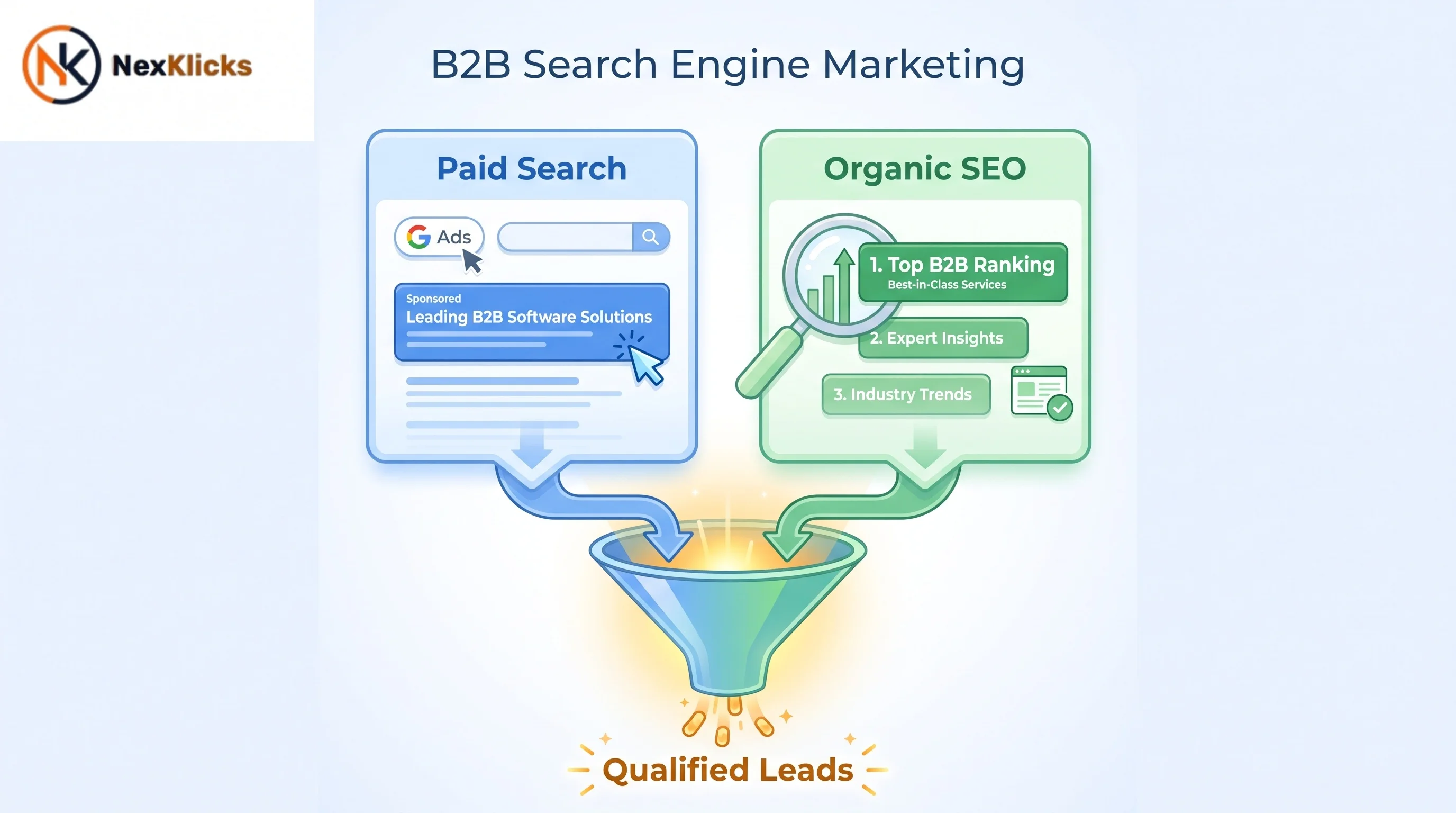
B2B search engine marketing is one of the most powerful ways a company can generate consistent, qualified leads. But most teams do it wrong, running generic Google Ads, publishing content without a strategy, and wondering why clicks never turn into real sales conversations.
According to Google and Millward Brown Digital, nearly 90% of B2B researchers use the internet during their research. The average B2B buyer runs 12 or more searches before contacting a vendor. If you are not showing up in those searches, your competitors are. This guide gives you the step-by-step system to fix that.
B2B search engine marketing is the use of paid search ads and organic SEO to reach business buyers through search engines like Google. It combines both channels to capture demand at every stage of the B2B buyer journey, from early research to final purchase decision.
Table of Contents
- What is B2B Search Engine Marketing?
- Who Should Do Search Marketing, and Why?
- What Are the Benefits of Search Marketing for B2B Companies?
- Key Elements of a B2B SEM Strategy (and How It Differs from B2C)
- Step 1: Define an Effective B2B Search Engine Marketing Strategy
- Step 2: Choose the Best Keyword Phrases
- Step 3: Optimize Your Site for Organic Search
- Step 4: Earn Inbound Links to Your Site
- Step 5: Run a Results-Focused Paid Search Campaign
- Step 6: Take Advantage of Google's Services for Quick Ranking
- How to Align Your B2B SEM Strategy With CRM and Sales Pipeline Data
- Measuring Success for B2B SEM
- Conclusion: Building a B2B Search Engine Marketing Strategy That Scales in 2026
- Frequently Asked Questions About B2B Search Engine Marketing
What is B2B Search Engine Marketing?
B2B search engine marketing refers to using both paid and organic search strategies to reach business buyers at the exact moment they are searching for a solution. According to Google and Millward Brown Digital, the average B2B buyer completes 12 or more searches before engaging with a specific brand. Your visibility across multiple search sessions directly affects how many leads enter your pipeline.
B2B search engine marketing uses two main tools: paid search ads through b2b Google Ads, and organic rankings through b2b SEO. Together, they cover every stage of the buyer journey.
B2b paid search means you pay to appear at the top of Google results immediately. B2b organic search means you earn your position over time through strong content and SEO. One gives you speed. The other gives you compounding, long-term returns.
The difference between b2b and b2c search marketing comes down to three things: longer buying cycles, buying committees, and the need for deeper content. B2C buyers decide in minutes. B2B buyers take months, with multiple stakeholders involved. That changes your entire keyword strategy, ad copy, and landing pages.
Quick Comparison
| Option | Best For | Key Benefit | Limitation |
|---|---|---|---|
| B2B Paid Search (PPC) | Fast lead generation | Immediate visibility on day one | Stops when the budget runs out |
| B2B Organic SEO | Long-term growth | Compounding traffic over time | Takes 3–6 months to see results |
| Combined SEM Strategy | Full-funnel coverage | Covers every buyer stage | Requires more planning |
According to BrightEdge, organic traffic accounts for 76% of trackable B2B website traffic, making SEO a non-negotiable part of any long-term strategy. The smartest approach is to run both simultaneously.
Comparison B2B Paid Search vs. B2B Organic Search: Paid search is better for immediate lead generation because your ad appears at the top of results on day one. Organic SEO works better for sustainable long-term growth. The key difference is speed versus compounding return on investment.
Who Should Do Search Marketing, and Why?
Any B2B company generating leads through digital channels should invest in search marketing. According to research cited by Pardot, 72% of B2B buyers start their research on a search engine, making search the most important discovery channel for B2B brands. Businesses with longer sales cycles benefit most, because search keeps you visible across the full research phase, not just at the point of purchase.
Search engine marketing for b2b companies works especially well for SaaS businesses, professional services firms, manufacturers, and IT service providers. If your buyers research before they buy, you need to be in search results when they do. You are ready to invest when you have a clear offer, a working website, and a basic understanding of who your buyer is.
Long sales cycle b2b search marketing strategy means staying visible across a months-long process. A buyer might search six different terms over three months before reaching out. Miss five of those searches, and you miss five chances to build trust.
What Are the Benefits of Search Marketing for B2B Companies?
Decision-maker targeting through search puts you in front of buyers at the highest-intent moment, not with a banner ad they ignore, but precisely when they have a problem and are looking for an answer.
Search marketing works at every funnel stage. Informational content targets early researchers. Comparison pages capture mid-funnel buyers. Demo and pricing pages close late-stage buyers. A complete b2b search marketing strategy covers all three simultaneously.
Cost per lead from search is far lower than from trade shows or cold outreach. A single well-optimized article can generate qualified leads for three to five years. The search terms your buyers use also reveal the exact language they use to describe their problems, language that belongs directly in your sales scripts and product messaging.
Key Elements of a B2B SEM Strategy (and How It Differs from B2C)
A B2B SEM strategy must account for longer buying cycles, multiple decision-makers, and search intent that shifts at each stage of the purchase journey. According to Forrester, 77% of B2B buyers will not speak with a salesperson until they have completed their own research. Your search presence is not just a marketing channel — it is your first sales conversation.
When a B2B purchase cycle lasts 60 to 180 days, a single ad click almost never converts the same day. A buyer might search “b2b marketing automation” in January, read comparisons in February, and request a demo in April. Your SEM must be present across all those moments, not just the last one.
B2B purchases involve three to ten people. A finance director, a department manager, and an IT lead will each search for different terms about the same product. Your b2b SEM strategy needs content and ads for each role, not one generic message.
Search intent b2b mapping means matching your content to what a buyer wants at each stage. “What is marketing automation?” needs an educational article. “Marketing automation vs CRM” needs a comparison page. “Marketing automation pricing” needs a pricing page or demo offer.
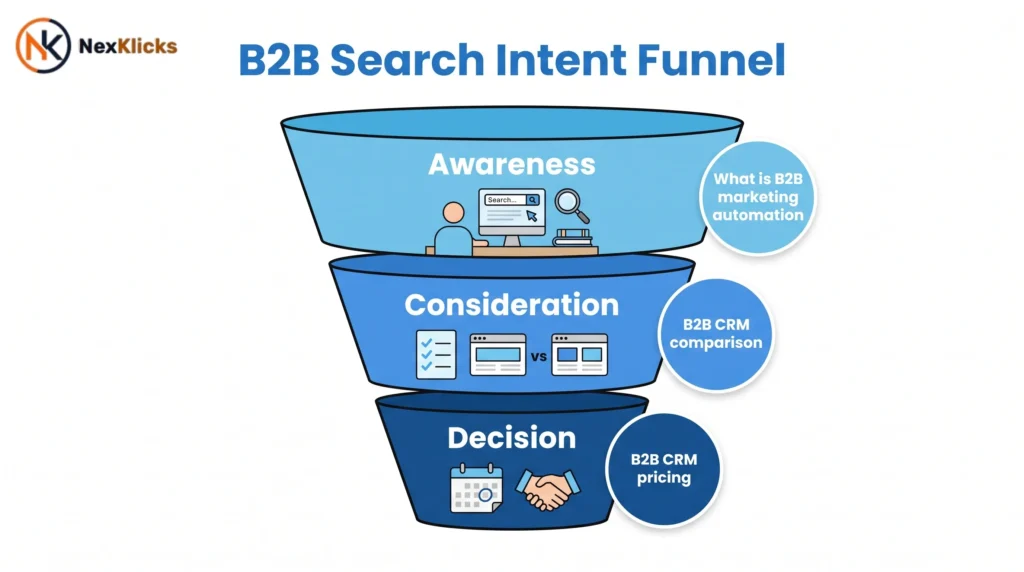
In b2b keyword research, always prioritize buyer quality over visitor quantity. A keyword with 50 monthly searches that drives demo requests is more valuable than one with 5,000 monthly searches that drives zero pipeline.
Step 1: Define an Effective B2B Search Engine Marketing Strategy
To define an effective B2B SEM strategy, follow these steps:
- Set goals tied to pipeline stages, not vanity metrics like clicks or impressions.
- Map your buyer persona to the specific search queries they use at each stage.
- Decide your paid-to-organic budget split based on your timeline and resources.
- Build a 90-day action roadmap with clear weekly milestones.
- Connect your SEM tracking to your CRM so you can measure lead quality from day one.
Stop optimizing for clicks and impressions. Focus on marketing qualified leads, cost per qualified lead, and pipeline contribution. A strong B2B buyer persona answers three questions: Who is searching? What problem are they solving? What would it take for them to trust you enough to fill out a form? Every keyword choice and landing page design flows from those answers.
Start with a 60% paid and 40% content and SEO budget split. As organic rankings grow, shift more toward content. Never go 100% paid when the budget stops; every lead disappears with it.
Step 2: Choose the Best Keyword Phrases
Open SEMrush or Ahrefs and search for your core service term. Filter for clear buyer signals — “enterprise,” “B2B,” “platform,” or “solution provider.” Group results by intent stage: awareness, consideration, and decision.
A B2B CRM company should not only target “CRM software.” They should also target “lead nurturing for B2B sales teams” because that is what their buyer searches for when they feel the pain that the CRM solves. Use the SEMrush Keyword Gap tool to find keywords your competitors rank for that you do not. These are your fastest-path-to-ranking opportunities.
Group related keywords into topic clusters: one pillar page covering the broad topic, with supporting posts linking back to it. This signals deep expertise to Google and improves rankings across every page in the cluster.
If you are also building a B2B content strategy alongside your SEM campaigns, our guide on keyword research for content writing shows how to apply keyword intent research specifically to blog and resource content.
Step 3: Optimize Your Site for Organic Search
Every B2B landing page needs a clear H1 with the target keyword, a meta description under 160 characters, internal links, and one focused call to action. Keep your highest-priority b2b SEO pages within two clicks of your homepage — pages buried deep rank poorly.
Page speed, broken links, and crawl errors are silent ranking killers. Use Google Search Console to run a coverage report monthly. Fix every error before investing time in new content. A slow, broken site will not rank well, no matter how strong the writing is.
For implementation instructions, Google Search Central’s structured data documentation provides the complete technical guide for adding schema markup to any B2B website.
Step 4: Earn Inbound Links to Your Site
Backlinks remain one of Google’s strongest ranking signals. Without them, even excellent b2b content marketing SEO will struggle to break into the top five positions for competitive keywords.
Publish original research as a data report. When other writers cover the same topic, they cite your data. A single well-promoted report can earn 30 to 50 backlinks over 12 months with no ongoing outreach. Your existing technology partners and industry associations are also easy, topically relevant link sources that most competitors overlook entirely.
If you want a broader breakdown of every method available, our guide to off-page SEO tactics covers the full range of link-building and authority-building approaches beyond what this article covers in depth.
Step 5: Run a Results-Focused Paid Search Campaign
Separate your b2b Google Ads campaigns by funnel stage and intent. Run one campaign for branded keywords, one for competitor keywords, and one for high-intent solution keywords. Keep ad groups tightly themed with three to five closely related keywords each. This keeps your quality score high and your cost-per-click low.
Lead your ad copy with the business outcome, not the feature. “Cut your B2B sales cycle by 30%” outperforms “Advanced CRM Software” every time. Your landing page must mirror your ad exactly — same headline, same promise, one form with no more than four fields, and a customer logo strip or testimonial above the fold.
How to Use Audience Layering in Google Ads to Reach B2B Decision-Makers
Audience layering is one of the most powerful and underused tactics in b2b search engine marketing. You combine keyword targeting with audience signals inside Google Ads to reach specific people, not just anyone who types a search term.
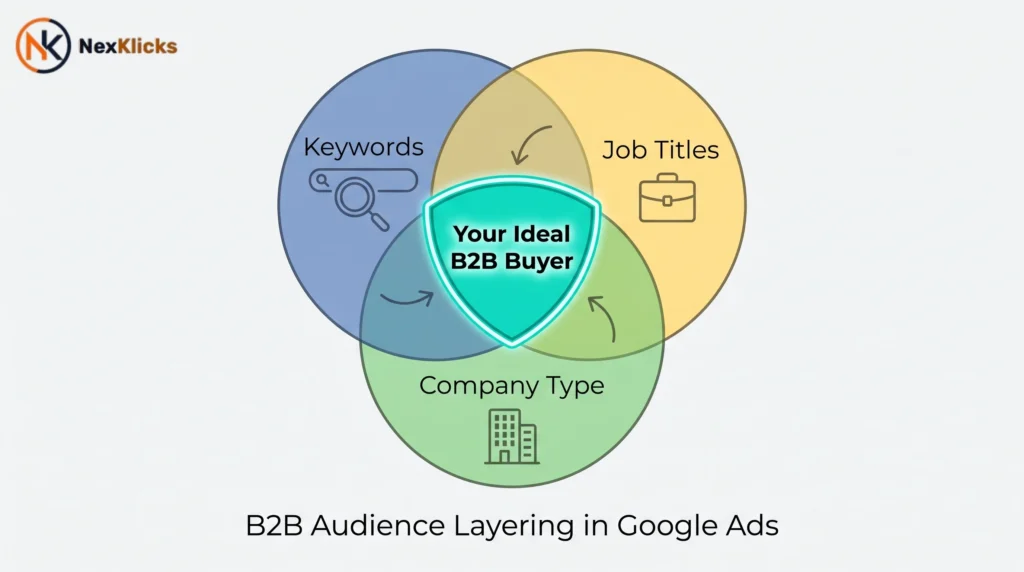
Here is how it works. You target the keyword “b2b marketing automation software” and simultaneously layer on an in-market audience for “business software” plus a custom audience built from job titles like “Marketing Director” or “VP of Operations.” Your ad now appears primarily for business professionals matching your ideal buyer profile, not for everyone who types the keyword.
You can also upload target company domains and use Customer Match to serve ads more aggressively to visitors from those specific companies, effectively filtering out students and casual browsers and concentrating your budget on people who could actually sign a contract.
For b2b PPC advertising match types, start with phrase match and exact match. Add negative keywords like “free,” “student,” “jobs,” and “tutorial” before launch. Review your search terms report weekly. A strong negative keyword list can reduce wasted spend by 20% to 40% in the first 90 days.
Start with Manual CPC to gather baseline data, then switch to Target CPA bidding once you have 30 to 50 conversions. Connect HubSpot or your CRM using offline conversion imports so Google’s algorithm optimizes toward real buyers, not just form fills.
Step 6: Take Advantage of Google’s Services for Quick Ranking
In Google Search Console, filter for pages ranking in positions 8 through 15. Add a FAQ section to each, strengthen the H1 to better match search intent, and build one or two internal links pointing to each from higher-authority pages. Most will move to page one within 30 to 60 days with no new content required.
Use sitelink and callout extensions in your ads to highlight key benefits. Adding FAQ schema and organization schema helps Google understand your content and can trigger expandable FAQ entries directly in search engine results pages, increasing click-through rate without changing your ranking position.
How to Align Your B2B SEM Strategy With CRM and Sales Pipeline Data
Most B2B SEM guides stop at lead generation. That is exactly where the real strategy begins.
Why Long B2B Sales Cycles Require Multi-Touch Attribution
B2B sales cycles commonly run 90 to 180 days. A single buyer might interact with your brand eight to twelve times before signing a contract, discovering you through an organic blog post, returning via a remarketed ad, then searching for your brand directly before requesting a demo weeks later.
Multi-touch attribution assigns credit to every touchpoint that influenced a conversion, not just the last click. Last-click attribution, which most companies still use by default, makes your organic blog content look worthless and your branded search look like the only hero. It leads to bad budget decisions.
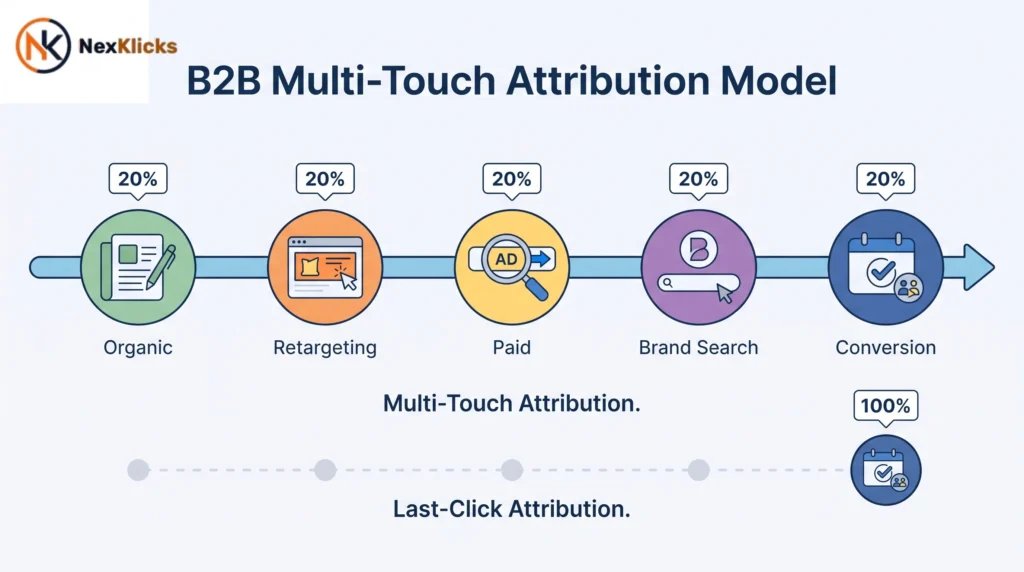
A linear attribution model splits credit equally across every touchpoint. A time-decay model gives more credit to touchpoints closer to the conversion. Either is far more accurate for a b2b search marketing strategy with long sales cycles. Set up multi-touch attribution in Google Analytics and compare it against your default last-click data.
Connect your Google Ads account to HubSpot or Salesforce. Import qualified lead and closed-won data from your CRM back into Google Ads weekly. Google’s algorithm then receives real revenue signals and finds more buyers who look like your actual customers, not people who click forms and disappear. Pull a closed-revenue report filtered by lead source. A small number of keywords almost always drive the majority of the closed pipeline. Double down on those. Pause the ones that generate leads that never close.
Measuring Success for B2B SEM
Focus on five core metrics: cost per qualified lead, lead-to-opportunity rate, pipeline value influenced by SEM, return on ad spend, and search impression share for priority keywords. Those five numbers tell you whether your b2b search engine marketing is working far better than a dashboard full of impressions and click-through rates.
Set up a lead scoring system in your CRM based on company size, job title, and on-site behavior. A campaign generating 20 high-scoring leads is almost always worth more than one generating 200 low-quality contacts. Build a single dashboard in Google Analytics showing total SEM spend, qualified leads, cost per qualified lead, and pipeline generated. Update it weekly. Leadership needs clarity, not complexity.
Conclusion: Building a B2B Search Engine Marketing Strategy That Scales in 2026
The companies that win in b2b search engine marketing are not the ones with the biggest budgets. They are the ones who connect search data to their sales pipeline, optimize for lead quality, and treat search as a long-term investment.
Combine paid and organic search for full-funnel coverage. Layer audiences in Google Ads to reach actual decision-makers. Apply multi-touch attribution so every channel gets the credit it deserves across your long B2B sales cycle.
Your next three steps: Audit your current search presence using Google Search Console and SEMrush to identify ranking gaps. Build or improve a dedicated landing page for each of your three highest-intent keywords. Then connect conversion tracking from your b2b search engine marketing campaigns directly to your CRM so every search effort is tied to real pipeline — starting today.
Frequently Asked Questions About B2B Search Engine Marketing
Q: What’s the best way to start b2b search engine marketing with a small budget?
A: Start with exact match keywords targeting your highest-intent buyers. Publish two to three SEO-optimized blog posts per month. Connect conversion tracking to your CRM from day one.
Q: How do I know if my B2B SEM strategy is actually working?
A: Track cost per qualified lead and pipeline contribution, not just clicks. If your cost per qualified lead is declining and pipeline is growing month over month, the strategy is working.
Q: Should I run SEO and PPC at the same time for B2B?
A: Yes, always. Paid search delivers leads quickly while organic SEO builds sustainable long-term traffic. Running both gives you full-funnel coverage.
Q: How long does it take to see results from b2b search engine marketing?
A: Paid search can generate qualified leads within days if set up correctly. Organic SEO typically takes three to six months before meaningful ranking improvements appear.
Q: Why does my B2B Google Ads campaign generate clicks but no leads?
A: The most common causes are a landing page that does not match the ad, a form asking for too much, or irrelevant traffic. Check your search terms report and your landing page conversion rate in Google Analytics before adjusting bids.


Leave a Reply