
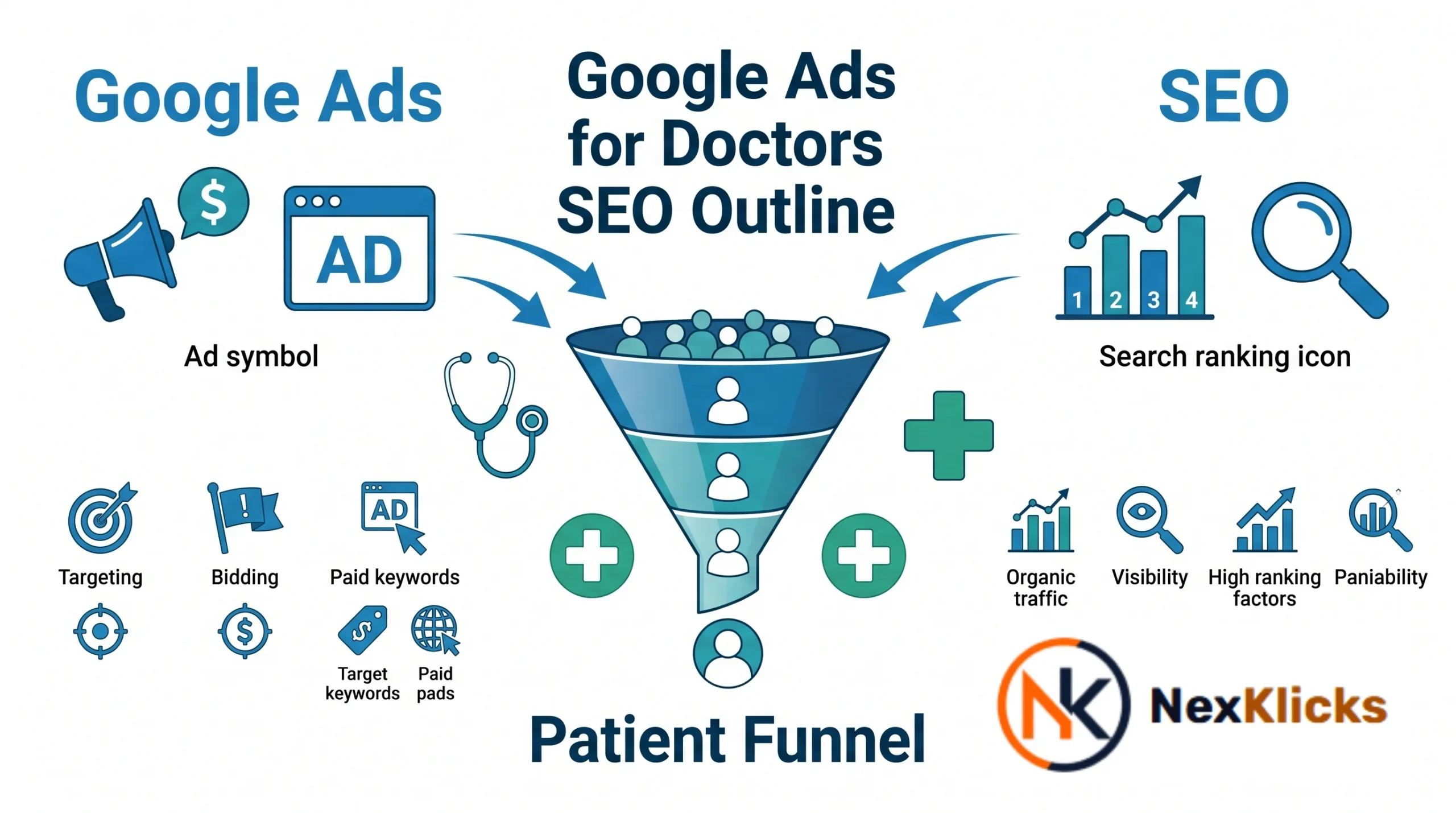
If your medical practice is investing in Google Ads but struggling to turn clicks into appointments, a well-structured google ads for doctors seo outline can make a significant difference. By combining healthcare PPC campaigns with SEO for doctors, practices can attract high-intent patients while building long-term online visibility. Instead of treating paid advertising and organic search as separate strategies, an integrated approach aligns keywords, landing pages, and conversion tracking to improve results.
Whether you run a primary care clinic, specialty practice, or multi-location healthcare organization, a strong framework helps maximize ROI, reduce wasted ad spend, and create a sustainable patient acquisition system through medical practice marketing.
A google ads for doctors seo outline is a structured strategy that aligns paid search campaigns with organic SEO to attract high-intent patients from Google. It covers keyword research, campaign architecture, landing page optimization, conversion tracking, and compliance giving medical practices a single, unified framework for sustainable patient acquisition.
What Is a Google Ads for Doctors SEO Outline?
Think of it as your clinic’s patient acquisition blueprint, not a generic marketing plan, but a structured, step-by-step framework that maps exactly how Google Ads and SEO work together to bring patients through your door.
Most agencies hand doctors a keyword list and a campaign. That’s not a strategy. A real google ads for doctors seo outline defines which keywords trigger paid ads versus organic content, how landing pages are built to support both channels, and how every dollar spent connects back to an actual appointment.
Here’s what it covers at a minimum:
- Keyword mapping: matching high-intent search terms to the right ad groups and organic pages
- Campaign architecture: organizing ads by specialty, condition, and location so budget doesn’t bleed across irrelevant searches
- Landing page structure: HIPAA-compliant pages that boost Quality Score and convert visitors into booked patients
- Tracking setup: connecting clicks to calls, forms, and real appointments without capturing Protected Health Information
A google ads for doctors seo outline is a combined paid and organic strategy designed to maximize patient acquisition for medical practices. According to WordStream’s 2024 Healthcare Industry Benchmarks, the average healthcare CPC is
$4.96 and the average conversion rate is 3.36%, meaning without an optimized structure, most practices are leaving significant ROI on the table. An integrated outline fixes that by aligning both channels around the same patient journey.
What competitors don’t tell you: this outline looks different depending on your specialty. A plastic surgeon running elective procedure ads needs a completely different campaign structure than a primary care physician targeting “doctor near me”
searches. We’ll cover those differences in Step 3.
Why Doctors Need Paid + Organic Integration
Running Google Ads alone is like renting visibility. The moment you pause spend, you disappear. Running only SEO means waiting 6–12 months to rank while your competitor’s ads sit at the top of every search.
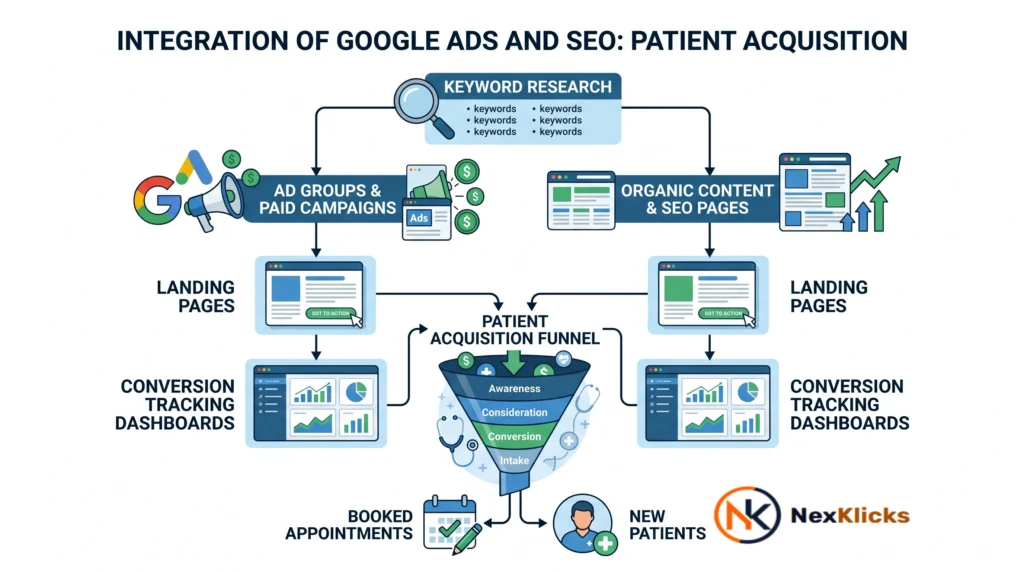
The seo and ppc integration model solves both problems. Here’s why it works better than either channel in isolation:
Google Ads feeds SEO data. The search terms report from your ad campaigns tells you exactly which phrases patients type before booking. That’s your organic content roadmap. You’re not guessing; you’re using real conversion data to build pages that rank. If you want to extend this research into your blog and service page content strategy, this guide on how to find and use the right keywords for content that ranks walks through the full keyword-to-content mapping process.
Shared keywords lower costs. When your landing pages rank organically for the same terms your ads target, Google’s algorithm rewards you with a higher Quality Score. Higher Quality Score means lower CPC. Clinics running integrated strategies typically see CPC drop 20–35% over 12 months as organic authority builds.
Trust compounds. A patient who sees your ad and then finds your clinic ranking organically right below it doesn’t just click; they trust. Local pack visibility from your Google Business Profile, an organic ranking, and a paid ad creates a sweep of the results page that competitors running only one channel can’t match.
Doctors need both Google Ads and SEO because each channel serves a different stage of the patient acquisition funnel. Paid ads capture patients searching right now, especially high-intent queries like “cardiologist accepting new patients near me.” Organic SEO builds long-term authority that reduces dependence on paid spend. According to WordStream’s 2024 data, healthcare advertisers with optimized landing pages achieve conversion rates more than double the vertical average, demonstrating the direct impact of the integrated approach.
Real-world scenario: a dermatology practice in Houston running ads-only was paying $68 per lead. After building organic service pages that matched their ad group themes, Quality Scores rose, CPC dropped to $4.10, and CPL fell to $31 in four
months without increasing budget.
Step 1: Define Patient Goals & KPIs
Before you touch Google Keyword Planner or write a single ad, you need numbers. Not vague goals like “get more patients” actual revenue-aligned targets that tell you when the strategy is working and when to pivot.
Start with patient lifetime value (LTV). If a new patient is worth $600 to your practice over 12 months, spending $40–$60 to acquire them makes perfect sense. If you don’t know your LTV, start there. It changes every budget and bidding decision that follows.
Set a realistic CPA target. For most US specialty practices, a cost per acquisition (CPA) of $25–$55 is achievable with a properly structured campaign. Multi-location practices with higher volume can push that below $20. Solo practices
in competitive metros should expect $45–$70 early on, dropping as Quality Score improves.
Define what counts as a conversion. This is where most practices go wrong. Clicks are not conversions. Form fills are not appointments. You need to track:
- Phone calls lasting more than 60 seconds (via call tracking healthcare tools like CallRail)
- Completed appointment request forms
- Live chat sessions that end in booking confirmation
- Offline conversions: patients who called, booked, and showed up
To set up KPIs for a doctor Google Ads campaign, follow these steps:
- Calculate patient lifetime value for your top 2–3 specialties.
- Set a maximum CPA at no more than 10% of LTV.
- Define conversion actions, calls, forms, and bookings before launch.
- Connect conversions to your CRM or scheduling software.
- Schedule a monthly review aligned to seasonal demand shifts.
Monthly reviews matter more in healthcare than most industries. Flu season, open enrollment periods, and elective procedure cycles all create demand spikes that should trigger budget adjustments, not be discovered three months after
the opportunity passed.
| Goal Type | Target Metric | Benchmark (US Specialty Practice) |
|---|---|---|
| Awareness | Impressions | 50K–150K/month |
| Lead Volume | New patient inquiries | 30–80/month |
| Cost Efficiency | CPA | $25–$55 |
| Revenue Return | ROAS | 4:1 minimum |
| Organic Growth | Organic sessions | +20% QoQ |
Step 2: High-Intent Keyword Research for Medical Practices in the USA
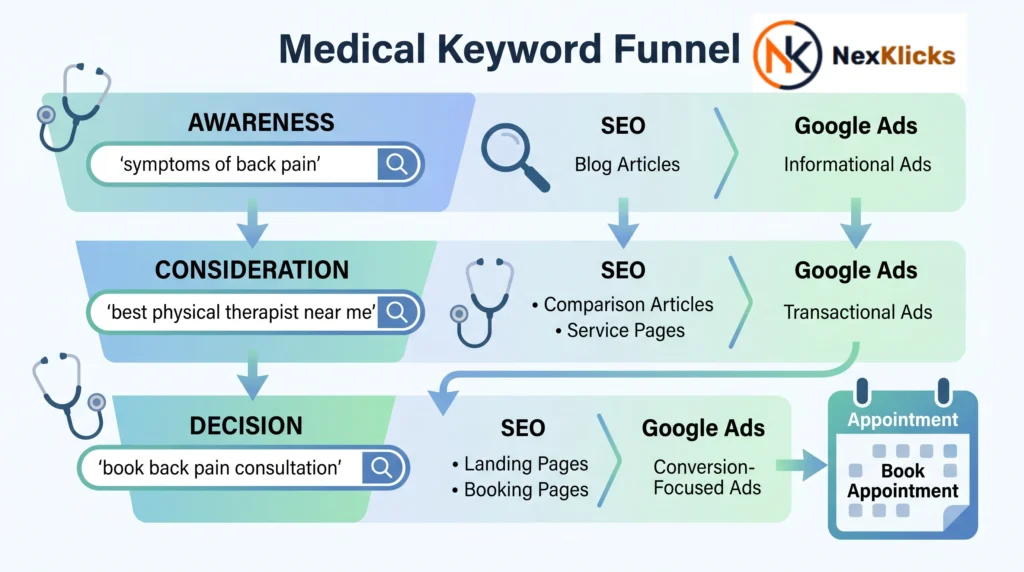
Wasted google ads for medical practices spend almost always starts here with the wrong keywords or no negative keyword strategy. Medical keyword research isn’t just about search volume. It’s about matching search intent to the stage in the patient decision journey.
Transactional keywords drive bookings. These are the terms patients type when they’re ready to make an appointment:
- “orthopedic surgeon accepting new patients [city]”
- “dermatologist near me open Saturday”
- “pediatrician accepting Medicaid [city]”
Informational keywords build organic traffic. These belong on blog posts and FAQ pages, not in your paid campaigns:
- “what causes lower back pain”
- “how long does knee replacement recovery take”
Mixing these in the same ad campaign is one of the most common and expensive mistakes in doctor marketing usa.
Use SEMrush to analyze competitor keyword gaps. Look at which terms competitors rank for organically but aren’t bidding on. That’s low-competition paid inventory with proven organic demand. It’s one of the fastest ways to find underpriced doctor near me ads opportunities in competitive metros.
Build your negative keyword list before you spend a dollar. In healthcare, this list needs to include terms like: free, salary, jobs, veterinary, symptoms, residency, Wikipedia, WebMD. Add 100+ negatives at campaign launch. This single step can reduce wasted spend by 25–40% immediately.
High-intent keyword research for medical practices requires separating transactional queries (ready to book) from informational ones (researching symptoms). Tools like Google Keyword Planner and SEMrush help identify
specialty-specific terms with strong booking intent. Negative keyword lists are equally critical. A negative keyword list healthcare campaign without 100+ exclusions routinely wastes 30–40% of monthly budget on irrelevant traffic like job seekers and symptom researchers.
Specialty-specific keyword logic matters. Here’s where competitor articles fall completely short:
- Plastic surgeons target elective, high-consideration terms: “rhinoplasty cost [city],” “breast augmentation consultation near me.” These patients research for weeks. Bid on comparison and consultation terms, not just procedure names.
- Primary care physicians target urgent and proximity terms: “doctor near me same day appointment,” “urgent care vs primary care [city].” Volume is high, competition is fierce, and negative keywords and geo-fencing are critical.
- Cardiologists and specialists target condition-specific terms: “irregular heartbeat specialist [city],” “heart palpitations doctor near me.” These patients are often scared, and in decision mode, ad copy should lead with reassurance and speed of access.
Step 3: Campaign Structure & Ad Groups for Doctor Google Ads
Poor google ads campaign structure healthcare is the single fastest way to burn budget. When all your keywords live in one campaign with one ad and one landing page, nothing can be optimized without affecting everything else.
The right structure for most US medical practices:
- Campaign 1: Brand/Reputation: Bidding on your own practice name and doctor name. Cheap, high-intent, protects you from competitors stealing your branded searches.
- Campaign 2: Core Services: One campaign per major specialty or service line. A multi-specialty group should have separate campaigns for dermatology, orthopedics, cardiology, and so on.
- Campaign 3: Condition-Based: Target symptoms and conditions rather than services. “Knee pain doctor near me” and “acne treatment specialist” capture patients who don’t yet know which specialty they need.
- Campaign 4: Performance Max: Use this for retargeting and visual placements. Show ads to people who visited your site but didn’t book.
Ad group segmentation by specialty within each campaign keeps ad relevance high and Quality Scores strong. Each ad group should contain 10–20 tightly themed keywords, one dedicated landing page, and 3–5 responsive search ads.
Performance Max vs. Search Campaigns: Search campaigns are better suited for high-intent, bottom-funnel patient acquisition because they capture active queries at the exact moment of search intent. Performance Max works better for retargeting and awareness when patients are in the research phase. The key difference is control. Search campaigns give you precise keyword-level data; Performance Max optimizes across channels with less transparency.
Quick Comparison
| Option | Best For | Key Benefit | Limitation |
|---|---|---|---|
| Search Campaigns | Active patient acquisition | Precise intent targeting | Higher management time |
| Performance Max | Retargeting + awareness | Cross-channel automation | Limited keyword visibility |
| Display Ads | Brand awareness | Visual reach | Low direct conversion rate |
| YouTube Ads | Elective procedure research | High engagement | Longer conversion cycle |
Geo-targeting deserves its own conversation. A clinic in Dallas doesn’t need impressions in Fort Worth suburbs unless patients realistically travel that far. Set radius targeting at 5–15 miles depending on specialty. Elective procedures pull patients from farther away; urgent care and primary care are strictly local.
Step 4: Landing Page & Ad Copy Optimization for Healthcare
Your google ads quality score is determined largely by one thing: how relevant your landing page is to the ad that brought the patient there. If someone clicks “knee surgeon Dallas” and lands on your homepage, your Quality Score drops, your CPC spikes, and your conversion rate collapses. That’s not a traffic problem; it’s a structure problem.
Every ad group needs its own landing page. Not your homepage. Not your about page. A dedicated page that mirrors the exact language of the ad, leads with a clear headline, and makes booking as frictionless as possible.
HIPAA-compliant landing pages for US practices must:
- Use consent-compliant forms that don’t pre-fill sensitive health information
- Avoid pixel-level tracking of any data that could qualify as PHI
- Include a visible privacy notice with a link to your HIPAA privacy policy
- Never ask for diagnosis, symptoms, or medical history in the form fields
Keep forms to three fields maximum: name, phone number, and preferred appointment time. Every additional field drops conversion rate by an estimated 10–15%.
Trust builders that lift medical landing page conversion rates:
- Board certification badges
- Real Google review count and average rating (current, not from two years ago)
- Photos of actual clinic and staff, not stock imagery
- A visible phone number in the header
- A booking form above the fold
Doctor landing page optimization is also where mobile performance matters most. Over 65% of healthcare searches happen on mobile devices. A page that loads in 4 seconds on desktop but takes 7 on mobile will tank your campaign. Aim for under 2.5 seconds on mobile. Use Google’s PageSpeed Insights to audit before launch.
Step 5: Smart Budget Planning for US Doctor Google Ads Campaigns
Here’s the uncomfortable truth about healthcare google ads strategy and budget: most practices don’t have a spending problem; they have an allocation problem. The money is there; it’s just going to the wrong keywords, wrong match types, and wrong times of day.
Starting budgets by practice type:
| Practice Type | Monthly Budget | Target CPA | Expected Monthly Leads |
|---|---|---|---|
| Solo Doctor | $1,500–$3,000 | $35–$55 | 20–45 |
| Multi-Specialty Group | $5,000–$15,000 | $20–$40 | 80–200 |
| Hospital / Health System | $20,000+ | $15–$30 | 300+ |
Budget allocation across channels:
- 50–60% to Search campaigns (highest intent, most direct ROI)
- 20–30% to Performance Max (retargeting and visual)
- 10–20% to Remarketing / YouTube (especially for elective procedures)
Bidding strategy should follow this progression:
- Start with Maximize Conversions with a CPA cap
- Once you hit 30+ conversions per month, switch to Target CPA
- As the account matures, test Target ROAS for high-LTV specialties
The WordStream Healthcare Benchmarks Report provides industry-average CPC, conversion rates, and performance benchmarks for healthcare Google Ads. It is widely used to evaluate campaign efficiency and ROI in medical marketing.
Cost per lead for doctors in competitive US metros varies significantly by specialty. Cosmetic and elective procedures (plastic surgery, LASIK, orthodontics) run $40–$90 CPL because of higher competition and longer consideration cycles. Primary care and urgent care in mid-size markets can achieve $15–$35 CPL with tightly structured campaigns and strong negative keyword lists.
Ad scheduling is an underused lever. Most practices see peak appointment requests between 8 AM–11 AM and 5 PM–8 PM on weekdays. Reducing bids by 30–40% overnight and on Sundays (unless you offer those hours) can shave 15–20% off monthly spend without sacrificing lead volume.
Step 6: Conversion Tracking Setup — HIPAA-Compliant From Day One
This is where virtually every competitor guide fails US medical practices. Healthcare conversion tracking isn’t just about adding a Google tag and watching the numbers roll in. In healthcare, standard pixel tracking can accidentally capture PHI, and that puts you in violation of HIPAA, regardless of whether you intended it.
Here’s the compliant setup:
Google Tag Manager (GTM) configuration:
- Deploy GTM on all pages, but restrict data layer pushes on any page that collects health information (patient intake forms, symptom checkers, patient portals)
- Track button clicks and form submissions by firing tags on thank-you or confirmation pages only, never on the form page itself
- Ensure no URL parameters containing diagnosis codes, appointment types, or patient identifiers are sent to Google Analytics or Ads
CallRail for call tracking:
- Use dynamic number insertion (DNI) to track which ad campaigns drive calls
- Configure CallRail to mask caller ID data in Google Ads integrations
- Enable keyword-level call tracking to identify which search terms drive booked appointments versus general inquiries
- Set minimum call duration thresholds (60–90 seconds) so only qualified conversations count as conversions
HIPAA-compliant advertising requires a Business Associate Agreement (BAA) with any third-party tool that touches patient data. Google does not sign BAAs, which means Google Analytics and Google Ads conversion tags must be configured to ensure no PHI enters those systems. CallRail does offer BAAs for healthcare clients; this is one reason it’s the preferred call tracking healthcare tool for HIPAA-compliant practices.
Offline conversion import closes the loop. Most practices book appointments through a scheduler (Kareo, Athenahealth, Jane App) that Google Ads never sees. By exporting a weekly CSV of GCLID values tied to actual booked appointments and uploading them to Google Ads, you teach the algorithm which ad clicks actually produced patients, not just form fills.
This HHS OCR Guidance on Online Tracking Technologies explains how HIPAA applies to tracking pixels and online technologies. It confirms that healthcare websites must ensure compliance when using analytics and ad tracking tools.
Healthcare CPC benchmarks improve as your conversion data matures. Smart Bidding algorithms need 30+ conversions per month to optimize effectively. If you’re importing offline conversions, that threshold becomes 30 actual booked appointments, a much stronger signal than raw form fills.
Common Google Ads Mistakes Doctors Make
You can have the best outline in the world and still lose money if you’re making any of these mistakes consistently. Most of them aren’t complicated; they’re just easy to overlook when you’re running a practice and managing marketing at the same time.
Broad match everywhere. This is still the most expensive mistake in ppc for doctors. Broad match keywords in healthcare will match queries like “doctor who season 4,” “free medical advice,” and “nursing salary.” Use phrase match and exact match for all high-intent keywords, and reserve broad match only for discovery campaigns with tight negative keyword lists.
No geo-fencing. A dermatology clinic in Manhattan showing ads to users in New Jersey isn’t just wasting money; it’s actively training Google’s algorithm on irrelevant location signals. Set geo-targeting at the ZIP code level for dense metro areas, and layer in location bid adjustments to prioritize the neighborhoods closest to your clinic.
Skipping ad extensions. Sitelink extensions, callout extensions, and structured snippets are free and can lift CTR by 10–20%. For medical practices, callouts like “Accepting New Patients,” “Same-Day Appointments,” and “Insurance Accepted” address the most common patient objections before they even click.
No remarketing list. About 70–80% of patients who visit your site and don’t book will consider a competitor. Remarketing for medical practices re-engages these visitors with targeted ads over 7–30 days. It’s typically the lowest CPA traffic in any healthcare account.
Ignoring mobile experience. With 65%+ of local search ads for doctors clicks coming from mobile, a slow or poorly formatted mobile landing page neutralizes every other optimization you’ve made.
Google Ads vs SEO for Clinics: Which Should You Prioritize in 2026?
The honest answer is: it depends on where your practice is today.
If you launched recently or moved to a new location, Google Ads delivers immediate patient acquisition strategy results while SEO authority builds. You can’t wait 9 months to rank organically when you need patients next week.
If you’ve been in practice 5+ years, have strong reviews, and have an established domain, a heavier SEO investment starts making more economic sense, especially for local seo for doctors targeting “near me” and map pack visibility.
Quick Comparison
| Factor | Google Ads | SEO for Doctors |
|---|---|---|
| Time to Results | Days | 6–12 months |
| Cost Structure | Per click (ongoing) | Time/content investment |
| Best For | Immediate bookings | Long-term authority |
| Scalability | Budget-limited | Compounds over time |
| Compliance Risk | HIPAA pixel concerns | Lower risk |
The practices winning in 2026 aren’t choosing between doctor seo services usa and paid ads. Many of the same structural errors that hurt paid campaigns also affect organic rankings. If you want to audit the SEO side of your practice’s digital presence, this breakdown of common SEO mistakes that quietly drain organic performance is a practical starting point. They’re running both with a shared keyword strategy, aligned landing pages, and unified conversion tracking. That’s what a proper google ads for doctors seo outline delivers, not a choice between channels, but a framework that makes both perform better together.
E-E-A-T for medical websites matters here too. Google’s Helpful Content system and Quality Rater Guidelines classify healthcare content as YMYL (Your Money or Your Life). Organic rankings in this space require demonstrated expertise, real author credentials, and trust signals that ads alone can’t build.
Medical Schema Markup for Doctors
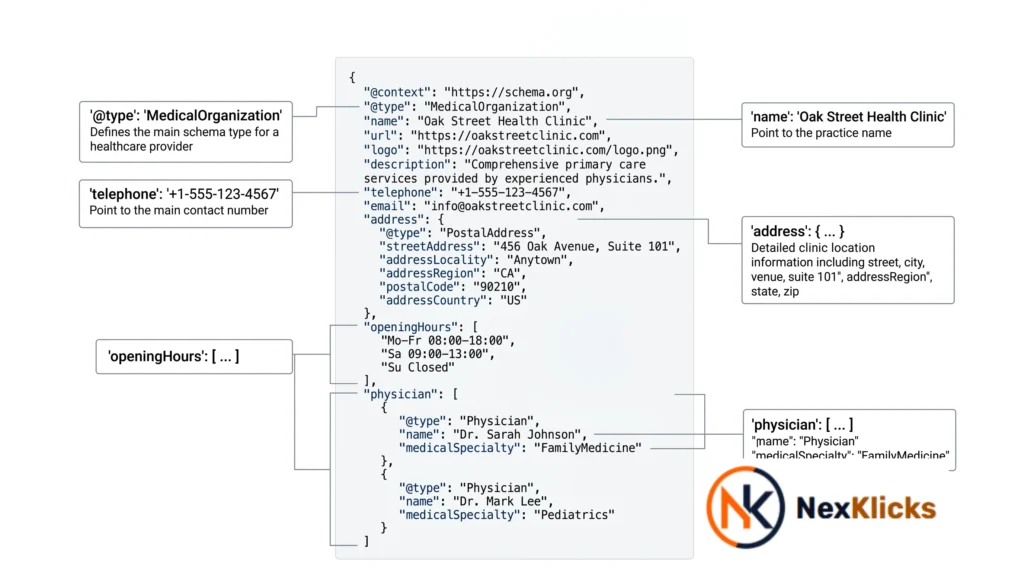
Medical schema markup is the layer of structured data that tells Google exactly who your practice is, what you treat, and who your physicians are without making Google guess from your page content.
For most US medical websites, the highest-value schema types are:
- MedicalOrganization — defines the practice entity, address, hours, contact details
- Physician — links individual doctors to their credentials, specialty, and affiliated organization
- MedicalSpecialty — associates your practice with specific medical disciplines
- HealthcareService — describes individual services with descriptions and service areas
- MedicalCondition (on condition-specific pages) — connects your content to recognized medical conditions
What to include in each schema block:
- Practice name, full address, phone number, and operating hours
- Doctor name, medical degree, board certification specialty, and NPI number, where appropriate
- Core services with plain-language descriptions
- SameAs references to your Google Business Profile, Healthgrades, and Doximity profiles
Why this matters practically: schema doesn’t guarantee rich results, but it dramatically improves how search intent for medical services is interpreted by Google’s entity-understanding system. For geo-targeting for clinics, consistent NAP (name, address, phone) across schema, your website, and your GBP listing is a foundational local SEO signal.
Building citations and backlinks from trusted medical directories is the next layer of off-page SEO tactics that build authority for healthcare websites and covers exactly how to do that without risking link penalties.
Google Business Profile Optimization for Doctors
Google business profile for clinics is the single highest-leverage, lowest-cost local visibility tool available to US medical practices. It determines whether you appear in the map pack for “doctor near me” searches, and that placement is worth more than most paid campaigns.
GBP optimization checklist for US medical practices:
- Primary category: Choose the most specific medical category available (e.g., “Orthopedic Surgeon” not just “Doctor”). This is the most important ranking signal in the profile.
- Secondary categories: Add 2–3 relevant secondary categories that match your actual service lines, not every category Google offers.
- NAP consistency: Your practice name, address, and phone number must be identical across your GBP, website, schema markup, and every directory listing. One inconsistency can suppress local rankings.
- Photos: Upload real clinic photos, staff headshots, and exam room images. Practices with 10+ photos see significantly higher profile views than those with stock imagery.
- Services: List every service with a description. This feeds directly into how Google matches your profile to patient searches.
- Posts: Publish weekly updates, new services, seasonal health tips, appointment availability. Active profiles outrank dormant ones.
- Reviews: Actively request reviews from satisfied patients (within HIPAA boundaries, don’t ask patients to mention their condition in reviews). Reply to every review, positive or negative.
- Appointment link: Connect your GBP directly to your scheduling platform. Patients who can book in two clicks convert at dramatically higher rates than those who have to navigate to a website first.
The GBP review strategy also supports your google ads quality score indirectly. A practice with 4.8 stars and 150+ reviews creates trust that makes patients more likely to click your ads and convert on your landing pages.
How to Choose a Google Ads Agency for Doctors in the USA
Not every marketing agency understands healthcare compliance, specialty-specific targeting, or how clinic google ads setup intersects with HIPAA obligations. Choosing the wrong agency doesn’t just waste budget; it can expose your practice to compliance risk.
Red flags that signal an agency isn’t right for medical practices:
- No medical case studies or healthcare portfolio
- Vague ROI promises without specific CPL or ROAS benchmarks
- No mention of HIPAA compliance in their onboarding process
- They don’t ask about your patient LTV or CPA targets
- They recommend broad match as a default strategy
- Monthly reporting, not weekly optimization
What a qualified agency should provide:
- 10+ active healthcare client campaigns with documented results
- A clear explanation of how they handle HIPAA-compliant tracking
- Weekly performance reviews with keyword-level data
- Custom landing pages built for your specific ad groups
- Transparent dashboards showing ROAS, CPL, impression share, and
conversion tracking health
Questions to ask before signing any contract:
- “Show me two healthcare campaigns where you achieved under $40 CPL. What was the campaign structure?”
- “How do you configure conversion tracking without capturing PHI in Google’s systems?”
- “Do you build specialty-specific landing pages or use our existing website pages?”
- “What’s your negative keyword strategy for healthcare campaigns?”
- “How do you handle ad disapprovals for medical claims?”
The google ads for doctors seo outline an agency follows tells you everything. If they can’t show you a structured framework covering keyword strategy, landing page logic, and compliance protocol, keep looking.
Frequently Asked Questions About Google Ads for Doctors SEO Outline
Q: Is $20 a day good for Google Ads?
A: Yes, $20/day can work for local businesses and testing campaigns, but results depend on your industry, competition, and targeting.
Q: What is local SEO for doctors?
A: Local SEO for doctors is optimizing a medical practice to rank higher in local search results and attract nearby patients.
Q: What are the 3 C’s of SEO?
A: The 3 C’s of SEO are Content, Code, and Credibility (authority/trust through backlinks and reputation).
Q: Is $100 a day good for Google Ads?
A: Yes, $100/day is a solid budget that provides enough data for optimization and can generate consistent leads in many industries.
Q: How much do Google Ads pay per 1000 views?
A: Google Ads doesn’t have a fixed payment per 1,000 views; earnings vary widely based on niche, audience, location, and advertiser demand.
Conclusion
A google ads for doctors seo outline is no longer optional; it is a strategic necessity for modern medical practices aiming to attract and convert high-intent patients in 2026. By aligning paid search strategy, organic SEO integration, and conversion-focused landing pages, doctors can significantly improve visibility, reduce wasted ad spend, and increase appointment bookings.
When properly structured, it ensures every click is guided through a clear patient journey backed by keyword mapping, local SEO optimization, and HIPAA-compliant tracking systems. This unified approach not only strengthens medical practice marketing performance but also builds long-term authority in competitive healthcare markets. Ultimately, success comes from treating Google Ads and SEO as one connected ecosystem rather than separate efforts, allowing clinics to scale sustainably while maintaining strong ROI, patient trust, and consistent growth across all digital channels.
This guide focuses on a structured Google Ads for doctors SEO outline to improve patient acquisition and reduce wasted ad spend. It does NOT cover general digital marketing strategies, social media marketing, or non-medical SEO topics.
Last updated: June 2026


Leave a Reply