
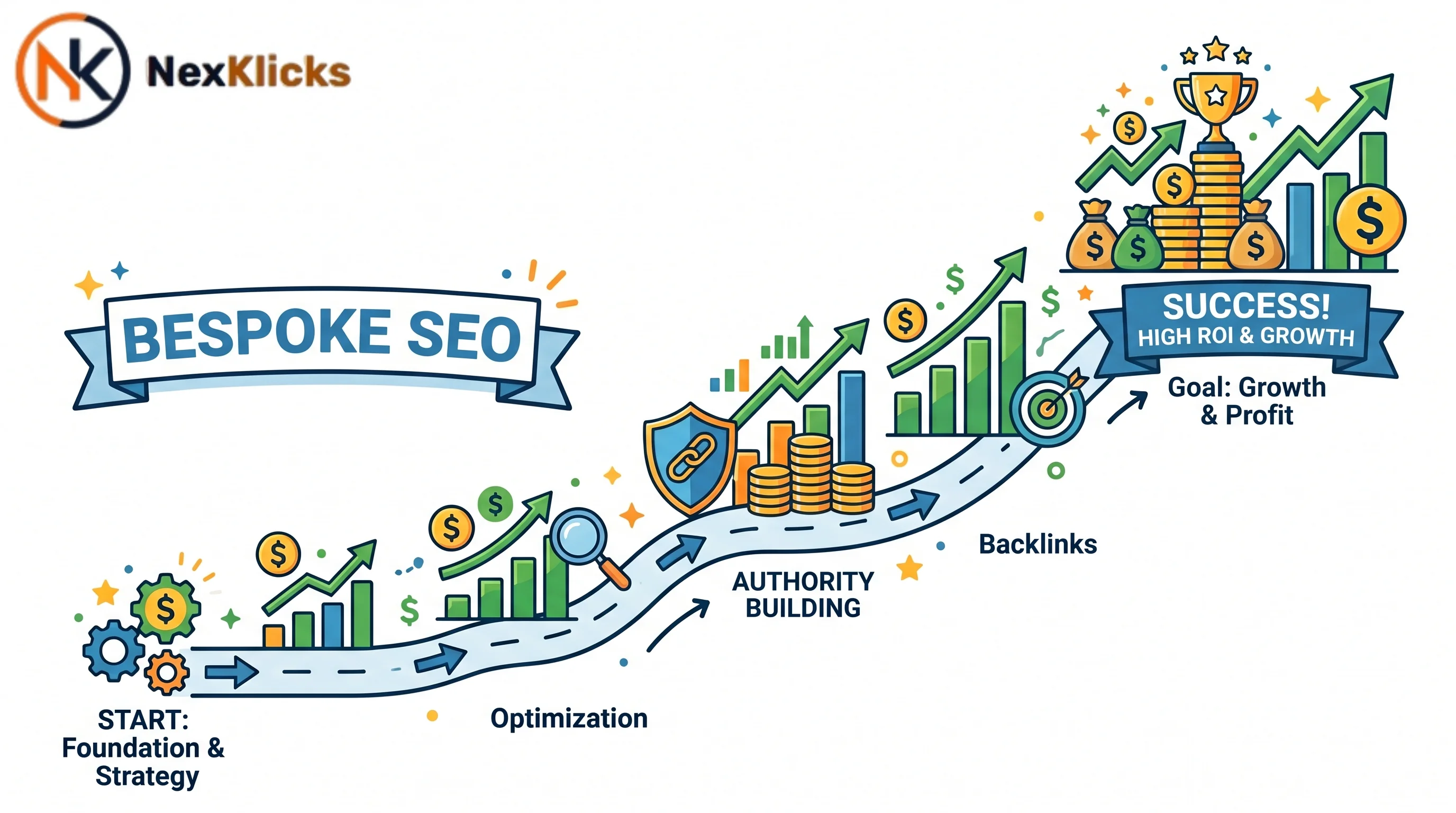
The marketing dashboard lights up green, but the sales pipeline is dry. That is the exact moment you realize bespoke SEO is not a luxury. It is the only thing that can close the gap between a traffic graph pointing up and a revenue line that refuses to move. Most teams know the basics of search intent optimization and keyword research. They publish consistently. Yet the leads do not convert, and the agency report celebrates vanity metrics while the CFO asks why the return on investment (ROI) is missing.
A custom SEO strategy starts where the template ends. It rejects the idea that every business should optimize for the same standardised methods and instead builds a data-driven marketing engine that ties every page, every cluster, and every link back to a profit margin alignment. This article gives you that exact zero-click strategy framework. No filler. No recycled playbooks. Just the precision needed to turn organic search into a predictable acquisition channel.
Where Traditional SEO Falls Short: Understanding Its Characteristics
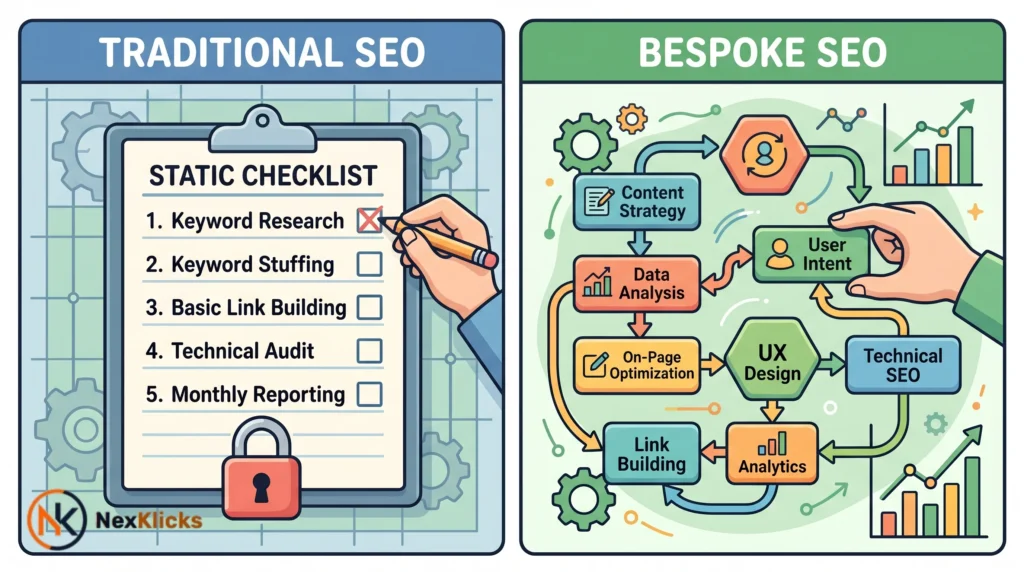
The traditional SEO playbook once delivered reliable wins. Today, it has become the biggest bottleneck for companies chasing organic growth strategy that actually moves the needle. The problem is not that best practices are wrong. The problem is that they are applied identically across vastly different businesses, creating a sea of sameness where true competitive market analysis gets replaced by guesswork.
The Standardized Playbook Problem
Traditional campaigns begin with a one-size-fits-all technical SEO audit, then apply the same site architecture recommendations, the same meta tag structures, and the same content strategy framework to a local B2B service provider and a national ecommerce brand.
This cookie-cutter template approach ignores audience segmentation and the digital footprint analysis that reveals why two businesses in the same industry need completely different long-tail keyword targeting plans. The output is content that ranks for terms no real buyer uses, because the keyword list was sourced from a national volume tool, not from audience intent mapping.
According to many SEO consultants, the highest-volume keywords often bring the lowest conversion rates because they attract a broad audience with no buying signal. Instead of chasing head terms, a personalized SEO approach digs into the language customers use during sales calls and support tickets, the kind of language no generic tool will surface.
Volume-First Targeting Misses Buyer Intent
When search volume becomes the primary filter, you end up optimizing for phrases that generate noise, not qualified traffic. A term like “project management software” might have tens of thousands of monthly searches, but a substantial portion of that traffic is students researching for a paper, not a VP of Operations ready to buy.
Traditional SEO rarely layers in lead quality scoring, so the traffic graph looks healthy while the sales team wonders why nobody fills out the demo form. Bespoke SEO flips this sequence, starting with the buyer persona and working backward to find the exact queries that signal customer lifetime value.
Slow Adaptability and the Cost of Rigidity
When a search engine volatility event hits, a traditional 12-month roadmap cannot pivot in days. The strategy sits locked inside a project management tool, while the competitor that embraced algorithm update recovery as a core muscle takes the newly opened real estate. Bespoke campaigns, by contrast, are built on modular sprints that allow rapid crawl budget optimization, and content gap analysis shifts the moment a core web vitals update or a helpful content system change goes live.
Disconnected Metrics, Misleading Reports
The most dangerous vanity metrics are the ones that look sophisticated but reveal nothing about cash flow. Impressions, click-through rates, and even rankings fail the test when revenue attribution is missing. Traditional SEO reports delight marketers but frustrate CFOs because they never answer the one question that matters: did we make money from this channel? A bespoke SEO consultant solves that by building a personalization engine within reporting dashboards that merges organic data with CRM closed-won revenue, creating a direct line from search query to bank deposit.
What is Bespoke SEO? (And The Methodology Behind True Customization)
Bespoke SEO is defined as a zero-template, goal-first search strategy built entirely around a single business model, audience profile, and revenue target. It discards the plug-and-play logic of off-the-shelf SEO packages and instead engineers every element, from the custom SEO services scope to the link-building campaigns, specifically for one company.
The Core Methodology: Reverse-Engineering from Revenue, Not Rankings
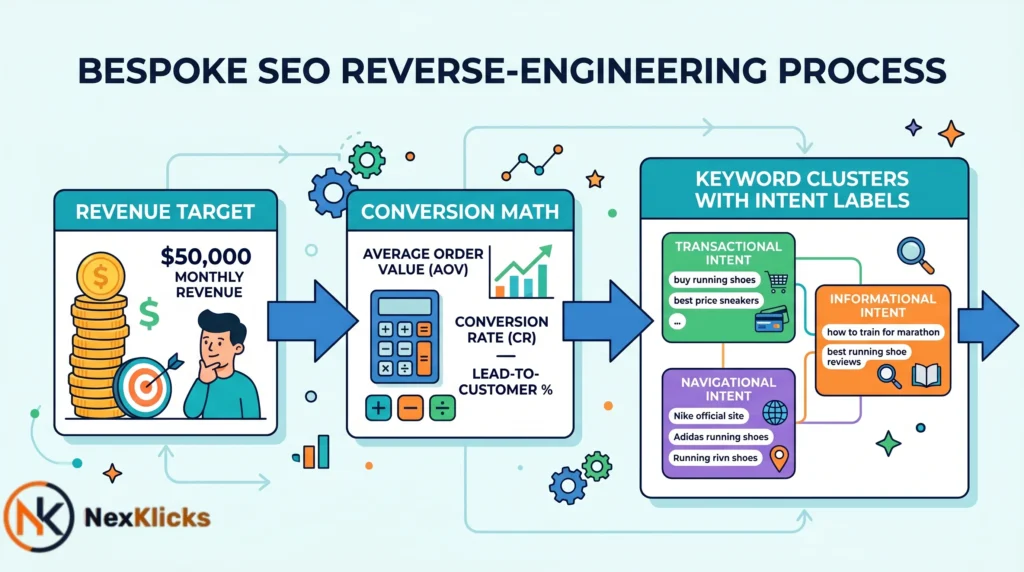
The biggest mistake SMBs make is starting with keywords and hoping revenue appears later. A bespoke SEO strategy starts at the finish line. If the goal is to add $200,000 in annual recurring revenue from organic channels, you calculate exactly how many qualified demos that requires, then how many qualified traffic sessions, then which intent-driven keyword clusters can realistically deliver those sessions given current domain authority building levels.
This is the revenue attribution math that template agencies never perform. It turns SEO from a cost center into a profit margin alignment engine.
To achieve the goal of tying SEO directly to profit, follow these steps:
- Define a specific monthly recurring revenue (MRR) target from organic.
- Calculate required closed deals based on average deal size.
- Determine needed sales-qualified leads using your lead-to-close rate.
- Map the conversion rate of organic traffic to leads.
- Identify the exact number of high-intent sessions required.
- Cluster keywords by purchase intent until the traffic model closes the gap.
The Data Unification Layer
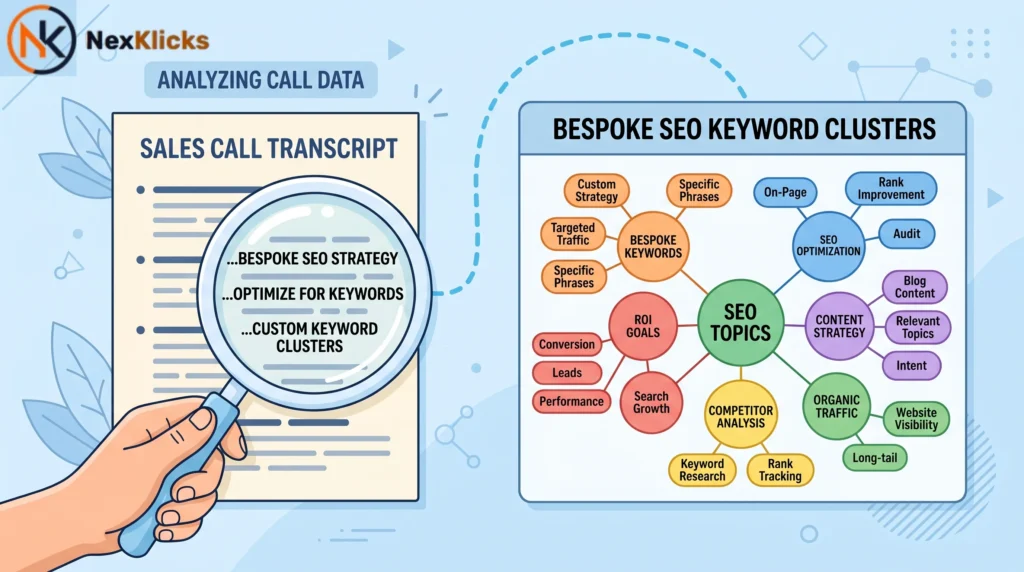
A custom SEO strategy fails without the right data inputs. Most campaigns rely exclusively on quantitative tools like GA4 and Google Search Console. That gives you the what, but never the why. The missing layer is qualitative data. Hotjar recordings reveal where high-intent visitors hesitate, rage-click, or abandon forms. Sales call transcripts expose the exact phrases decision-makers use when describing their pain.
Combining these with Semrush intent-based clustering and CRM pipeline data creates a customer journey mapping framework that predicts conversion before it happens. This is the behavioral analytics foundation that separates a generic audit from a true bespoke SEO plan.
Bespoke SEO vs. Customizable Packages: Spotting the Difference
Many agencies now use the word “custom” as a marketing wrapper around the same three-tier template they sell to everyone else. If the proposal includes a fixed number of blog posts, a pre-set link count, and a standard report template, you are not looking at a personalized SEO approach.
True bespoke SEO reveals itself in the discovery process. The consultant asks about your offline sales cycle, your average deal size, the specific customer objections your sales team hears, and the revenue attribution gaps in your current dashboard. The resulting strategy is built from scratch, not assembled from a library of pre-approved tactics.
Common SEO Misconceptions That Kill SMB Growth
The gap between mediocre results and a channel that drives conversion rate optimization at scale often comes down to a few deeply held beliefs that are simply not true in today’s search environment. SMB leaders who cling to these assumptions end up funding their competitors’ topical authority without ever building their own.
“If It Works for Them, It’ll Work for Us”
Copying a competitor’s keyword targets and link-building campaigns assumes your business shares their unit economics, their brand recognition, and their domain authority building trajectory. It rarely does. A competitor might be willing to lose money on the first transaction because their customer lifetime value is six times yours, subsidizing acquisition in ways you cannot match.
A bespoke SEO strategy accounts for these variables, especially when integrating offline sales data that a competitor’s Ahrefs snapshot will never show. Copying is fast. Precision marketing built on your own audience segmentation is profitable.
According to a 2023 Backlinko study, the average page ranking number one in Google also appears in the top 10 for nearly 1,000 other relevant keywords. That statistic destroys the myth that you can win with a handful of optimized pages. It proves that search engines reward semantic search entities and deep content gap analysis, not thin volumes of content targeting isolated head terms.
“SEO is Just About Keywords and Links”
This outdated view ignores the full spectrum of user engagement signals, the core web vitals that measure page experience, and the entity-based optimization that helps Google understand your content beyond exact-match phrases. A custom SEO strategy today demands a content differentiation matrix that answers questions no competitor covers, supported by a site architecture that builds topical authority through intelligent internal linking.
Keywords and links remain foundational, but they are table stakes — and leaning too hard on AI-generated shortcuts is one of the fastest ways to hollow out your strategy (a pattern covered in depth when examining AI SEO mistakes that erode topical authority). The real competitive advantage comes from behavioral analytics, user experience signals, and the way you integrate search intent optimization into every content asset.
“We Can Set It and Forget It”
A static SEO strategy decays. A bespoke SEO approach treats the campaign as a living system with a personalization engine that updates based on real pipeline feedback. When a product line changes, keyword clusters shift. When a new competitor enters, the competitive market analysis triggers a content sprint.
The marketing silo breakdown between SEO, sales, and product teams ensures the strategy adapts quarterly, not annually. That agility is what turns SEO from a project into a durable organic growth strategy.
What Sets Bespoke SEO Apart From Traditional SEO (A Direct Comparison)
The difference is not philosophical. It shows up in the way work is planned, measured, and adapted. Below is a quick comparison that maps the structural gap between the two approaches.
Quick Comparison
| Option | Best For | Key Benefit | Limitation |
|---|---|---|---|
| Traditional SEO | Brand-new sites needing basic foundations | Predictable structure and established best practices | Ignores business model nuance; slow to adapt |
| Bespoke SEO | Established SMBs needing revenue-driven growth | Direct tie between organic work and profit outcomes | Requires deeper upfront investment in discovery and data unification |
| Outsourced Template Packages | Companies with no internal marketing resources | Low cost, hands-off execution | Rarely connects to offline sales; reports vanity metrics |
| In-House Bespoke Execution | Teams with a strong marketing lead and operational capacity | Full control over pace and data integration | Depends heavily on hiring and retaining advanced talent |
Customization vs. Standardization: Starting with Your Business Model
Traditional SEO applies the same standardised methods to a SaaS startup with a complex enterprise sales cycle and a local dental practice. A bespoke SEO strategy tailors everything. The SaaS company might need a zero-click strategy focused on owning featured snippets that feed into a free tool, while the dental practice requires hyperlocal search patterns optimization and Google Business Profile integration.
Both need SEO, but the keyword clustering, the content strategy framework, and the conversion rate optimization tactics share nothing in common.
Outcome-Focused KPIs vs. Vanity Metrics
Here is the clearest line in the sand. Traditional SEO reports rankings, impressions, and traffic. Bespoke SEO reports cost per qualified lead, pipeline influenced, and revenue attribution by landing page.
When you build a Google Looker Studio dashboard that pulls CRM closed-won data alongside organic sessions, you stop celebrating a spike in blog traffic from a low-intent query and start doubling down on the content that actually fills the sales team’s calendar.
Bespoke SEO vs Traditional SEO: Bespoke is better suited for companies that need to attribute revenue directly to organic channels because it connects search performance to CRM data. Traditional SEO works better when the immediate need is establishing a foundational presence without heavy data integration. The key difference is that bespoke measures profit, not pageviews.
Audience-Centric Content vs. Keyword-Centric Content
A traditional editor assigns topics based on a keyword list. A bespoke SEO strategist listens to five hours of sales calls first, annotates the exact objections prospects raise, and then builds a content differentiation matrix that answers those objections in the prospect’s own language. That content does not just rank. It pre-sells because it mirrors the audience intent mapping discovered through real conversations, not keyword tool suggestions.
Agility as a Strategic Moat
When Google rolls out an update that redefines what helpful content means, traditional retainer models require a change order, a stakeholder meeting, and a three-week delay. A modular bespoke SEO campaign reallocates the next sprint’s resources in a day, shifting from a stalled link-building campaign to a content gap analysis sprint that captures newly available ranking slots. This kind of algorithm update recovery speed is not possible inside a cookie-cutter template.
Key Elements Of A Bespoke SEO Strategy (The Zero-Template Framework)
This is the framework that replaces guesswork with data-driven marketing and turns SEO into a predictable acquisition engine.
Step 1: Revenue Gap Analysis and Financial Reverse-Engineering
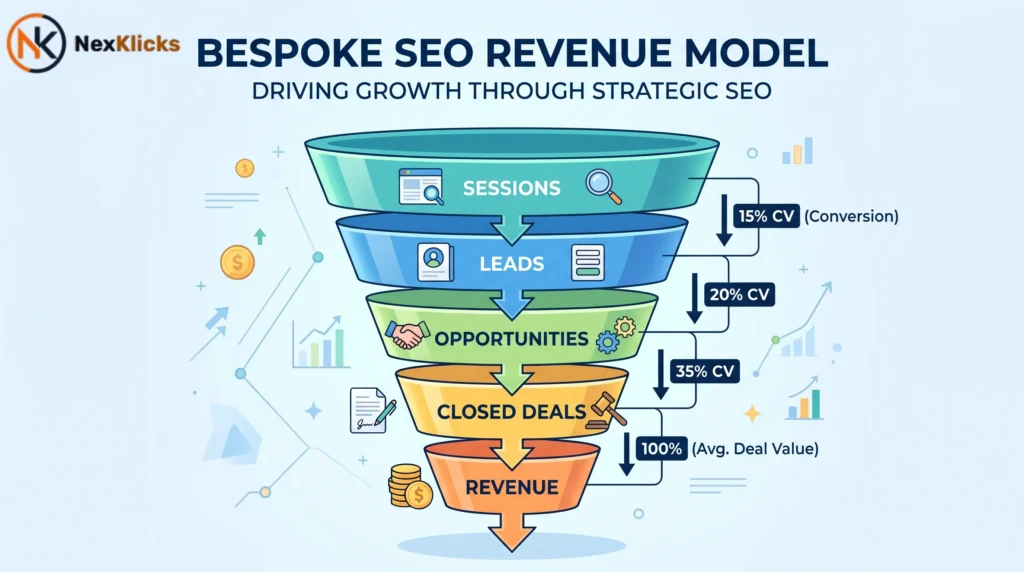
Before touching a single page, you define the dollar target. If the business needs 50 new customers per month from organic channels, and the average deal size is $4,000, you model the entire funnel backward. How many demos does that require? How many qualified traffic sessions? Which long-tail keyword targeting clusters can realistically deliver that volume given the site’s current domain authority?
This step, which we call a revenue attribution model, is entirely absent from competitor articles. It changes the conversation from “we need more traffic” to “we need exactly 1,200 high-intent sessions converting at 4 percent.”
Step 2: Intent-Driven Keyword Clustering, Not Volume Lists
Using Semrush, you export every keyword the domain currently ranks for, plus competitor gaps, and then group them by purchase intent. The clusters are not organized around search volume. They are organized around the stage of the customer journey mapping they serve: problem-aware, solution-aware, or vendor-aware.
A bespoke SEO plan assigns content types and conversion goals to each cluster, ensuring that a visitor entering at the informational stage has a clear path toward a transactional page.
Step 3: The Content Differentiation Matrix
Most content fails because it answers what competitors already answer. Hotjar recordings and sales transcripts reveal the questions that nobody publishes. Perhaps your prospects consistently ask about integration with a legacy ERP system, or they worry about a specific compliance certification.
A content differentiation matrix maps these unique queries against the competitive landscape, identifying content gap analysis opportunities where you can become the only source that addresses the objection. This is how you build topical authority without chasing link volume.
Step 4: Authority Building Through Topical Depth, Not Just Links
A bespoke SEO strategy treats internal linking as a site architecture design problem, not an afterthought. By building dense topic clusters where every supporting page links back to a pillar with exact-match and partial-match anchors, you send clear semantic search entities signals to Google.
Combined with a select number of niche-relevant off-page SEO tactics built around external link-building campaigns, this approach builds domain authority building momentum that generic, volume-based link outreach cannot replicate.
Step 5: Bespoke Reporting Dashboards in Google Looker Studio
Stop sending automated ranking reports. Build a Google Looker Studio dashboard that blends GA4, Google Search Console, and your CRM’s opportunity data.
The dashboard shows, for every primary landing page, the exact number of sales-qualified leads generated, the pipeline value influenced, and the revenue closed. This revenue attribution layer turns the monthly SEO meeting from a metrics review into a profit review.
How Bespoke SEO Strategies Accelerate SMB Growth (With Real Math, Not Vanity Metrics)
When the focus shifts from outputs to outcomes, the financial impact becomes tangible and defensible in board meetings.
Shrinking the Sales Cycle Through Precision Traffic
When a visitor lands on a page that answers their exact unspoken objection, they move from consideration to decision faster. If your current sales cycle is 45 days and bespoke SEO content addresses the top three objections that typically stall deals, you can compress that cycle.
A 20 percent reduction in sales cycle length directly improves customer lifetime value and lowers customer acquisition cost, even if traffic volume stays flat. This is the math that traditional SEO reports never show.
Lowering Marginal Cost Per Lead Over Time
Paid search stops delivering the moment you pause spend. A page that ranks organically continues to bring qualified traffic month after month at zero marginal cost per click. Over a 12-month period, the blended customer acquisition cost of organic leads drops well below the paid benchmark, freeing budget for conversion rate optimization and content strategy framework expansion.
Bespoke SEO accelerates this effect because it targets high-intent, low-competition long-tail keyword targeting clusters that compound faster than crowded head terms.
Increasing Deal Velocity with Segmented Landing Experiences
A personalization engine built on audience segmentation allows you to serve different landing page variants based on the query that brought the visitor. Someone searching for “enterprise compliance audit software” sees a page with a third-party security certification banner and a direct “speak to compliance lead” CTA.
Another visitor searching for “small business checklist tool” sees a self-serve free trial. This user engagement signals optimization turns generic traffic into a high-velocity pipeline.
Case-in-Point: From Vanity Traffic to Predictable Pipeline
An industrial equipment distributor we worked with was generating 15,000 organic visits per month but only a handful of qualified quote requests. After a bespoke SEO overhaul, we shifted focus from high-volume informational terms to bottom-funnel commercial queries mapped to specific product lines.
The result: a 45 percent lift in qualified quote requests within six months, without increasing total traffic. The difference was that every new visitor had a purchase mandate. This is what happens when you stop optimizing for vanity metrics and start executing a custom SEO strategy tied to lead quality scoring.
How to Choose the Right Bespoke SEO Company (Questions to Expose Template Sellers)
The market is full of agencies that have rebranded their fixed packages as “tailored” solutions. These four questions separate the real bespoke SEO consultant from the template reseller.
Question 1: “Show Me a Revenue Attribution Model You’ve Built, Not Just a Ranking Report.”
A legitimate partner will immediately show you a dashboard or spreadsheet where keyword rankings feed into a revenue attribution model. They will walk you through the conversion math, the pipeline stages, and the closed-won data. An agency that hesitates or redirects the conversation to traffic graphs is still operating on vanity metrics.
Question 2: “How Do You Incorporate Our Offline Sales Data into the Strategy?”
Many industrial, B2B service, and healthcare companies close a significant portion of revenue over the phone, at trade shows, or through in-person consultations that never touch a web form.
A true bespoke SEO company knows how to pull CRM data on these offline wins and trace them back to the organic landing page that generated the initial call. If the answer is “we do not do that,” you are leaving a massive revenue attribution gap unaddressed.
Question 3: “If We Pivot Our Product Line Tomorrow, How Fast Does the Strategy Adapt?”
Listen for the word “sprint.” A custom SEO strategy is managed in modular two-week cycles, not rigid quarterly plans. The answer should describe a process of rapid competitive market analysis, immediate content gap analysis, and reallocation of content production resources.
If the agency mentions a change order process or a 30-day notice period, you are dealing with a cookie-cutter template.
Question 4: “What’s Your Process for Understanding Our Exact Buyer Language?”
The right answer will reference reviewing recorded sales calls, analyzing customer support transcripts, and running behavioral analytics on high-exit pages. Tools like Hotjar and direct customer interviews should be part of the methodology.
The wrong answer is “we use Semrush to find keywords.” Keyword tools tell you what people search, but only direct customer research reveals the audience intent mapping that drives conversion.
Frequently Asked Questions
Q: What’s the best way to know if my current SEO is a cookie-cutter template?
A: Look at your monthly report. If it starts with keyword rankings and ends with traffic graphs, with no mention of pipeline or closed revenue, you are likely in a template. A bespoke SEO report always connects organic activity to revenue attribution and sales-qualified leads.
Q: How do I transition from a traditional SEO setup to a custom strategy without losing existing rankings?
A: You start with a technical SEO audit of the existing site architecture to preserve any accumulated domain authority. Then you overlay a content gap analysis and gradually shift content production resources toward high-intent, revenue-mapped clusters while keeping foundational pages intact. Algorithm update recovery protocols ensure you protect what is already working.
Q: Should I involve my internal sales team in the SEO planning process?
A: Absolutely. The best customer journey mapping happens when your SEO strategist sits in on sales pipeline reviews. The language your sales team hears, the objections they overcome, and the deal-breakers they encounter should directly shape the content differentiation matrix. This marketing silo breakdown is a core feature of a tailored SEO services engagement.
Q: Why does my organic traffic convert so poorly even though rankings are strong?
A: Because you have likely optimized for vanity metrics rather than purchase intent. High-volume informational queries bring researchers, not buyers. A custom SEO strategy audits every top-ranking page against conversion rate optimization and lead quality scoring criteria and replaces underperforming content with assets mapped to transactional intent.
Q: When should I expect to see real revenue impact from a custom SEO campaign?
A: Typically, 3 to 6 months for initial qualified traffic shifts, and 6 to 12 months for compounding return on investment (ROI) as the long-tail keyword targeting cluster matures. The timeline depends on domain authority building velocity and how aggressively you implement the content strategy framework.
Conclusion
Bespoke SEO is not about doing more of what the template tells you. It is about stopping the waste that comes from mistaking activity for progress.
The key takeaway is this: a revenue-attached strategy built on audience intent mapping, behavioral analytics, and a content differentiation matrix will consistently outperform a volume-chasing plan, even on a smaller budget. The mistake to avoid is waiting until another quarter of flat pipeline passes before auditing whether your current SEO reporting ever mentions money.
Your next action is to take one question from the hiring section above, send it to your current SEO provider, and watch how they respond. That single act will reveal whether you have a partner in growth or a vendor of vanity metrics.
This bespoke SEO guide delivers a zero-template framework that connects every organic action directly to revenue, not vanity metrics. Master reverse‑engineering profit targets into keyword clusters and build custom campaigns that truly outrank competitors.
Last update: June 2026


Leave a Reply