

You have been publishing more content than ever. You have the AI tools. You have the workflows. But your rankings are not climbing. In fact, some of your best pages are quietly sliding down the search results page, and you are not sure why.
Here is what most guides will not tell you: the problem is not that you used AI. The problem is how you used it.
According to a 2024 2024 BrightEdge Research report, 68% of marketers using AI for content production reported a measurable decline in organic traffic within 90 days when AI content was published without human editing or E-E-A-T signals. That is not a small number. That is most people who tried to scale with AI and did not build in the right safeguards.
This guide covers every major ai seo mistakes damaging site performance in 2026, the actual mechanism behind each one, and what to do about it immediately. If you are also making broader SEO mistakes as a small business owner, many of these patterns will look familiar.
What Counts as AI SEO Mistakes in 2026 (And Why It’s Different Now)
AI SEO mistakes are any practices where AI-assisted or AI-generated content, links, or keyword strategies violate Google’s quality guidelines, misalign with search intent, or undermine topical authority, resulting in reduced organic visibility.
AI SEO mistakes in 2026 are not just about using AI incorrectly. They occur when AI tools replace human editorial judgment, produce content without verifiable expertise, or generate scaled output that lacks structural coherence. The Google Helpful Content Update specifically targets pages that exist for search engines rather than people, and AI-produced content without oversight frequently falls into that category.
This matters now more than it did two years ago because Google RankBrain and BERT have become significantly better at understanding semantic relationships between ideas. They do not just read your page. They evaluate whether your content ecosystem makes sense as a whole. A single well-written post buried in a sea of thin AI content will still drag.
The other shift is the rise of AI Overviews Google now shows at the top of search results. Getting featured in those overviews requires a completely different quality standard than traditional blue-link ranking. Thin content does not get cited. Unverified content does not get cited. Pages without clear authorship rarely do either.
So the mistakes below are not legacy problems. They are happening right now, on sites that thought they were doing AI-assisted SEO correctly.
Mistake 1: Publishing AI Content Without E-E-A-T Signals
This is the most common ai seo mistakes in 2026, and it is the one neither competitor article addresses directly.
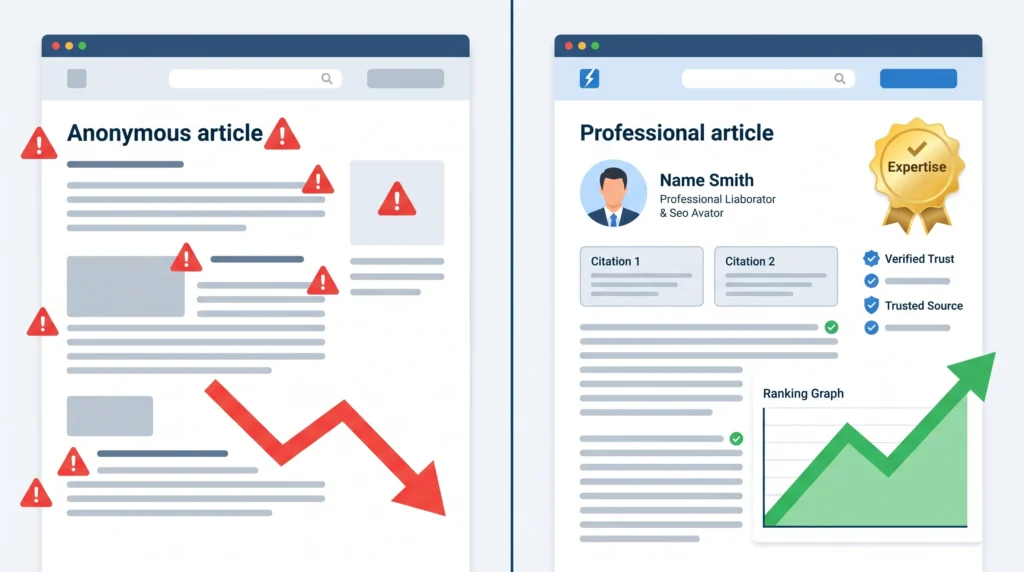
E-E-A-T compliance stands for Experience, Expertise, Authoritativeness, and Trustworthiness. Google uses it as an evaluative framework, particularly for Your Money or Your Life (YMYL) topics and anything where accuracy matters. When you publish AI-generated pages without attaching any of these signals, you are essentially handing Google an anonymous article with no credentials and expecting it to outrank content written by verified humans.
AI-generated thin content fails on every E-E-A-T dimension by default. There is no named author. There is no first-person experience. There are no citations from credible sources. There is no external validation that the information is accurate.
According to the 2024 BrightEdge Research report, sites that published AI content with no author attribution or external citations saw organic traffic declines within 90 days at a rate of 68%. The fix is not stopping AI use entirely. It is attaching human signals: a named expert author, first-hand experience references, and links to primary sources. These signals tell both Google and readers that a real person vouches for the accuracy of the content.
For a broader look at building credible content, see the content writing tips guide.
What to fix:
- Add a named author to every article, with a short bio and relevant credentials.
- Include at least one original insight or experience-based observation per article, even if AI drafted the rest.
- Link to primary sources, studies, or tool documentation rather than other blogs.
- Add a “Last reviewed by” date, especially on evergreen posts.
Use Google Search Console to identify pages with declining impressions. Cross-reference those pages against your publishing log to see which ones went live without author attribution or citations. That pattern usually reveals the core issue quickly.
Mistake 2: Over-Relying on AI for Keyword Strategy Without Search Intent Validation
AI keyword tools are fast. They can generate hundreds of keyword clusters in seconds. But speed creates a specific problem: they surface keywords without always understanding the search intent mismatch between what a keyword implies and what a searcher actually needs.
RankBrain and BERT evaluate intent at the query level. If your page targets a keyword like “best AI SEO tools” but the content reads like an informational guide rather than a comparison, Google will suppress it in favour of pages that match the dominant intent for that search. It does not matter how well-optimised your metadata is.
The seo automation risks here are real. When you let AI determine your keyword strategy without manually validating each intent, you end up with pages that are optimised for a keyword but misaligned with what searchers want to do when they type it. Understanding how to choose the right keywords for content writing before deploying AI tools is the foundational step most teams skip.
What to fix:
- For every target keyword, open an incognito browser and study the top five results. Ask: are these mostly informational articles, comparison pages, or product pages? Your content format must match.
- Use Surfer SEO to audit your existing pages for intent alignment. It surfaces whether your page’s content type matches the format that currently ranks.
- Never delegate final keyword selection to an AI tool without a human review step. The tool proposes. A person decides.
Conversational search queries are growing in volume as voice and AI search become mainstream. These queries have implicit intent that keyword volume data does not capture. A page optimised for “ai seo mistakes” needs to answer the conversational version too: “What mistakes am I making with AI in SEO?”
Mistake 3: Using AI to Scale Content Volume Without Topical Depth
Publishing fifty articles in a month sounds like a content strategy. In 2026, without a topical cluster architecture behind it, it is just noise.
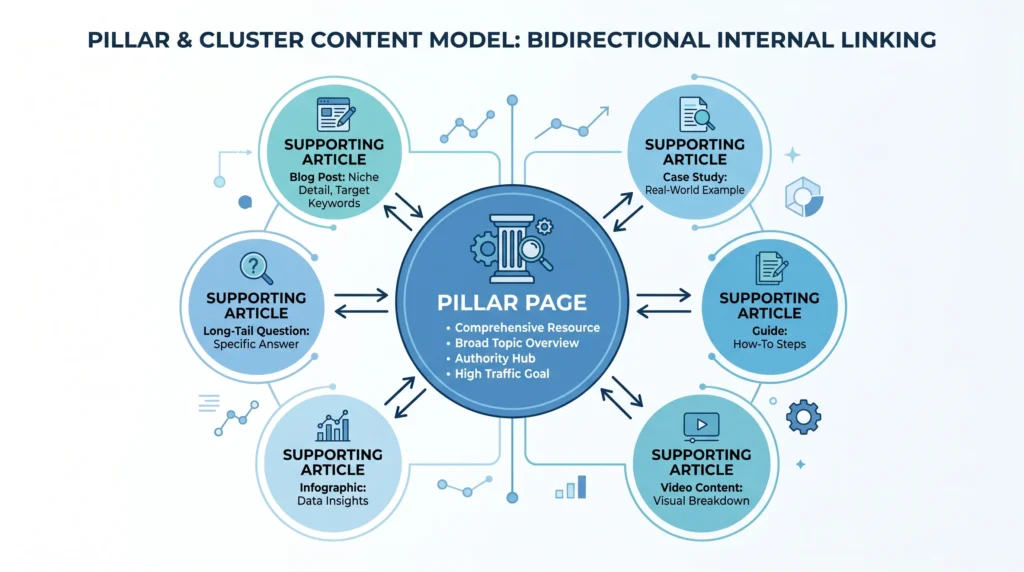
Topical authority seo is built when a site covers a subject comprehensively across multiple interconnected pages. Google’s systems evaluate whether your site can be trusted as a source on a topic by looking at the breadth and depth of your coverage, and how those pages link to each other.
Here is where the second competitor gap becomes critical. Most guides talk about publishing more content. Almost none of them explain that publishing AI-generated topical clusters without internal linking between those pages actively dilutes your authority rather than building it. You end up with isolated pages that cannot pass content quality signals to each other because there are no links connecting them. A practical way to close those coverage gaps is to get a topical map of your competitor’s SEO so you can see exactly where your structure falls short.
To build topical authority with AI content: start with a pillar page on your core topic, then create at least five supporting cluster pages covering subtopics. Link every cluster page back to the pillar, and link the pillar to all clusters. Use Google Search Console to monitor which cluster pages gain impressions first. Those are your strongest topical signals, and they should receive the most internal link support.
What to fix:
- Map your content before publishing. Every new AI-generated article should have a designated pillar page to link back to.
- Audit existing AI content with Originality.ai to identify pages with no internal link connections. These are your orphaned pages, and they weigh down your topical authority profile.
- Prioritise depth over volume. Ten well-linked, expert-level articles on a topic outperform fifty loosely connected ones.
Answer engine optimisation and generative engine optimisation both favour sites with clear topical structure. If you want your content cited in AI Overviews, you need to be the most comprehensive source on the subject, not just a frequent publisher.
Mistake 4: AI Keyword Stuffing Disguised as Natural Language Optimization
This one is subtle, which is why it keeps catching people out.
Early ai seo errors to avoid lists warned against obvious keyword stuffing. Repeating “best project management tool” seven times in a paragraph. That was easy to spot. The 2026 version is harder to detect because AI writing tools have learned to distribute keyword variants across a page in ways that look natural on the surface but read as manipulative to semantic keyword optimization algorithms.
AI keyword stuffing in 2026 looks like this: a 1,500-word article that contains the primary keyword once in the title, twice in H2s, once in the meta description, twice in the body, and then uses five close variants throughout. Each instance feels natural in isolation. Collectively, the page is over-indexed for a single semantic cluster, and Google’s natural language processing seo systems notice.
The Google Helpful Content Update specifically penalises pages that appear written to satisfy search engine formulas rather than readers. Keyword distribution patterns are one signal it uses.
Quick Comparison: AI Writing Approaches and Their SEO Risk
| Approach | Best For | Key Benefit | Limitation |
|---|---|---|---|
| Full AI draft, no editing | Speed | Fast output at scale | High penalty risk, no E-E-A-T |
| AI draft + human edit | Balanced content | Combines speed with quality | Requires editorial time |
| AI outline + human writing | Authority content | Strongest E-E-A-T signals | Slowest production |
| AI for research only | Data-heavy content | Accurate structure | Limited content ROI |
| AI + Surfer SEO optimisation | SEO-targeted posts | Intent-aligned, optimised | Needs human review layer |
What to fix:
- After AI generates a draft, run it through Surfer SEO to check keyword density across the full semantic field, not just the primary term.
- Read the article aloud. If any sentence feels like it exists to include a keyword rather than to inform the reader, rewrite it.
- Use synonyms and related phrases naturally. If your article is about ai seo mistakes, you do not need to use that exact phrase more than six times across 2,500 words.
Mistake 5: Building AI-Assisted Backlinks That Lack Contextual Relevance
Automated link schemes are not a new problem. What is new is the scale at which AI tools now enable them.
Some SEO teams use AI to generate guest post pitches, outreach emails, and even article content for link placement at a volume that was not feasible before. The result is backlinks from pages that have no genuine topical relationship to the content they link to. In entity-based SEO, Google does not just count links. It evaluates whether the linking page, the anchor text, and the destination page form a coherent topical relationship.
Automated anchor text manipulation is also a growing signal. When every backlink uses the same anchor text pattern because an AI tool generated the outreach, it creates an unnatural anchor text distribution that algorithmic review catches. Before outsourcing any link building to AI workflows, read through the guide on responsible backlink outsourcing to understand which signals Google scrutinises most.
What to fix:
- Evaluate every link opportunity by asking: does this page cover a topic my target audience genuinely reads? If not, the link adds noise, not authority.
- Diversify anchor text manually. Use brand name, naked URL, generic phrases, and partial keyword matches across your backlink profile.
- Invest in digital PR. A single mention in an industry publication with genuine editorial standards does more for ai search visibility than fifty AI-generated guest posts on low-authority blogs.
- Audit your backlink profile quarterly using tools like Ahrefs or Google Search Console’s link report. Disavow links from pages with zero topical relevance.
Mistake 6: Ignoring Technical SEO While Over-Investing in AI Content
Content gets the attention. Technical SEO keeps getting delayed. This imbalance is one of the most expensive common seo mistakes in ai search era strategies create.
Core web vitals are a ranking factor, and they affect how AI Overviews and zero-click search optimization features interact with your pages. A slow-loading page that contains excellent content may still lose featured placements to a faster page with slightly less depth. If you are running a SaaS product, the technical requirements are even more specific; the SaaS technical SEO guide covers the exact audit process.
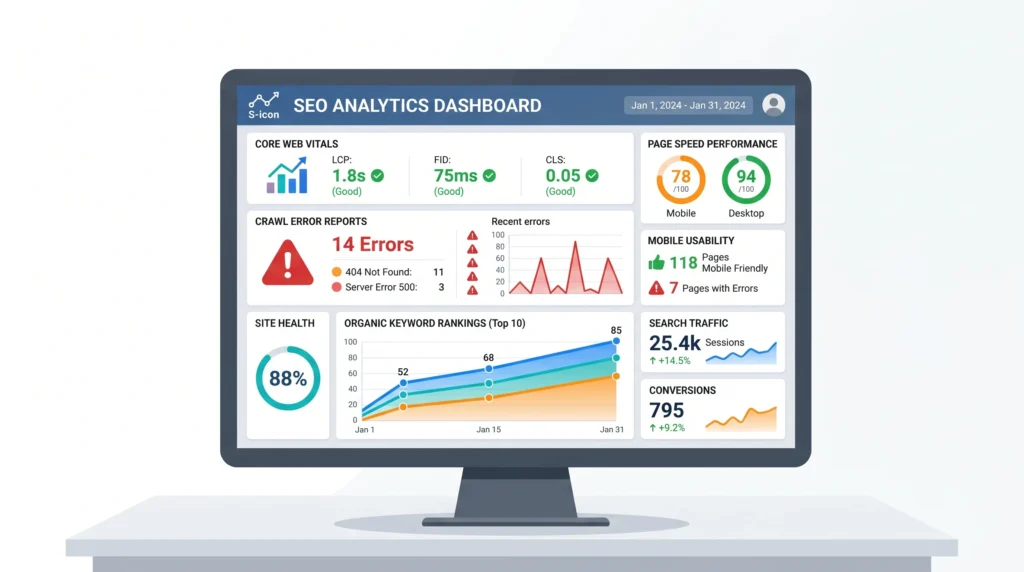
Crawl budget misuse is another technical issue that AI content scaling worsens. When you publish hundreds of thin or duplicate pages, Googlebot spends its crawl budget on those instead of your best content. Your cornerstone pages get crawled less frequently. Updates do not get indexed as quickly.
Structured data schema errors are common on AI-generated pages because the content structure is often inconsistent. An FAQ section that AI generates may not map cleanly to valid FAQ schema markup, which means you lose the rich result opportunity entirely.
What to fix:
- Run a monthly technical audit using Google Search Console and a tool like Screaming Frog. Prioritise crawl error resolution over new content publication when the error count is high.
- Implement FAQ schema on every article that includes a Q&A section. Validate it using Google’s Rich Results Test before publishing.
- Compress images, enable lazy loading, and use a content delivery network. These three changes address the majority of core web vitals failures for content-heavy sites. If you are on Shopify, the Shopify site speed guide walks through platform-specific fixes.
- Consolidate or redirect thin AI-generated pages that are not generating impressions. Reducing crawl budget waste directly benefits your highest-value pages.
- Do not overlook mobile. Run your site through the mobile SEO checklist to catch Core Web Vitals failures that only appear on smaller screens.
- Client-side rendering frameworks like Angular create a retrieval gap that most teams don’t catch until their content is already invisible to AI bots. Our guide on AngularJS SEO and AI crawler visibility explains exactly how to fix it.
Mistake 7: Failing to Update or Audit AI-Generated Content Over Time
AI content has a specific decay problem. Because it is often based on training data with a knowledge cutoff, it becomes outdated faster than content written by an author who actively tracks their niche.
Content decay rate is the speed at which a page loses impressions and clicks after publication. For AI-generated content, this rate is often higher because the information is not refreshed by someone with ongoing expertise in the subject. Understanding the difference between what Search Console clicks vs sessions actually tells you helps you catch decay before it becomes a rankings problem. A page about seo algorithm updates 2026 that was written by an AI in early 2025 and never reviewed will lose relevance faster than one maintained by an active SEO practitioner.
Duplicate semantic content is also a consequence of scaling with AI without a content audit process. Different AI-generated posts on overlapping topics will often cover the same ground with slightly different phrasing. Google’s systems identify this as low-value content, and it dilutes your topical authority rather than strengthening it. Understanding how Google handles multiple links to the same page also matters here, as internally linking near-duplicate pages signals confusion rather than authority.
What to fix:
- Schedule quarterly content audits. Use Google Search Console to identify pages where impressions are falling. Those are your decay candidates.
- Update statistics, examples, and tool references in every AI-generated article at least once every six months.
- Use Originality.ai to scan your content library for semantic overlap between posts. Pages covering more than 60% of the same ground as another page should be merged or differentiated substantially.
- Add a visible “Last updated” date to every post. This is a trust signal for both readers and crawlers.
How to Use AI in SEO the Right Way Without Triggering Penalties
AI is not the enemy of good SEO. Thoughtless AI use is.
The sites ranking well in 2026 are not avoiding AI. They are using it for specific tasks where it adds genuine speed and value, then applying human judgment at every decision point that affects quality, accuracy, or strategic direction.
Human oversight in seo is not a bureaucratic extra step. It is the actual differentiator between content that builds authority and content that drains it. The same principle applies for SaaS companies; most of the common SaaS SEO mistakes trace back to removing human review from content and technical workflows.
Here is what a responsible AI-assisted SEO workflow looks like:
Research phase. Use AI tools to surface keyword clusters, identify PAA questions, and map competitor content gaps. Then validate every keyword against real search intent manually.
Drafting phase. Use AI to generate a structured draft or outline. Then edit for accuracy, add first-person experience signals, insert citations from primary sources, and rewrite any section that reads formulaically.
Optimisation phase. Use Surfer SEO to check semantic coverage and keyword distribution. Use Originality.ai to check for unintentional duplication with your existing content library. Use Google Search Console to monitor performance post-publication.
Maintenance phase. Set a calendar reminder every 90 days to review each AI-assisted post. Check whether the statistics are still current, whether the tool recommendations are still valid, and whether the page is gaining or losing impressions.
Voice search seo mistakes are also worth noting here. AI-generated content often misses conversational search queries because it optimises for written keyword patterns rather than spoken question formats. Including natural language question-and-answer sections within your content improves both answer engine optimization performance and voice search visibility.
AI SEO Mistakes Checklist: Audit Your Site Before Your Rankings Drop Further
Use this checklist as a monthly audit framework for any site using AI in its content process.
Content Quality
- Every published page has a named author with credentials or verifiable expertise.
- At least one first-person insight or original observation appears per article.
- All statistics link to primary sources, not aggregator blogs.
- No page relies entirely on AI-generated text without a human editorial pass.
Keyword and Intent
- Every target keyword has been manually validated against the dominant SERP intent.
- Keyword density has been reviewed in Surfer SEO for the full semantic cluster.
- No page targets a keyword cluster already covered by another post on the same domain.
Technical Health
- Core Web Vitals scores have been checked in the last 30 days.
- FAQ sections use valid structured data schema, confirmed by Rich Results Test.
- No orphaned AI-generated pages exist without at least two internal links pointing to them.
Link Profile
- Backlinks from the last 90 days have been reviewed for topical relevance.
- Anchor text distribution across new links is varied and natural.
- No guest post outreach used identical AI-generated pitch templates at scale.
Content Freshness
- All AI-generated posts published more than six months ago have been reviewed for accuracy.
- Declining pages identified in Google Search Console have been updated or consolidated.
- Semantic overlap between posts has been audited using Originality.ai.
FAQ
Q: What’s the best way to check if AI content is hurting my SEO?
A: Open Google Search Console and filter for pages with falling impressions over the last 90 days. Cross-reference those pages with your AI publishing dates. That correlation usually identifies the problem quickly.
Q: How do I fix AI content that has already been penalised?
A: Add a named author with credentials, insert original insights or first-person observations, link to primary sources, and update any outdated statistics. Resubmit the URL for indexing in Google Search Console after editing.
Q: Should I stop using AI tools for SEO content entirely?
A: No. Use them for drafting, research, and structure. Stop using them as a replacement for human editorial judgment. AI drafts need human review, accurate sourcing, and E-E-A-T signals before publishing.
Q: Why does Google penalise AI-generated content if it reads well?
A: Google evaluates content quality beyond readability. It looks for authorship signals, topical depth, citation patterns, and user engagement. AI content that reads well but lacks these signals still fails the Helpful Content System evaluation.
Q: When should I update AI-generated blog posts?
A: Every six months at minimum. Prioritise posts where Google Search Console shows declining impressions or where the topic involves statistics, tools, or algorithm-dependent advice, as these become outdated fastest.
Conclusion
The single most important thing to take away from this guide is that AI does not cause ranking drops. The absence of human judgment in AI-assisted workflows does.
The most damaging AI SEO mistakes often happen when businesses publish AI-generated content without attaching authorship, citations, and first-hand experience signals. That omission is responsible for more Helpful Content System demotions in 2026 than any other single factor.
Your next action: open Google Search Console, filter pages by declining impressions over 90 days, and identify which of those pages were published without a named author or primary source citations. Fix those pages first. Everything else follows.
This guide focuses on the most common AI SEO mistakes that reduce rankings, traffic, and topical authority. It does NOT cover advanced AI tool tutorials, prompt engineering techniques, or AI software reviews.
Last updated: June 2026

Leave a Reply