
The journey to global markets is paved with good intentions, but a poorly executed expansion can leave your website invisible to the very audiences you’re trying to reach. A standard technical seo audit won’t cut it when you’re dealing with multiple languages, countries, and cultural nuances. You need a specialized approach.
The international seo audit is the only way to diagnose why your site performs well at home but struggles abroad. It forces you to look beyond simple translation and confront the core elements of geo-targeting, content localization, and the complex web of hreflang tags. This isn’t just a checklist; it’s the strategic blueprint for turning your global ambition into tangible organic growth.
What Is An International SEO Audit?
An international SEO audit is a comprehensive review of your website’s ability to rank in multiple countries or languages. It goes far beyond a standard audit by examining your URL structure, technical health, content localization, keyword strategy, and, most critically, your hreflang implementation. Its purpose is to identify specific gaps that are preventing your site from performing on a global stage.
Unlike a domestic technical SEO audit, an international one must account for how search engines serve different versions of your pages to users in different regions. It must check if your content, metadata, and signals align with local search intent and if your site architecture supports multi-country or multilingual SEO without causing confusing duplicate content issues. It’s the only way to ensure that you’re not just translating content but truly serving the right audience in the right way.
An International SEO Audit is defined as a systematic review of a website’s technical configuration, content, and off-page factors to diagnose and fix issues preventing it from ranking in target countries and languages. It ensures the right content reaches the right global audience.
Why an International SEO Audit is Critical for Global Growth
Ignoring the unique requirements of international SEO isn’t just a missed opportunity; it’s an active hindrance to your global growth. Your potential customers in other countries are searching for your products or services right now. If your site isn’t optimized for them, your competitors’ are.
The Numbers Don’t Lie
The data is compelling. Beyond the 76% preference for native language content, 96% of marketers who invested in localization reported a positive ROI. Furthermore, 68% of B2B decision-makers now begin their research in an AI search tool. This means your visibility in AI-driven search environments, like Google’s SGE, is becoming just as critical as traditional rankings. An audit that doesn’t account for this is incomplete.
The risks of inaction are equally serious. A broken hreflang setup or a poorly managed site migration can cause entire regional sections of your site to be de-indexed. Correcting a failed international rollout is almost always significantly more expensive and time-consuming than building it correctly from the start. In essence, a step-by-step international SEO audit is the most cost-effective insurance policy for your global expansion.
Phase 1: Pre-Audit Strategy
Before you even look at a piece of code or a line of content, you need a plan. The most technically perfect audit is useless if you’re not auditing the right things. The pre-audit phase is about defining your goals and ensuring your resources align with your ambitions.
Step 1: Define Your International SEO Goals
Your first action item is to get incredibly specific about your target markets. Which countries and languages are you targeting? This is more nuanced than it sounds. Switzerland has four official languages, while a single language like Spanish spans over 20 countries.
- Decision Point: Geo-Targeting vs. Linguistic Targeting
- Geo-targeting focuses on specific countries. You’ll optimize for users in Japan, including local hosting signals, ccTLDs, and Japan-specific content.
- Linguistic targeting focuses on language. A single Spanish-language section can attract users from Spain, Mexico, Argentina, and beyond.
Many brands benefit from a hybrid approach: using linguistic targeting for broader language groups while having specific geo-targeted strategies for their most important markets.
Step 2: Analyze Market Potential & Viability
Blindly entering a new market is a recipe for disaster. You must assess if there’s actually a demand for what you offer.
- Action Item: Use a robust tool like SEMrush Market Explorer to assess market size, total traffic, and consolidation. This will show you if the market is open for new players or dominated by a few giants.
- Checklist: Beyond search data, confirm you can handle international shipping, review local regulations, and genuinely understand cultural preferences. Just because you can sell in France doesn’t mean you should without proper research.
Step 3: Review International SEO Resource Requirements
International SEO is an investment. You need to budget for more than just a new domain.
- Action Item: Outline the costs for professional translation and content localization, the technical setup (regional URLs, hreflang), and additional content creation support like writers and editors who are native speakers. You might be a lean startup or an established global brand; your budget will dictate your strategy.
Phase 2: Technical Infrastructure Analysis
This is where the rubber meets the road. A weak technical foundation will cripple even the best content. Your international SEO audit must be a forensic examination of how your site is structured and served to the world.
Step 4: Evaluate Your URL Structure For International Targeting
Choosing the right URL structure is one of the most consequential decisions in international SEO. The choice isn’t always easy, but a clear decision matrix can help.
Quick Comparison
| Option | Best For | Key Benefit | Limitation |
|---|---|---|---|
| ccTLD (e.g., .fr) | Large enterprises with dedicated regional teams. | Strongest geo-targeting signal, high local trust. | Most expensive, divides authority, requires separate link-building. |
| Subdirectory (e.g., /fr/) | Most businesses have a centralized content team. | Consolidates domain authority, easy to manage. | Slightly weaker geo-targeting signal than a ccTLD. |
| Subdomain (e.g., fr.) | Flexible hosting needs or staging environments. | Flexible, can be hosted in-country for speed. | Link equity is partially separated, can dilute authority. |
For most growing businesses, subdirectories on a strong root domain represent the best balance of SEO performance and management complexity.
Step 5: Conduct A Technical SEO Analysis
Your content may be brilliant, but if search engines can’t find or properly render it, it’s invisible. This section of the audit is about ensuring flawless technical health. If your site has deeper infrastructure problems, professional technical SEO audit services can surface issues that crawlers alone will miss.
- Crawlability & Indexing:
- Tool: Use Screaming Frog and Google Search Console to crawl all regional variants of your site.
- Check: Look for incorrect
noindextags,robots.txtrules blocking regional URL patterns (e.g.,/fr/), and “orphaned” pages that aren’t linked from your sitemap or internal navigation.
- Page Speed & Core Web Vitals:
- Tool: Use Google PageSpeed Insights and test from each target region, not just your home country.
- Check: Implement a Content Delivery Network (CDN) with edge nodes close to your target markets. Compress images with next-gen formats like WebP and enable browser and server-side caching. Ensure you are meeting the new INP (Interaction to Next Paint) standard for responsiveness.
- Mobile Friendliness:
- Tool: Test with Google’s Mobile-Friendly Test for each regional variant.
- Check: Responsive design, readable fonts, and large, tappable CTAs. In many emerging markets, mobile accounts for over 90% of web traffic.
- HTTPS & Security:
- Check: Every single regional version of your site must be served over HTTPS. Mixed-content warnings destroy user trust and can suppress rankings.
Step 6: Audit and Implement Hreflang Tags
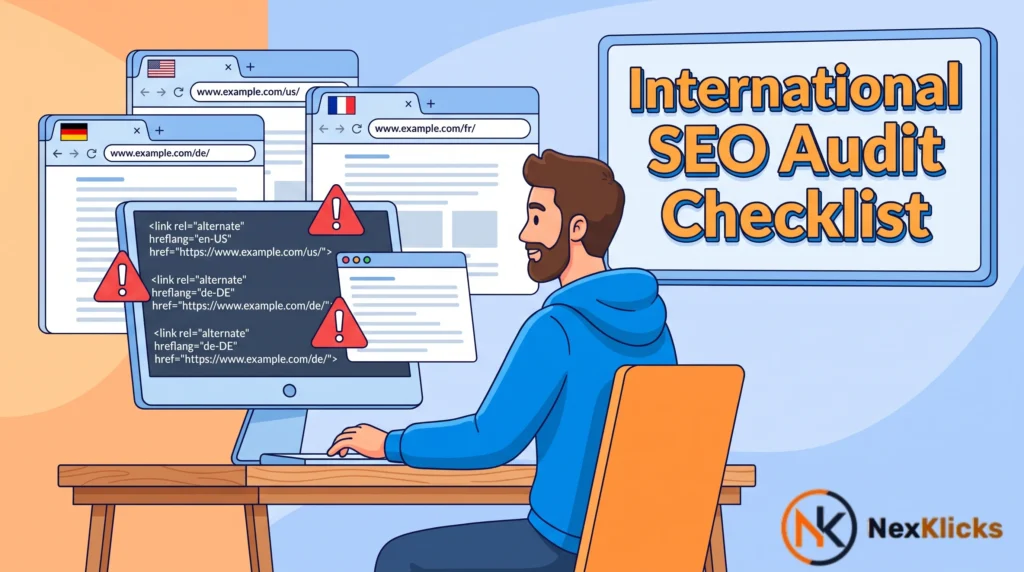
Hreflang tags are the technical backbone of an international SEO audit, and getting them wrong silently kills your regional rankings. They tell Google which language and regional version of a page to serve to a user.
- The Golden Rules of Hreflang:
- Every page must reference all other language/region variants of that page, including itself. This is called a self-referential tag.
- Bidirectionality is mandatory. If Page A points to Page B, Page B must point back to Page A.
- Always include an
x-defaulttag to point to a default or fallback page for users who don’t match any specific language or region targeting.
Common Errors to Fix:
- Missing reciprocal tags: One of the most frequent and damaging mistakes.
- Incorrect language/country codes: Using “en-UK” instead of the correct “en-GB”.
- Hreflang pointing to redirected or non-indexed URLs.
- Mismatched hreflang and canonical tags.
To audit your hreflang tags:
- Use a crawler like Screaming Frog to extract all hreflang annotations from your site.
- Cross-reference them to ensure every page has a self-referencing tag.
- Verify that all tags are reciprocal (A points to B, B points to A).
- Check for any tags pointing to 404 or redirected pages and fix or remove them.
Step 7: Handle Duplicate Content and Canonicalization Issues
Having similar content across regions is common. For instance, a US and UK page for the same product will have near-identical descriptions. This is where canonical tags become essential.
- Action Item: Use a canonical tag to specify the “master” version of a page for each language or region. This prevents keyword cannibalization by telling search engines which version is the primary one.
- Check: Always keep your hreflang and canonical tags in sync. The canonical tag on a page should point to the same page or the primary regional version, not to another language version.
The 2026 Technical Must-Checks
The world of SEO evolves fast. A 2026 audit must include checks that were barely on the radar a year ago.
- AI Bot Governance:
- The Mistake: 71% of publishers are accidentally blocking AI retrieval bots (like GPTBot, ClaudeBot, and Google-Extended) in their
robots.txtfile. This removes their content from the knowledge bases powering AI search tools. If you’re unsure how AI-driven search is changing your visibility, start by reviewing the most common AI SEO mistakes to avoid before you touch your robots.txt. - Check: Audit your
robots.txtto ensure you are allowing these retrieval bots. You might want to block AI training bots, but you almost certainly want to allow retrieval bots for AI search.
- The Mistake: 71% of publishers are accidentally blocking AI retrieval bots (like GPTBot, ClaudeBot, and Google-Extended) in their
- Structured Data for AI:
- Check: Search engines are increasingly understanding the web through entities. Audit your structured data and schema markup for semantic completeness. Ensure you have proper entity relationships and
sameAslinks to build a robust knowledge graph. This makes your content more “citable” by AI systems.
- Check: Search engines are increasingly understanding the web through entities. Audit your structured data and schema markup for semantic completeness. Ensure you have proper entity relationships and
- Content Pruning Analysis:
- Check: Identify pages across all your regional sites that have received zero organic traffic over the past 12 months. Removing or consolidating this low-value content can significantly improve your crawl budget and strengthen your overall quality signals.
Phase 3: Content & Keyword Strategy
Content that ranks in one country can utterly fail in another. This phase is about moving beyond translation to true, effective content localization.
Step 8: Conduct International Keyword Research For Each Market
This is non-negotiable, and it’s a step that separates a surface-level review from a genuine international SEO audit. Keyword research here is independent market discovery, not a translation exercise.
- Action Item: Start fresh in each target language. Do not translate your existing keyword list.
- Tools: Use Ahrefs or SEMrush with regional database filters, Google Keyword Planner with country targeting, and Google Trends to compare search volume and seasonality.
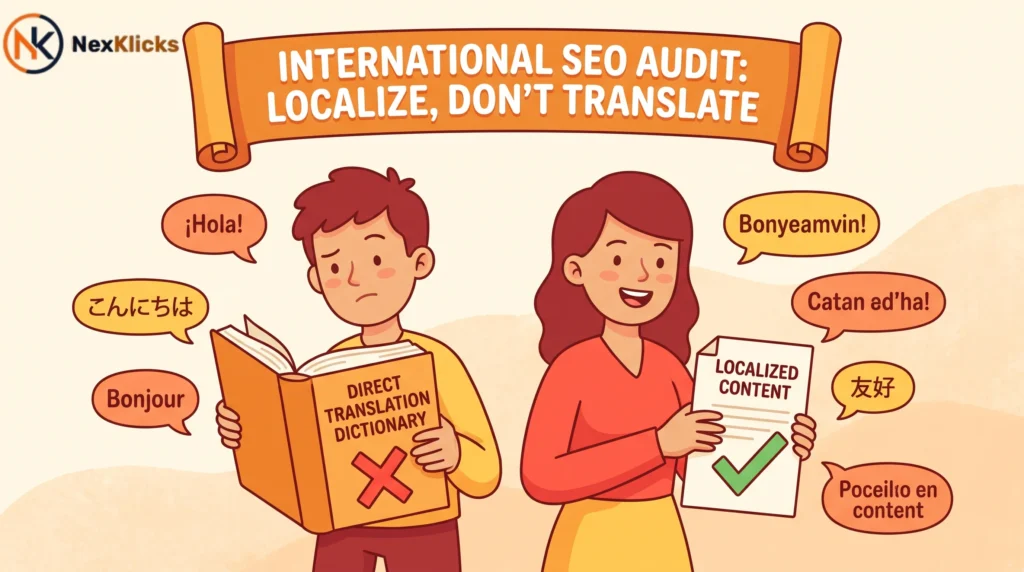
- Check: For example, if you sell glasses in Spain, you would target the word “gafas.” In Mexico, you would target “lentes.” This seems obvious, but it’s a common pitfall. You must identify local slang, cultural nuances, and seasonal trends unique to each market.
Step 9: Optimize Content for Localized & Multiregional Audiences
- Action Item: Localize, don’t just translate. The difference is profound. Translation converts words; localization adapts the entire message—the tone, cultural references, examples, imagery, and offer framing—to resonate authentically with a local audience.
- Checklist:
- Replace sports analogies, idioms, or pop culture references that won’t land.
- Adapt pricing formats, date formats, and measurement units.
- Adjust imagery to reflect local demographics and aesthetics.
- Rethink your value proposition. What matters in a price-sensitive market like Brazil may differ from a quality-focused market like Germany.
Step 10: Localize Metadata and Structured Data
- Action Item: Your title tags, meta descriptions, H1 tags, and URL slugs must be written in the target language, not in English with a translated title bolted on.
- Action Item: Implement locally-targeted structured data. For example, use local business schema with the local address format, currency, and review platforms relevant to that specific country.
Phase 4: Authority Building & Off-Page SEO
You can have the most perfectly localized content on the planet, but if you lack authority in a given region, your rankings will stall.
Step 11: Build International Backlinks (Commonly Overlooked)
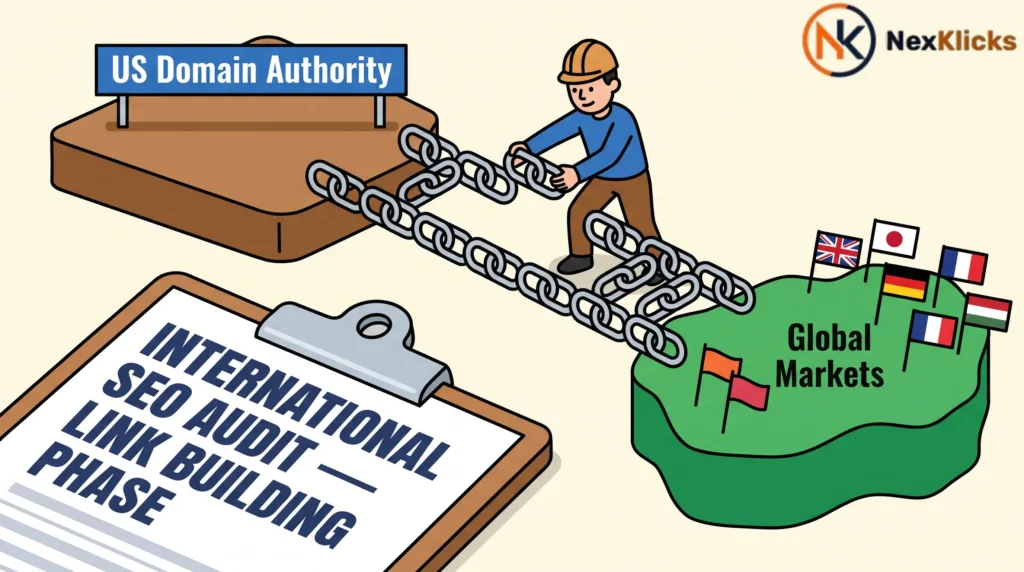
One of the biggest gaps in a typical international SEO audit is the backlink profile. A strong US backlink profile does not automatically give you authority in the UK or Japan. Before building a regional backlink strategy, review proven off-page SEO tactics for local authority. Many of these principles apply directly to international link acquisition.
- Action Item: Assess your regional backlink profile. Do you have links from reputable, country-specific domains (like
.de,.fr,.jp)? - Tactics for Local Link Building:
- Get listed in local business directories and regional industry associations.
- Build relationships with local journalists, bloggers, and publishers.
- Create region-specific resources (local statistics, market reports, location-specific guides) that naturally earn local links.
- Run localized digital PR campaigns targeting regional media outlets.
Phase 5: Measurement & Reporting
You can’t improve what you don’t measure. Your international SEO audit must culminate in a solid framework for tracking your global performance.
Step 12: Set Up International SEO Tracking and Reporting
- Google Search Console: Add each regional variant (or ccTLD) as a separate property. Use the country filter to segment performance data by region.
- Google Analytics 4 (GA4): Configure geographic reports to segment organic traffic, conversion rates, and engagement metrics by country.
- Rank Tracking: Use tools like Ahrefs or SEMrush to track keyword rankings for specific countries. This gives you accurate position data that accounts for regional personalization.
- Conversion Tracking: Track conversions by market. A gap in conversion rates often reveals localization issues that rankings alone won’t expose.
Your 12-Step International SEO Audit Checklist
This is the core of your strategy—an actionable, printable checklist to guide your entire audit. Use this international SEO audit checklist to ensure you leave no stone unturned.
The Actionable Checklist (One-Pager)
- [ ] Target countries and languages defined.
- [ ] Geo-targeting vs. linguistic targeting approach confirmed.
- [ ] Market potential analysis completed for each target region.
- [ ] URL structure (ccTLD, subdirectory, or subdomain) selected and implemented.
- [ ] Full crawl of all regional variants completed.
- [ ] Indexing issues identified and resolved.
- [ ] Page speed benchmarked by region (Core Web Vitals).
- [ ] Mobile usability tested across all regional pages.
- [ ] HTTPS confirmed on all regional URLs.
- [ ] Duplicate content and canonicalization audited.
- [ ] Hreflang tags implemented and validated (self-referencing, bidirectional, x-default).
- [ ] Hreflang errors identified and resolved.
- [ ] Key pages fully localized (not just translated).
- [ ] Metadata (title tags, meta descriptions, H1s) localized.
- [ ] Regional internal linking structure reviewed and optimized.
- [ ] Cultural references, imagery, and messaging reviewed.
- [ ] Regional backlink profile assessed.
- [ ] Local link acquisition strategy defined.
- [ ] Google Search Console is configured for each regional property.
- [ ] Country-specific rank tracking enabled.
- [ ] GA4 geographic segmentation and reporting confirmed.
- [ ] AI bot access governance configured (allow retrieval bots).
- [ ] Structured data audited for semantic completeness.
- [ ] Content pruning analysis performed.
Common International SEO Mistakes To Avoid
Even experienced SEOs make costly errors when going global. Awareness of these pitfalls is half the battle.
The 7 Deadly Sins of International SEO in 2026
- Translation vs. Localization: You’re translating, not localizing. It’s the single most common and damaging mistake.
- One-Size-Fits-All Keywords: Using the same keyword strategy for every country. This ignores local search behavior and cultural nuance.
- Hreflang Hell: Incorrect or incomplete hreflang implementation. It’s a silent ranking disaster.
- Blocking the Bots: Accidentally blocking AI retrieval bots in
robots.txt. You’re excluding your content from the future of search. - Ignoring Local Engines: Optimizing exclusively for Google in markets where Baidu, Yandex, or Naver dominate. For a truly comprehensive strategy, you must know which search engine your audience uses.
- Slow Global Pages: Not using a CDN results in poor Core Web Vitals in target regions. A fast site in the US might be painfully slow in Southeast Asia.
- No Local Links: Neglecting to build a local backlink profile. Without local authority, you will be outranked by native sites.
Choosing an International SEO Agency or Consultant
The complexity of international SEO often necessitates bringing in outside expertise. But how do you choose the right partner?
The 2026 Vetting Process
- Demand a Thorough Audit: An agency that wants to jump straight to implementation without a thorough audit is a huge red flag. The audit is their diagnostic tool.
- Verify Past Performance: This is critical. Don’t take their word for it. Request verified access to Google Search Console data for past clients. Use tools like Ahrefs or SEMrush to review their clients’ organic traffic trends over time.
- Ask About AI Search: How does the agency optimize for AI search (often called GEO or AEO)? Their strategy must go beyond traditional blue-link rankings.
- Check for Red Flags: Be wary of agencies that focus on vanity metrics, refuse to share past performance data, or lack real multilingual expertise on their team. If they rely on Google Translate, run.
Conclusion: Take the Next Step in Your Global SEO Journey
The international SEO audit is arguably the highest-leverage investment a business with global ambitions can make. It doesn’t just identify problems; it gives you a clear, prioritized roadmap to solve them. It’s the tool that transforms a globally ambitious business into a globally visible one.
A successful international presence requires a commitment to native-language research, proper hreflang implementation, and genuine content localization. International SEO for ecommerce, SaaS, or media all share these fundamental requirements, though the specifics will differ. The one mistake you must avoid is viewing your international strategy as a one-time project. It’s an ongoing process.
Ready to take the next step? Use the checklist above to start your own audit. If you find you’re in over your head, or if you’re entering multiple markets simultaneously, partnering with an experienced international SEO company can save you months of costly trial and error. Start your audit today.
Frequently Asked Questions
Q: How long does an international SEO audit take?
A: A thorough audit typically takes 2–6 weeks, depending on the number of target markets, the size of your site, and whether technical issues require immediate remediation.
Q: What is the most important factor in international SEO?
A: While hreflang implementation and URL structure are technically critical, content localization is what ultimately drives conversion and long-term rankings.
Q: Do I need a separate website for each country?
A: Not necessarily. Subdirectories under a single domain (e.g., example.com/fr/) consolidate domain authority and are often the most effective option for growing businesses.
Q: How is international SEO different from multilingual SEO?
A: International SEO vs multilingual SEO is a common point of confusion. International SEO focuses on targeting users in different countries (and may involve the same language, like US vs. UK English). Multilingual SEO specifically addresses multiple languages. Many strategies require both.
Q: What are the new technical items to check in a 2026 audit?
A: Key new areas include AI bot governance (not blocking retrieval bots), auditing structured data for semantic completeness (for AI citation), and performing content pruning analysis.
Q: How do I find an international SEO agency I can trust?
A: Demand verified data from past clients, check for AI search experience, and avoid any agency that skips the detailed audit phase.
This guide walks you through every critical step of a complete international SEO audit, from hreflang implementation and URL structure to content localization and regional link building. Use it as your go-to playbook before expanding into any new global market.
Last Updated: June 2026


Leave a Reply