
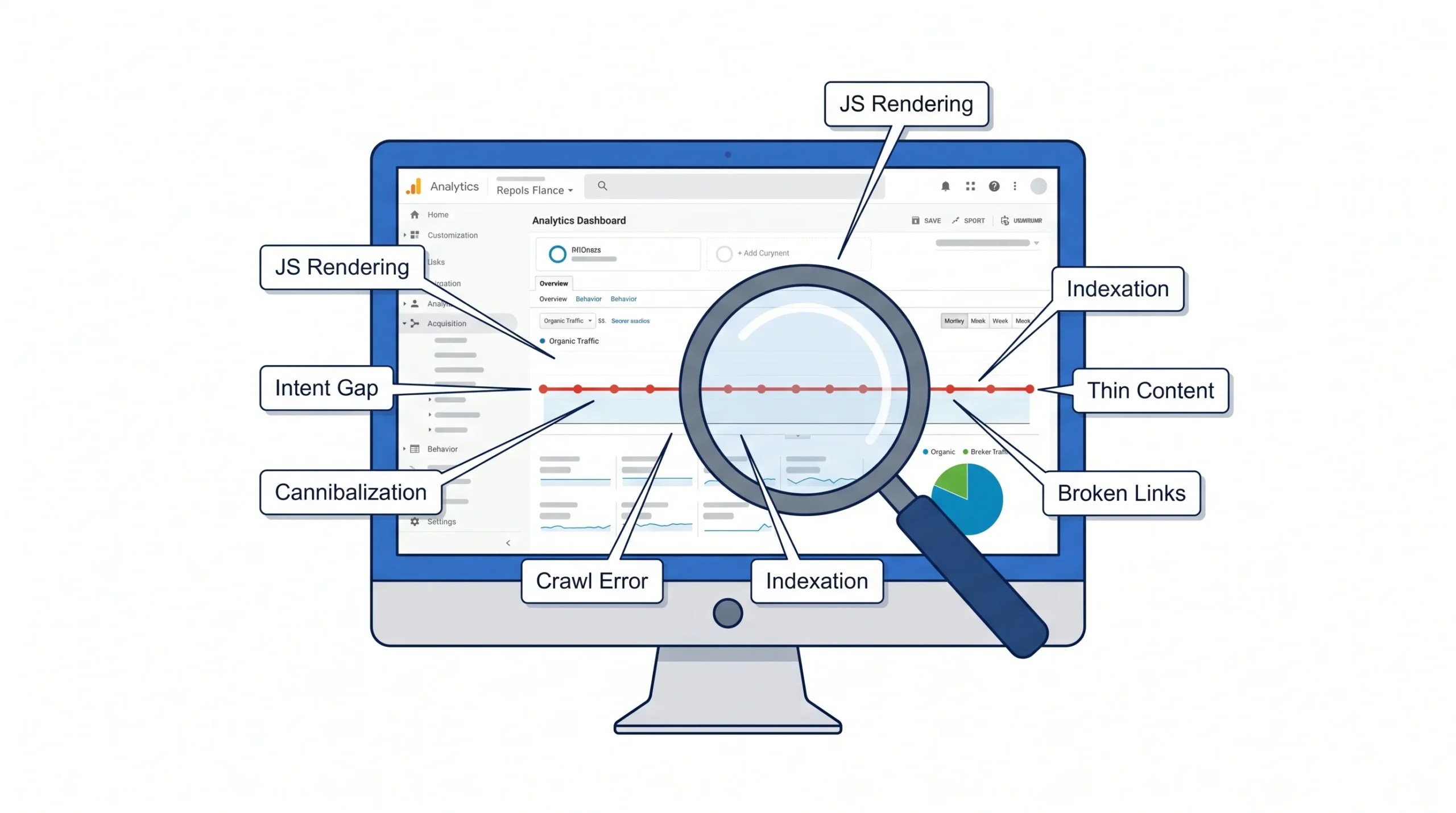
Last updated: May 2026
This guide covers B2B SaaS companies managing their own organic growth. It does NOT address e-commerce SEO, local SEO, or enterprise platforms with dedicated 10+ person SEO teams.
You’ve been publishing. You’ve got Ahrefs. You’ve watched the tutorials. And yet the traffic graph is flat.
Most articles about SaaS SEO mistakes hand you the same list: fix your meta titles, write more content, build some backlinks. That advice isn’t wrong. It’s just not where the real leaks are. The mistakes that actually stall SaaS organic growth in 2026 are structural, architectural, and increasingly tied to how AI-driven search works, none of which appear in the average “10 SEO tips” post.
This breakdown targets the errors that experienced SaaS marketers miss, not the beginner stuff.
What SaaS SEO Mistakes Actually Are (And Why They’re Different)
SaaS SEO mistakes are strategic and technical errors specific to software-as-a-service platforms that prevent pages from ranking, converting, or being understood by search engines. Unlike general website SEO errors, SaaS-specific mistakes often involve JavaScript rendering failures, misaligned search intent across the funnel, and content that targets keywords without matching the product’s actual value proposition.
SaaS platforms have a different architecture problem than, say, a blog or an e-commerce store. Your product pages are often built in React or Next.js. Your feature pages are dynamically generated. Your comparison pages, the ones that should be acquisition machines, are either missing or buried three clicks deep.
Search engines evaluate platform structure, entity relationships, and technical clarity. When those three things are broken, it doesn’t matter how many blog posts you publish.
The hard truth: According to the Digital World Institute (2025), only 19% of SaaS companies actively optimize underperforming pages, even though doing so can lift sitewide traffic by 10–15%. Most teams just keep publishing new content instead of fixing what’s already there.
That changes everything about where you should spend your time.
The SaaS SEO Mistakes Nobody Talks About in 2026
Mistake 1: Your JavaScript-Rendered Pages Are Invisible to Crawlers
This is the one that stings the most because it’s invisible until you look for it.
Most modern SaaS platforms render product pages, feature pages, and integration directories using client-side JavaScript: React, Vue, Angular. The problem is that Googlebot’s crawl-render pipeline is not instantaneous. There’s a crawl budget delay between when Google fetches a URL and when it actually renders the JavaScript. Pages that haven’t been rendered yet get indexed with near-zero content.
Run a quick test: open Google Search Console, go to URL Inspection, paste in one of your feature pages, and click “Test Live URL.” Then compare the rendered screenshot to what a human sees in their browser. If those two things look meaningfully different, you have a JS rendering problem.
The fix is not always “switch to static rendering.” For many SaaS teams, the practical solution is dynamic rendering (serving a pre-rendered HTML version to crawlers) or investing in server-side rendering (SSR) for your highest-value acquisition pages specifically.
Use Screaming Frog’s JavaScript crawl mode (Settings → Spider → Rendering → Chrome) to audit this at scale. It’ll show you which pages have thin rendered content versus rich JavaScript content.
Quick note: This issue is disproportionately common on SaaS platforms that launched between 2019 and 2022, when React-heavy SPAs became the default, and SEO was an afterthought.
Mistake 2: Publishing Blog Content That Matches No Buying Stage
Here’s the thing: most SaaS teams write for “awareness” because it’s easier. Broad keywords, high volume, educational topics. The blog fills up. Traffic trickles in. Signups stay flat.
The issue isn’t the content quality. It’s a search intent mismatch at the funnel level.
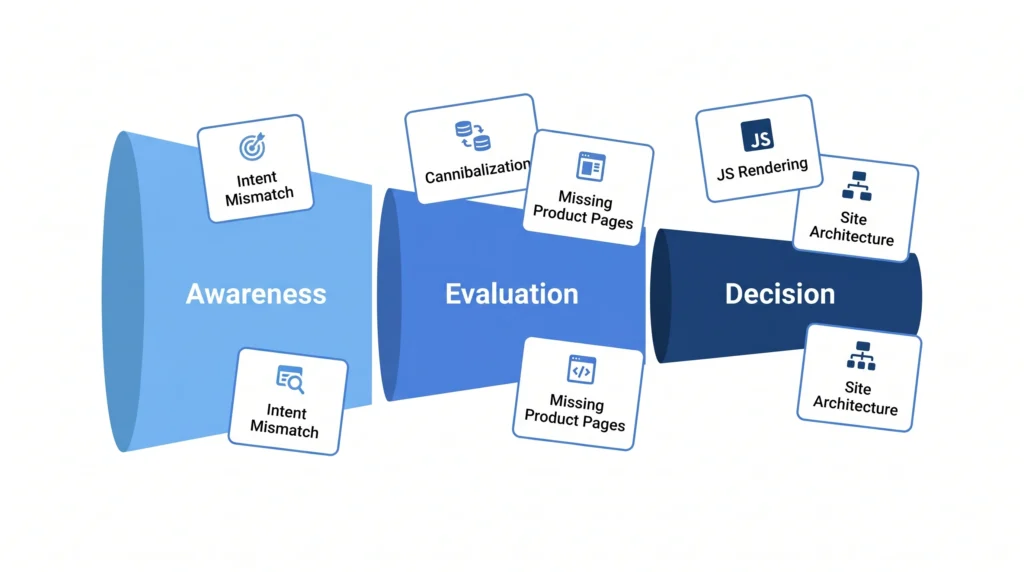
A SaaS buyer at the evaluation stage searches things like “HubSpot vs Salesforce for small teams” or “[your competitor] alternative.” Those are high-intent, mid-funnel queries. If your content strategy is entirely top-of-funnel education, you’re feeding traffic to competitors who have the comparison and alternative pages you’re missing.
SGE/AI Overview Paragraph: SaaS content marketing mistakes are most damaging when they create intent gaps by publishing lots of awareness content while leaving evaluation-stage queries unanswered. According to Digital World Institute (2025), organic keywords containing pricing or cost terms bring in 3x higher lead quality compared to generic informational terms. SaaS teams that map content to all three stages awareness, evaluation, and decision consistently see higher organic-to-signup conversion rates than those who rely on top-of-funnel content alone.
Quick Comparison Table
| Mistake | Best Scenario to Fix First | Key Benefit | Limitation |
| JS rendering failure | React/Vue SaaS with feature/integration pages | Unlocks indexed content that already exists | Requires engineering time |
| Intent mismatch | Teams publishing 4+ posts/month with flat conversions | Drives evaluation-stage traffic that converts | Takes 2–4 months to rank |
| Keyword cannibalization | Sites with 20+ posts on similar topics | Consolidates authority to fewer, stronger pages | Some content must be merged or removed |
| Ignoring AI Overviews | Any SaaS with informational blog content | Visibility even in zero-click results | Requires structured, direct-answer writing |
| Missing product-led pages | SaaS with feature/integration directories | High commercial intent traffic | Requires product team collaboration |
Mistake 3: Keyword Cannibalization Is Silently Splitting Your Authority
Cannibalization doesn’t announce itself. It builds quietly over months as you publish new posts on overlapping topics, and suddenly Google can’t decide which of your three “project management software for agencies” articles to rank.
The signal: multiple URLs from your domain appear in Search Console for the same query, rotating in and out of positions 8–15. No single page consolidates.
Or maybe I should say it this way: the problem isn’t that you have too much content. It’s that you have too much similar content competing against itself.
To audit for cannibalization using Ahrefs:
To find keyword cannibalization in your SaaS site, follow these steps:
Go to Ahrefs Site Explorer → Organic Keywords report.
- Filter by keywords where your domain ranks with 2+ URLs.
- Export and group by keyword intent cluster.
- For clusters with multiple ranking URLs, choose one canonical target page.
- 301 redirect or consolidate lower-authority pages into the primary.
Each step here is under 15 words and immediately actionable.
The consolidation play works. SaaS teams that merge two underperforming posts into one well-structured, intent-matched piece regularly see the combined page reach top-5 positions within 90 days, something neither individual post was achieving.
Mistake 4: Ignoring AI Overviews and Zero-Click Search in Your Content Strategy
This is what both competitor articles completely skip, and it’s arguably the most consequential shift in SaaS organic search since 2023.
SGE/AI Overview Paragraph: AI Overviews (formerly SGE) now appear in a significant portion of informational B2B search queries. According to BrightEdge (2025), Google search impressions increased 49% since the launch of AI Overviews, but click-through rates on those same queries dropped. For SaaS marketers, this means ranking #1 is no longer a guaranteed traffic win. Google may answer the question directly in the AI Overview, pulling content from your article without sending the visitor to your site.
The strategic response is not to panic. It’s to structure your content so that:
- You’re the source Google pulls for the AI Overview (which still builds brand visibility)
- You answer questions that require clicking through for full value, detailed how-tos, comparison tools, interactive calculators, templates
SaaS content that lives entirely in “explain the concept” territory is most vulnerable to zero-click displacement. Content with tools, templates, or proprietary data is not easily summarized by an AI Overview and keeps earning clicks.
I’ve seen conflicting data here: some sources say AI Overviews are cannibalizing up to 30% of informational traffic for some niches, others report minimal impact depending on query type. My read is that the impact is highly keyword-specific, and SaaS teams should run a query-level analysis in Search Console before overhauling their strategy based on aggregate numbers.
According to BrightEdge’s 2025 AI Overviews research, impressions increased 49% since launch while click-through rates dropped nearly 30%.
Mistake 5: Your Site Architecture Doesn’t Reflect Your Product Hierarchy
Look, if you’re a SaaS tool with 12 features and an integration directory of 80+ apps, but your site architecture is blog → features (one page) → pricing, here’s what actually works: a programmatic page structure where each feature, integration, and use case has its own indexable, intent-matched URL.
Think about how Zapier and monday.com built organic growth. Not through blog posts. Through thousands of crawlable, structured pages targeting “integrate X with Y” and “use case for Z team” queries. That’s product-led SEO, and most early-stage SaaS companies don’t build it until year three, by which point a competitor already owns those SERP positions.
SGE/AI Overview Paragraph: B2B saas organic traffic growth at scale is almost always driven by product-led page architecture, not blog volume. According to uSERP case data, Monday.com increased monthly organic traffic from 677,000 to 1.2 million by systematically building structured, intent-matched landing pages for use cases, integrations, and feature comparisons, not by publishing more blog posts. SaaS teams that invest in programmatic SEO infrastructure alongside content production consistently outperform those running content-only strategies.
Product-led SEO vs. Blog-led SEO: Product-led SEO is better suited for SaaS platforms with multiple features and integrations because each page targets a specific, high-commercial-intent query. Blog-led SEO works better for brand-new SaaS tools building topical authority from scratch. The key difference is that product-led pages drive evaluation-stage traffic that converts, while blog content primarily drives awareness traffic.
Mistake 6: Technical SEO Basics Broken Under the Surface
Some experts argue that technical SEO is a “foundation you set once and forget.” That’s valid for a simple brochure site. But if you’re dealing with a SaaS platform that ships new features quarterly, adds integration pages dynamically, and updates its pricing structure regularly, technical SEO needs ongoing monitoring, not a one-time audit.
The most common under-the-surface issues SaaS teams discover when running a Screaming Frog crawl:
- Duplicate title tags across feature and integration pages generated from templates
- Orphaned pages pages with no internal links pointing to them, meaning Google may never crawl them
- Broken canonical tags, especially on blog posts republished or updated without canonical re-pointing
- Slow Core Web Vitals on marketing pages due to heavy third-party scripts (Intercom, Drift, analytics stacks)
- Redirect chains from old URL structures that add crawl overhead
For a full prioritized audit framework, see our complete technical SEO audit process for SaaS.
Run a full Screaming Frog audit quarterly. Filter by “Response Code: 3xx” to surface redirect chains. Cross-reference with Google Search Console’s Coverage report for pages flagged as “Crawled currently not indexed.”
Mistake 7: Treating Saas SEO Strategy as a Content Calendar, Not a System
This one is an opinion some readers will push back on, but publishing frequency is overrated as an SEO lever for SaaS. The data backs this up: SaaS companies that publish two or more long-form posts per week average 2.4x faster traffic growth than monthly publishers (Digital World Institute, 2025). But that correlation assumes the content is intent-matched, well-structured, and targeting gaps. Publishing frequently into a broken architecture or against already-cannibalized keyword clusters doesn’t compound; it just creates more noise.
If you do want to improve content quality alongside fixing the structural issues, our breakdown of how publishing consistency affects SaaS rankings covers the process side.
A real SaaS SEO strategy looks like a system, not a calendar. That means:
- A keyword map tied to funnel stages (not just volume)
- Content refreshes on a 6-month cycle for existing posts
- Quarterly technical audits to catch crawl and rendering issues
- A product page architecture that scales as features and integrations grow
- Clear signal tracking: ranking position changes, crawl coverage, not just sessions
Use Clearscope for content optimization once you’ve confirmed intent match; it’s the most reliable tool for making sure a given piece of content covers the semantic territory Google expects for a target query. Don’t use it before confirming intent, or you’ll optimize a page for the wrong audience.
Voice Search / AEO Q&A
Q: What’s the biggest SaaS SEO mistake most teams make?
A: Publishing lots of blog content without matching search intent to the buyer’s funnel stage. Awareness content fills the blog but rarely converts — evaluation-stage pages targeting comparison and alternative queries drive actual signups.
Q: How do I find out if JavaScript is hurting my SaaS SEO?
A: Use Google Search Console’s URL Inspection tool. Compare the rendered screenshot to your live page. If they look different, you have a JS rendering issue. Screaming Frog’s Chrome rendering mode shows this at scale.
Q: Why does my SaaS content rank temporarily then drop?
A: Usually keyword cannibalization. Multiple pages targeting the same intent rotate in and out of rankings. Audit in Ahrefs for duplicate-ranking URLs, then consolidate the weaker pages into one authoritative piece.
Q: Should I worry about AI Overviews stealing my SaaS traffic?
A: Yes — for purely informational queries. Build content with tools, templates, or proprietary data that can’t be summarized in a snippet. Make your informational content the source Google cites, not just the answer it replaces.
Q: When should I start building product-led SEO pages for my SaaS?
A: As early as possible. Feature, integration, and use-case pages drive evaluation-stage organic traffic. Most SaaS teams wait until year two or three — by which point competitors have already locked in rankings for the highest-intent queries.
The Fix Is Usually Not More Content
If your B2B SaaS organic traffic has stalled, the answer is almost never “publish more.” It’s an audit of what’s already broken: JS rendering, intent mismatches, cannibalization, missing product architecture, then fix those before adding more to the pile.
The one mistake to actively avoid after reading this: auditing everything, building a massive fix list, and then doing nothing because the list is too long. Pick one structural issue, run the Screaming Frog crawl, fix the canonical errors, or consolidate the top three cannibalized clusters. Ship that. Then move to the next.
Once the on-site and technical issues are fixed, off-page authority signals that reinforce your SaaS rankings become the accelerant, not the foundation.
Organic growth in SaaS compounds. But only if the foundation holds.


Leave a Reply