
Last updated: May 2026
This guide covers local SEO fundamentals and Google Business Profile optimization for single-location small businesses in the U.S., UK, Canada, and Australia. It does NOT address multi-location enterprise SEO or paid local advertising strategies.
Your competitor down the street is showing up in the map pack. You’re not. You set up a Google Business Profile. You got a few reviews. Nothing changed.
Usually, the problem runs deeper than your GBP. It starts with foundational SEO mistakes that kill local rankings before they start
Most articles will tell you to “optimize your online presence.” That’s not an answer — that’s a slogan. This guide skips the obvious and gets into what actually moves rankings in 2026: profile completeness signals, NAP consistency, local citations, and the emerging AI search factor that 65% of small businesses haven’t thought about yet.
This works best for single-location service businesses, retail shops, and restaurants trying to capture “near me” searches. It won’t solve ranking problems caused by a penalized domain or a business in a highly saturated metro area competing against franchises with 500+ reviews.
What Local SEO Actually Is (The Version That Makes It Click)
Local SEO is the practice of optimizing your business’s online presence, so it appears in geographically relevant search results — specifically Google’s map pack and the organic results below it. Unlike general SEO, it’s not just about your website. It’s about signals across your Google Business Profile, third-party directories, and local web mentions working together.
Google’s local algorithm weighs three things: proximity (how close the searcher is), relevance (how well your listing matches the query), and prominence (how well-known and trusted your business appears online). You can’t control proximity. You can control everything else.
Here’s the thing: according to Google Consumer Insights, cited consistently by BrightLocal and Backlinko through 2024–2025, 76% of people who conduct a local mobile search visit a physical store within 24 hours. That’s not a vanity stat. That’s the entire reason this matters.
Why Your Google Business Profile Isn’t Working Yet
This is the part most guides skip.
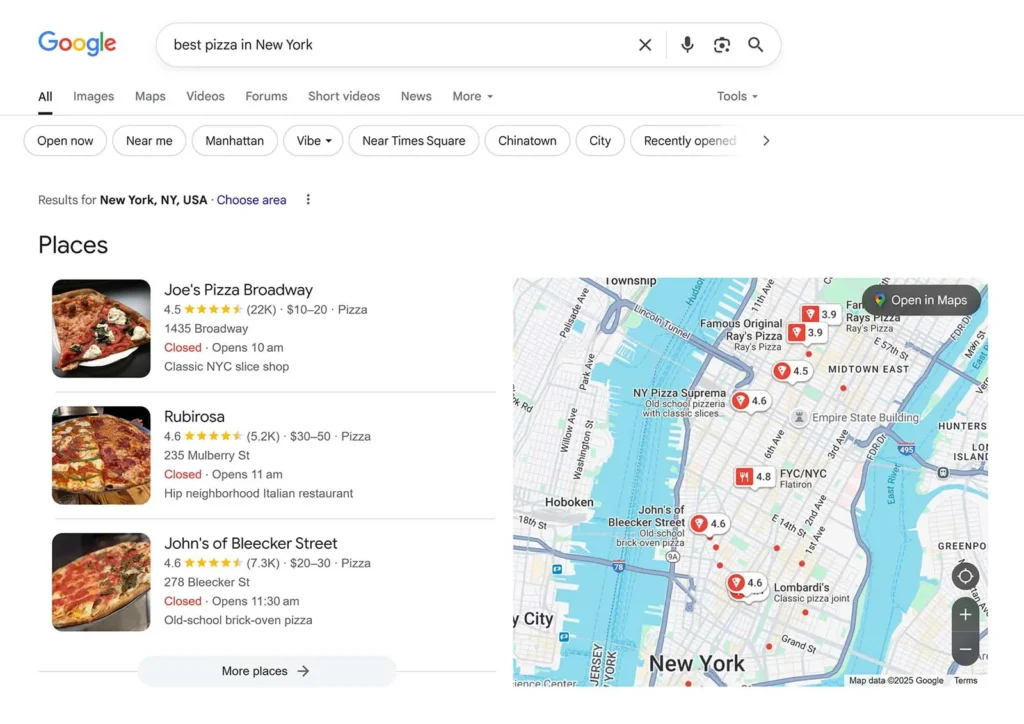
Claiming your GBP isn’t enough. Filling it in once and forgetting it isn’t enough either. Google treats your profile like a living document — it rewards businesses that actively signal they’re open, engaged, and relevant.
The most common GBP mistakes small business owners make:
- Wrong or missing primary category. This is the single highest-impact field on your entire profile. A plumbing company that selects “Plumber” instead of “Emergency Plumber” or “Drain Cleaning Service” as a secondary category is leaving intent-matched traffic on the table. Add up to 10 categories — most businesses use fewer than three.
- Service area set incorrectly. If you serve customers at their location (a mobile mechanic, a cleaning service), you should hide your address and set a service area radius. Showing a home address while also listing a service area confuses Google’s proximity algorithm.
- No posts in the last 30 days. Google posts don’t directly boost rankings, but they signal that the business is active. A profile that hasn’t been updated in six months looks abandoned.
- Photos with zero engagement. Businesses with 100+ photos on their GBP get 520% more calls than businesses with fewer than 10. That’s a BrightLocal finding from 2024. Not a coincidence.
For a detailed breakdown of how these local principles apply to a competitive service vertical, the carpet cleaning SEO guide covers every tactic from GBP category selection to call tracking setup.
Quick note: the “Questions & Answers” section of your GBP is public and editable by anyone — including competitors. Check it monthly and seed it with your own questions and answers before someone else does.
To optimize your Google Business Profile properly, work through these steps:
To fully optimize your GBP:
- Claim and verify your listing at business.google.com
- Select your most accurate primary category and add up to 9 secondary categories
- Write a 750-character description with your main service and city naturally included
- Add at least 10 photos (exterior, interior, team, products, or services)
- Enable and respond to the Q&A section with your own seeded questions
- Post a GBP update at least once every two weeks
If you want the full technical layer handled — schema, crawlability, Core Web Vitals, and on-page fixes across your entire site — see Nexklicks’ complete SEO optimization service.
The NAP Problem Nobody Talks About
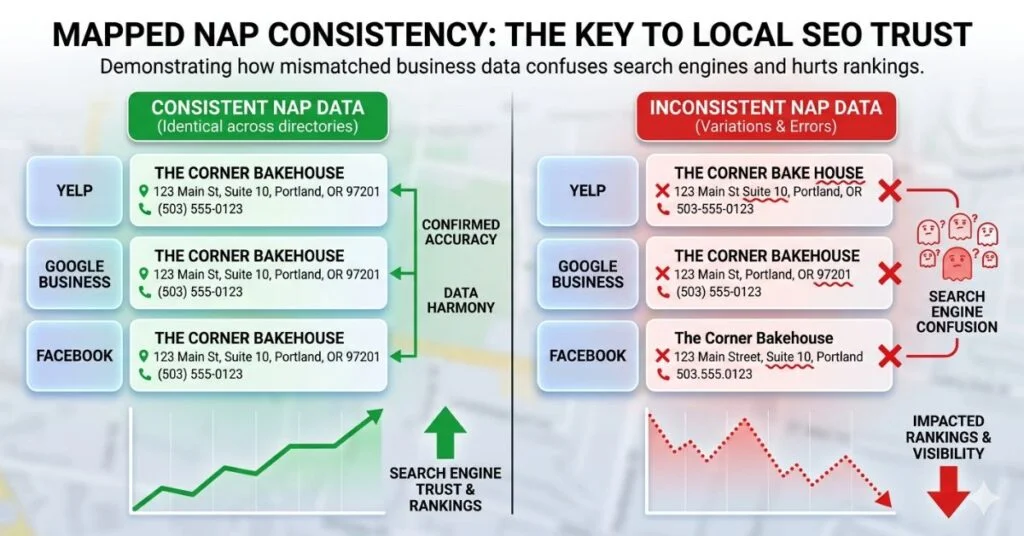
NAP stands for Name, Address, Phone number. It needs to be identical — not just similar — across every place your business appears online.
Or maybe I should say it this way: Google doesn’t just “prefer” consistency, it uses NAP signals as a trust verification layer. If your business is listed as “Mike’s Auto Repair” on your website but “Mike’s Auto Repair LLC” on Yelp, and your old address is still live on a forgotten directory from 2019, Google’s algorithm downgrades confidence in your listing’s legitimacy.
Where NAP inconsistencies hide:
- Old Yelp, Yellow Pages, or Citysearch listings from when the business first launched
- Local chamber of commerce directories
- Outdated listings from a previous address
- The footer of your own website (check it — it’s often out of date)
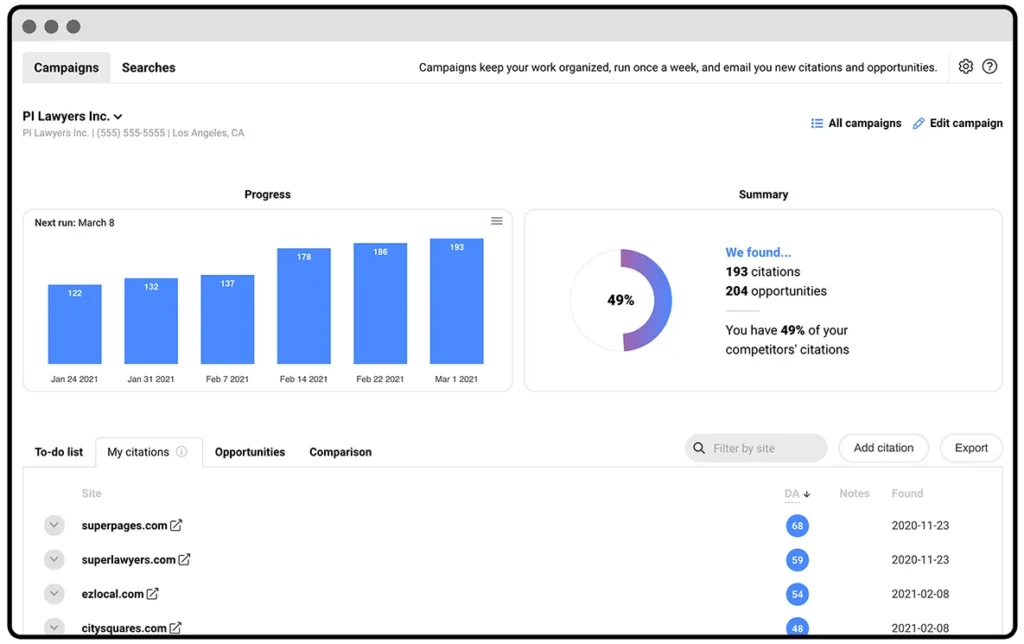
Use BrightLocal’s Citation Tracker or Whitespark’s Citation Audit tool to find every place your business is listed and flag the mismatches. Both tools show you the exact fields that differ and which directories to prioritize for corrections. Citations and reviews are just one layer. If you want to go deeper, the off-page authority signals that support your local rankings extend well beyond directory listings.
If you run an accounting firm specifically, the complete SEO for accountants guide covers how to apply every one of these local SEO principles to a CPA or tax preparation practice, including the Map Pack ranking factors, NAP consistency, and review-building strategy.
Some SEO professionals argue that minor NAP variations don’t significantly hurt rankings in 2026, given how sophisticated Google’s entity matching has become. That’s valid for well-established businesses with hundreds of citations and strong domain authority. But if you’re a newer business or one that recently moved or rebranded, consistency still matters — and it costs nothing to fix.
Local Keyword Strategy: What to Target and Where to Put It
Most small business owners think about keywords the wrong way. They chase high-volume terms — “best plumber in Chicago” — when the searches that actually convert are more specific: “emergency pipe burst repair Chicago” or “licensed plumber Wicker Park.”
If you run a faith-based organization, a dedicated church SEO strategy will serve you better than generic local SEO advice. The intent signals, schema types, and GBP categories are different enough to warrant their own approach.
If you operate in a high-competition local category like automotive retail, the principles here scale directly. See how they apply in the full car dealer SEO guide for dealership-specific strategy.
The keyword layer that matters most for local SEO:
- Geo-modified service terms: “[service] + [city/neighborhood]” — these are your primary targets
- “Near me” intent keywords: Don’t literally write “near me” in your content; Google handles the proximity matching. Write for the service and the geography instead.
- Question-format long-tails: “How much does a plumber cost in Chicago?” — these target featured snippets and People Also Ask boxes
Where to place local keywords:
| Location | What to Do | What NOT to Do |
| GBP Business Description | Include city + primary service naturally in the first 250 chars | Don’t keyword-stuff — Google may flag it |
| Website Title Tag | Lead with service + city: “Plumbing Services Chicago | Mike’s Auto” | Don’t force the exact phrase awkwardly |
| H1 Heading | Match the intent, not just the keyword | Don’t copy the title tag word for word |
| Service Pages | One page per core service + city combination | Don’t create identical pages for 50 suburbs |
| About Us / Contact Page | Mention neighborhoods you serve naturally | Don’t list every zip code in a paragraph |
Quick Comparison — Local SEO vs. Paid Local Ads:
Local SEO is better suited for long-term visibility and trust-building because it compounds over time and doesn’t stop the moment you stop paying. Google Ads Local campaigns work better when you need immediate visibility for a time-sensitive promotion or when you’re entering a new market cold. The key difference is that local SEO builds an asset; paid ads rent a position.
If writing optimized service pages isn’t in your wheelhouse, Nexklicks’ SEO and content writing service builds location pages that rank and convert.
For a full industry-specific walkthrough, our landscaping seo guide shows exactly how these local SEO principles apply to a landscaping business from keyword research through to monthly tracking.
Quick Comparison: Local SEO Ranking Signals
| Signal | What It Is | Impact Level | How to Fix It |
| Google Business Profile completeness | All fields filled, categories accurate, photos added | Very High | Complete every GBP field; add 10+ photos; post every 2 weeks |
| NAP consistency | Identical business name, address, and phone across all directories | High | Audit with BrightLocal or Whitespark; correct mismatches at source |
| Review quantity & recency | Volume of Google reviews + how recently they were posted | High | Set up a post-service text/email review request system |
| Local citations | Mentions of your business on third-party directories | Medium | Fix core aggregators first (Data Axle, Neustar); add 10–20 niche directories |
| On-page local keywords | Service + city terms on website title tags, H1s, and service pages | Medium | One dedicated service page per core service + city; no keyword stuffing |
| LocalBusiness schema markup | Structured data on your website telling Google your NAP, hours, and services | Medium | Add JSON-LD LocalBusiness schema to homepage and contact page |
| GBP posts & activity | Regular updates, offers, and Q&A activity on your profile | Lower (but signals trust) | Post once every 1–2 weeks; respond to all reviews within 72 hours |
The Citation-Building Process That Actually Moves Rankings
A citation is any online mention of your business name, address, and phone number — whether or not it links back to your website.
The research on citations is clear but often misread. I’ve seen conflicting data — some sources say citations have declined in ranking weight since 2020, others say they’re still a top-five local ranking factor. My read is that volume matters less now than quality and consistency. A listing on a trusted, niche-relevant directory (a local bar association for a law firm, or HomeAdvisor for a contractor) carries more weight than fifty generic directory listings.
The citation stack that matters in 2026:
- Core aggregators first: Data Axle, Neustar Localeze, and Foursquare feed hundreds of downstream directories. Fix your listing here, and the corrections propagate outward. Whitespark’s Local Citation Finder shows which aggregators are sourcing your current data.
- Industry-specific directories: Avvo for lawyers, Healthgrades for doctors, Houzz for contractors, and TripAdvisor for restaurants. These carry disproportionate trust signals for their respective industries.
- Local directories: Your city’s chamber of commerce, local newspaper business listings, and local bloggers who maintain “best of [city]” pages.
That’s it. You don’t need 300 citations. You need the right 30, with consistent NAP. If you are managing all of this on a limited budget, the full breakdown of cheap SEO tactics for local business owners covers the free and low-cost tools that work specifically for service-area websites in the USA, including Google Business Profile, citation tools, and page speed fixes that cost nothing.
Reviews: The Ranking Signal You Can Actually Control
Google uses both the quantity and recency of reviews as ranking signals. A business with 200 reviews, but the last one posted 14 months ago, will often rank below a business with 40 reviews posted consistently over the last six months.
Here’s what that means practically: a one-time review push doesn’t sustain rankings. You need a system.
A simple review acquisition system:
- Text or email customers within 24–48 hours of service completion (highest response window)
- Include a direct link to your GBP review page — don’t make them search for it
- Train any staff who interact with customers to ask verbally: “If you were happy with today’s service, a Google review helps us a lot.”
- Respond to every review — positive and negative — within 72 hours
A Statista survey found that 98% of U.S. consumers read online reviews of local businesses at least occasionally, with 76% doing so regularly or always. Responding to negative reviews publicly demonstrates professionalism to every future reader, not just the person who left the review.
Look — if you’ve been open for three years and have fewer than 15 Google reviews, that’s the single highest-leverage thing you can fix this week. Not your schema markup. Not your backlink profile. Reviews.
The AI Overview Problem Small Businesses Don’t Know About Yet
This is what neither competitor’s article covers.
Google’s AI Overviews now appear in approximately 32% of local queries. ChatGPT, Perplexity, and similar tools are increasingly being used for local business recommendations — BrightLocal’s 2026 Local Consumer Review Survey found that 45% of consumers now use ChatGPT or another generative AI tool for local business recommendations.
Here’s the problem: only 35% of SMBs have a complete Google Business Profile (SMB Marketing Report, 2025). And according to SOCi’s Local Visibility Index (2026), less than half of businesses that lead in Google’s local search results also appear in AI local recommendations. AI tools source local business information differently — they weigh structured mentions on expert-curated “best of” lists, third-party review platforms, and consistent entity data across the web.
What this means for your local SEO strategy in 2026:
- Optimize your GBP completely (AI tools pull from Google’s entity data)
- Maintain active profiles on Yelp, Tripadvisor, and industry directories (AI tools index these directly)
- Get featured on local “best of” lists and city guide websites — these carry outsized weight in AI recommendation systems
- Use LocalBusiness schema markup on your website (structured data helps both Google’s AI Overviews and third-party AI tools identify and categorize your business correctly)
This isn’t a reason to panic. It’s a reason to be one of the 65% of small businesses that actually have this handled. Nexklicks’ complete SEO optimization service includes full schema implementation and structured data setup if you want this handled properly from day one.
Voice Search & AEO: 5 Questions Your Customers Are Actually Asking
Q: What’s the best way to get my business on Google Maps?
A: Claim and verify your Google Business Profile at business.google.com. Fill in every field completely, select accurate categories, add photos, and start accumulating reviews. Verification takes 5–14 days by postcard or phone.
Q: How do I rank higher in local search results without paid ads?
A: Focus on three things: a fully optimized GBP with consistent NAP across directories, a steady stream of recent Google reviews, and at least one service page on your website per core service and city combination.
Q: Should I create separate pages for every city I serve?
A: Only if you have genuinely different content to write for each location. Thin city pages with identical content swapped out are a spam signal. If you serve nearby suburbs, mention them naturally in your service descriptions and GBP service area — don’t build 30 near-duplicate pages.
Q: Why does my competitor rank higher even though I have more reviews?
A: Reviews are one signal. Google also weighs proximity to the searcher, relevance of your GBP categories to the query, website authority, NAP consistency, and citation quality. Run a gap analysis on their profile vs. yours — usually the difference is in their category selection or the completeness of their service descriptions.
Q: When should I hire an SEO agency for local SEO instead of doing it myself?
A: Do it yourself for the first 90 days — claim your GBP, fix NAP issues, build your 30 core citations, and start your review system. If you’re in a competitive niche (law, healthcare, real estate) or a major metro area, and you’re still not ranking after six consistent months, that’s when an agency’s backlink-building and technical SEO capabilities start to justify the cost.
The Real Timeline: What to Expect and When
SEO is a long game. That’s not a hedge — it’s accurate.
Most small businesses see measurable movement in map pack rankings within 60–90 days of completing the foundational steps: GBP optimization, NAP cleanup, and core citation building. Full stabilization, where you’re consistently holding a top-3 position for primary keywords, typically takes 4–6 months.
What most guides skip is that rankings can temporarily drop after you make changes. Updating your GBP categories, switching your service area, or correcting old citations can cause a short-term fluctuation as Google reprocesses your signals. Don’t reverse the changes — the drop is usually temporary.
The businesses that win local SEO aren’t necessarily the ones that do the most. They’re the ones who do the fundamentals consistently and don’t abandon the strategy after 30 days. For a concrete look at what that consistency produces, see how Nexklicks has grown organic traffic for brands across industries — including a 91% organic traffic increase for a B2B eCommerce brand and 78% growth for a creator tools platform.
The One Mistake That Erases All Your Progress
Letting your GBP go inactive.
Google will sometimes merge a well-optimized profile with a duplicate listing it finds in its database. If you don’t log into your GBP regularly, you may not notice the merge happened — and suddenly your reviews, photos, and optimized categories are gone.
Check your GBP dashboard at least once a week. Look for suggested edits from the public (Google allows anyone to suggest changes to your listing), unauthorized photo uploads, and any duplicate listings under your business name.
That’s the work. Not glamorous. But it’s what keeps the rankings you earn.

Leave a Reply