
Last updated: May 2026
This works best for: Small business owners who have already attempted basic SEO and are getting little to no organic traffic. It does NOT address enterprise-level technical audits, e-commerce platform migrations, or penalty recovery from manual Google actions, which deserve their own treatment.
Here’s a stat that should stop you cold: according to Ahrefs, roughly 90% of all web pages get zero organic traffic from Google. Zero. Not a trickle, nothing.
If you’ve been publishing blog posts, tweaking your meta tags, and wondering why nothing’s moving, you’re in the majority. That’s not reassuring. It’s a signal. Most of those pages aren’t failing because SEO doesn’t work. They’re failing because the SEO being done on them is wrong.
If you’re unsure whether a specific provider is legitimate, this honest breakdown of seo by highsoftware99.com gives you a reusable framework for evaluating any branded SEO service before you pay.
This isn’t another list of vague tips. What follows are the specific, fixable mistakes that are most likely responsible for your flat traffic, ranked by how often they silently kill results without the owner ever realizing it.
Quick Definition: Mistakes small business owners make when using SEO typically fall into three categories: targeting the wrong terms, skipping technical fundamentals, and treating SEO as a one-time task rather than an ongoing system. Each mistake compounds the others.
Mistake #1: Targeting Keywords Nobody Actually Searches, or Everyone Already Dominates
This is the most common one. And it’s brutal because it looks like real work.
You research a keyword. You write a 1,200-word article. You optimize the title and meta description. Then you wait. Six months later, nothing.
The problem usually isn’t the content. It’s that you either picked a keyword with near-zero monthly search volume, or more painfully, you picked a real keyword that Forbes, HubSpot, and three established agencies are already fighting over.
Small business websites typically have low domain authority. Competing for “best digital marketing agency” head-to-head with sites that have thousands of backlinks isn’t a strategy. It’s expensive wishful thinking.
If you’re not sure how to evaluate keyword difficulty for your site, our step-by-step guide on how to choose the right keywords for your content covers the full process.
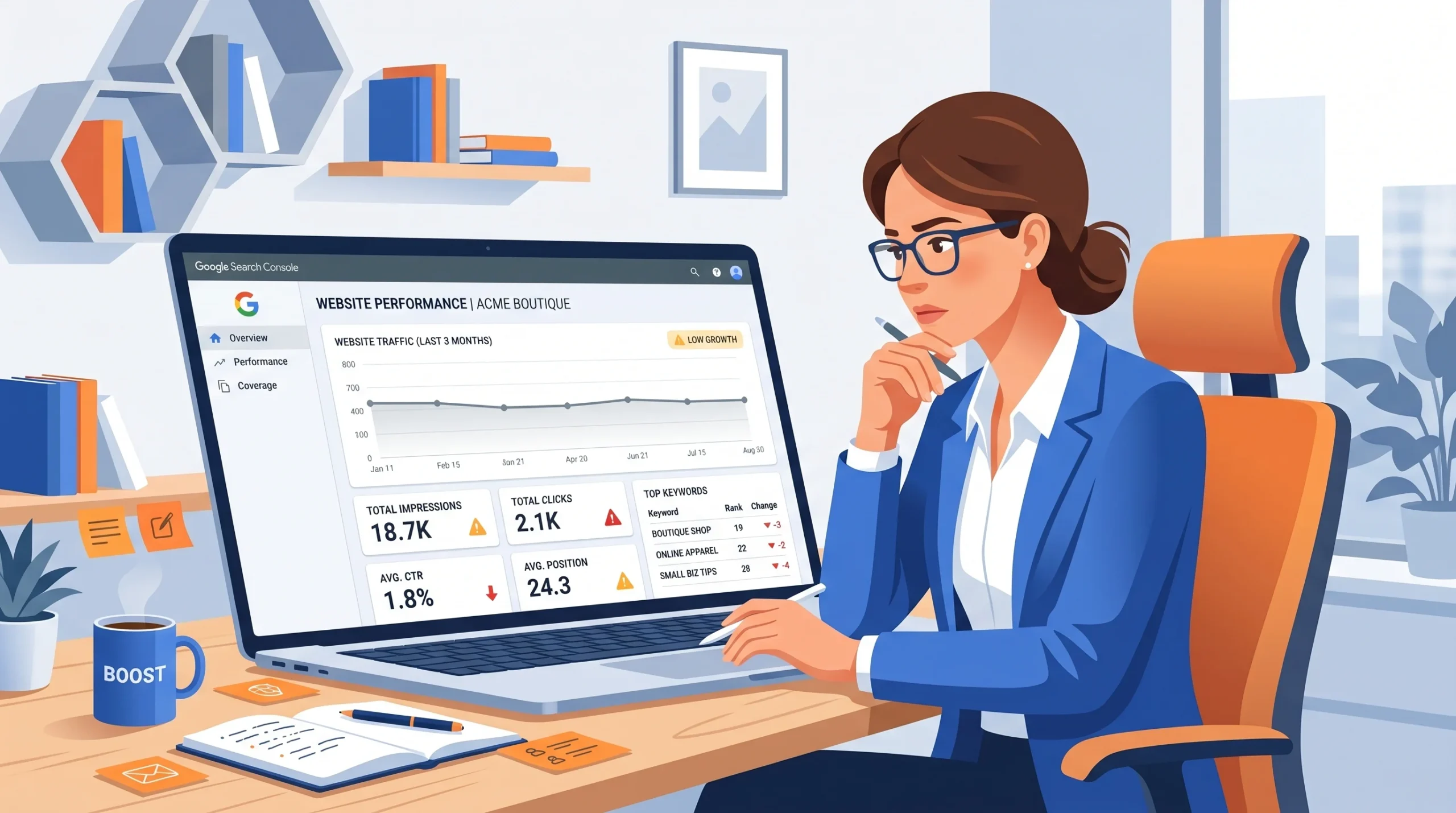
What actually works: Go long-tail and local. A keyword like “SEO mistakes small business owners make” is far more winnable than “SEO tips.” Tools like Google Search Console show you what queries you’re already appearing for, sometimes on page two or three, that you could push to page one with a targeted update.
One thing many owners notice when first opening Search Console is that the click numbers don’t match what Google Analytics shows, which is normal, but confusing why your Search Console clicks and GA4 sessions never match explains exactly why that gap exists.
Quick note: Semrush and Ahrefs both show keyword difficulty scores. Anything above 60 for a new or small-domain site is almost certainly not worth targeting directly.
According to Ahrefs (2024), approximately 90% of web pages receive zero organic search traffic. The primary reason isn’t content quality; it’s that most pages target keywords they have no realistic chance of ranking for, given their site’s current authority level.
If your content itself is the weak point, this guide on writing content that’s actually optimized to rank walks through the full process.
Mistake #2: Ignoring Search Intent The Mistake That Quietly Wastes Every Effort
Here’s the thing: Google isn’t just matching keywords anymore. It’s a matching purpose.
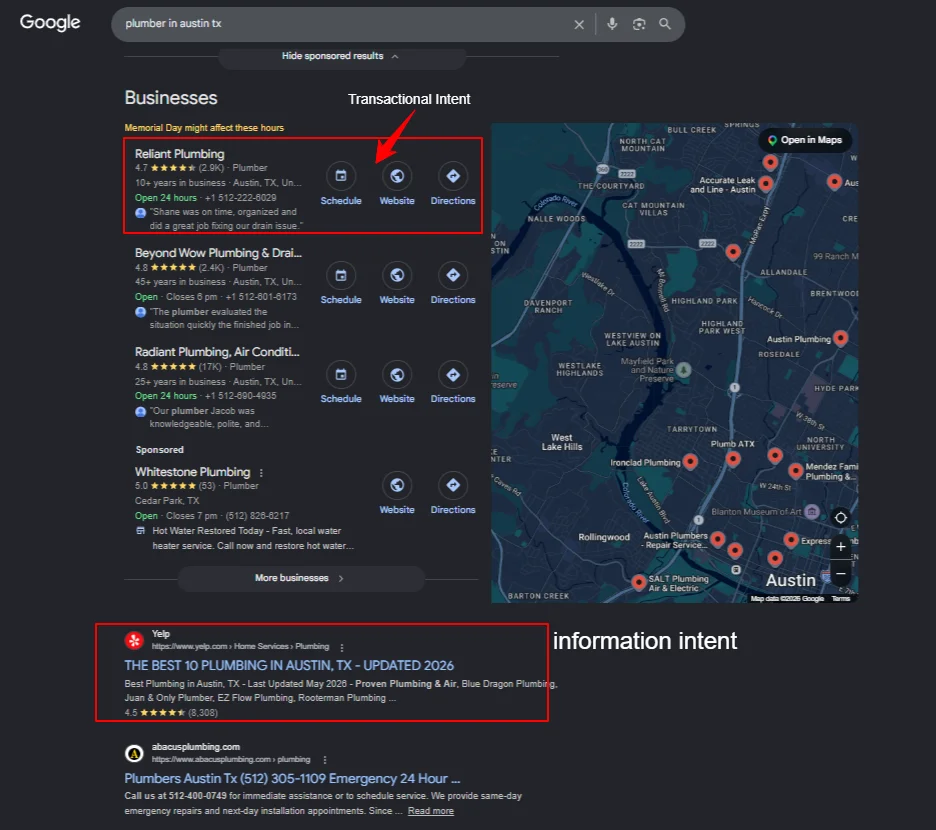
Say you run a plumbing business in Austin. You write a blog post called “How to Fix a Leaking Pipe.” You rank for it. Congratulations, you’re now getting traffic from people who want to fix the pipe themselves. They’re not calling you. They never were.
That’s a search intent mismatch. Informational content attracts informational searchers. If your goal is leads, you need transactional or local-intent pages, service pages, location pages, and “hire a plumber in [city]” content.
Or maybe I should say it this way: ranking is not the same as winning. You can rank #1 and still get zero customers if the keyword attracts the wrong people.
Many of the conversion problems small businesses attribute to SEO are actually rooted in poor customer experience. A dedicated customer experience strategy often resolves what rankings alone cannot.
The fix is direct: Before writing any piece of content, Google the keyword yourself. Look at the top five results. Are they blog posts? Service pages? Product listings? Comparison articles? Whatever Google is already rewarding tells you exactly what format and intent to match.
Mistake #3: Skipping Google Business Profile The Fastest Free Win Most Owners Leave on the Table
If you serve customers in a specific city or region, your Google Business Profile (GBP) is more important than your website for local search visibility. Full stop.
“Near me” searches have exploded over the past three years. When someone searches “accountant near me” or “best coffee shop in [city],” Google surfaces the local map pack, three business listings with ratings, hours, and directions above most organic results.
Accounting firms face a specific version of this problem. The SEO for accountants guide breaks down exactly which mistakes CPA firms most commonly make and provides a step-by-step roadmap for fixing them.
If your GBP is incomplete, unverified, or simply missing, you don’t appear there. Doesn’t matter how good your website is.
This same mistake is especially damaging for nonprofits and faith communities. See how it plays out in our guide to local search visibility for churches.
Business owners often assume their website is doing the heavy lifting. It’s not for local searches.
What to check immediately:
- Is your GBP verified and fully filled out (hours, services, photos, description)?
- Are you collecting reviews consistently? Recency and volume both influence local ranking.
- Are you posting updates to GBP? Most competitors don’t. That alone creates a gap.
For a full walkthrough of the local ranking factors, see our guide on how to rank in the local map pack. Home service businesses are especially exposed to these errors. The carpet cleaning SEO mistakes section covers nine specific patterns that appear in nearly every local service site audit.
If you run a local service business, the mistakes in this list apply directly to how you rank in your city. Our landscaping seo guide shows the correct system to replace these patterns with.
Mistake #4: Building on the Wrong Platform Without Knowing the SEO Cost
Wix. Squarespace. Some proprietary website builder that your web designer set up in 2019.
These platforms aren’t evil. But they do create real, measurable SEO limitations, and most small business owners have no idea until they’re already invested.
The problems vary by platform but commonly include: auto-generated URLs with session parameters that confuse crawlers, limited control over structured data and schema markup, JavaScript-heavy rendering that slows Core Web Vitals scores, and restricted access to robots.txt or canonical tags.
Dealership websites are one of the highest-risk environments for the mistakes covered above. For a complete walkthrough of how to fix them in an automotive context, the car dealer SEO article covers inventory page optimization, duplicate content, and local pack strategy in full.
Some experts argue these platforms have “come a long way” and are now SEO-friendly. That’s valid for basic use cases. But if you’re dealing with a site that needs serious technical SEO, custom schema, advanced redirects, and server-side rendering, these platforms will hit a ceiling fast.
If your site structure is the root of your SEO problems, a full website redesign with Garage2Global is often the most efficient fix, rather than patching issues one at a time.
The honest answer: WordPress with a solid hosting provider (not shared hosting) still gives you the most SEO control. If you’re not ready to migrate, at a minimum, audit your current platform’s limitations in Google Search Console. Look for crawl errors, index coverage issues, and Core Web Vitals scores under the “Experience” section. These platform-level issues overlap with, but are distinct from, the SaaS-specific SEO mistakes that don’t apply to general small business sites, things like JavaScript rendering failures and programmatic page architecture that only matter once you’re running a software product.
To audit your site for technical SEO issues, follow these steps:
- Open Google Search Console and navigate to “Coverage” to identify crawl errors.
- Check “Core Web Vitals” under the Experience tab, and flag any pages marked “Poor.”
- Run your homepage URL through Google’s PageSpeed Insights tool.
- Search “site:yourdomain.com” in Google to see how many pages are indexed.
- Fix any pages returning 404 errors or marked “Excluded” without a redirect.
Before setting up any redirect, read our full guide on 404 redirect to homepage SEO so you understand why blanket homepage redirects create soft 404s and make the problem worse.
One structural issue worth checking during that audit: if your nav, sidebar, and body copy all link to the same page, Google may only be reading the nav anchor, which is usually the weakest one. That’s the duplicate internal links and the first-link priority problem most site owners don’t catch until they’re deep into an SEO review.
Mistake #5: Publishing Content With No Backlink Plan
Content without links is a library with no address. Nobody finds it.
This is exactly where many businesses struggle with execution and end up needing structured support, which is why backlink outsourcing is often used to ensure consistent and high-quality link acquisition instead of random outreach efforts.
Backlinks, links from other websites pointing to yours, remain one of Google’s strongest ranking signals. Yet most small business owners publish content and assume Google will eventually discover and reward it.
I’ve seen conflicting data on exactly how much weight backlinks carry versus content quality in 2025–2026. Some sources say Google is deprioritizing them as AI Overviews take over, others say they’re still the single biggest differentiator for competitive terms. My read is this: for new or low-authority sites, backlinks are still the gap between ranking and not ranking on anything competitive.
Three realistic link-building moves for small businesses:
- Get listed in relevant local directories (Chamber of Commerce, industry-specific directories)
- Write guest posts or contribute quotes to local news sites and industry blogs
- Create one genuinely useful free resource, a local guide, a tool, a stat roundup that others will naturally link to
For a full breakdown of what’s working in 2026, read our guide on off-page SEO tactics that actually build authority.
If you want to see which tools and tactics cover the full cheap SEO process, keyword research, content, internal linking, and page speed without spending more than $50 per month, the complete guide to affordable SEO tools that actually work walks through every step.
According to a study by Ahrefs, 90% of pages get zero organic traffic, and backlinks are the single biggest differentiator between the pages that rank and the ones that don’t.
Mistake #6: Treating SEO as a One-Time Setup
This one stings because it comes from the right intention. You do research, update your pages, install an SEO plugin, and feel like you’ve handled it.
Many small business owners also assume they need multiple SEO plugins to optimize their site properly. In reality, understanding the fundamentals often matters more than adding another tool. If you’re trying to simplify your setup, learn how to do WordPress SEO manually without any plugin while still covering the essential on-page and technical SEO elements Google cares about.
Six months later, a Google core update rolls out. Your rankings shift. You don’t notice until three months after that. Small business owners who want to move beyond one-size-fits-all tactics should understand how a bespoke SEO strategy is built to reverse-engineer revenue, not just chase rankings.
Google pushed major core updates in March and July of 2025 that specifically punished shallow content and rewarded sites demonstrating consistent expertise and trustworthiness. Sites that had “set it and forget it” SEO took the hardest hits.
SEO is closer to a garden than a construction project. You can’t plant it and walk away.
If you’re ready to move beyond individual fixes and build a full digital scaling system, our guide on how to scale your business online with Garage2Global walks through the entire integrated approach, including a step-by-step roadmap, real cost expectations, and timelines by business type.
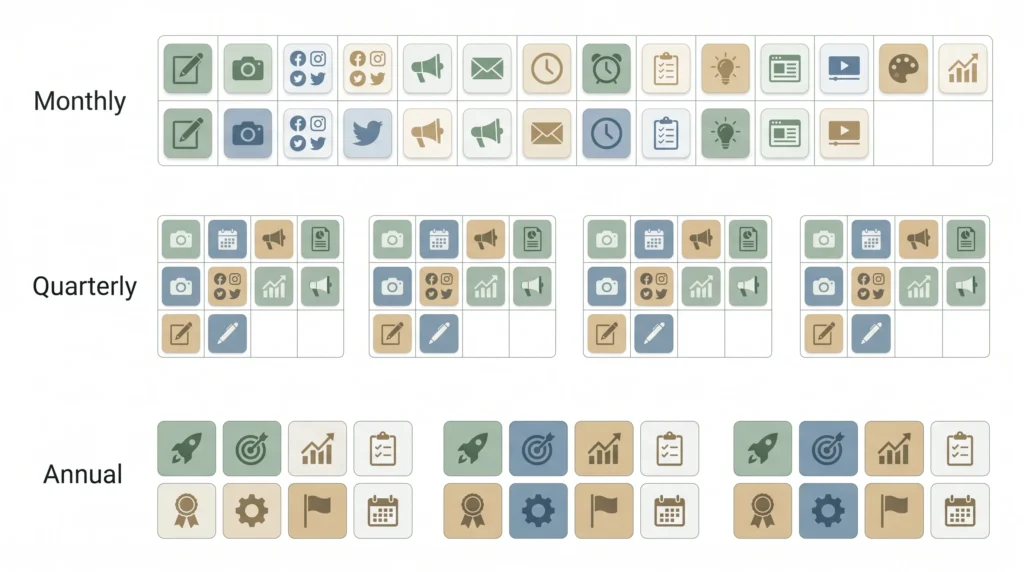
A realistic maintenance rhythm:
- Monthly: Check Search Console for new ranking drops or crawl errors
- Quarterly: Update top-performing pages with fresh stats, examples, or sections
- Annually: Full content audit identifies pages with declining traffic and decides whether to update, consolidate, or remove
Mistake #7: Not Adapting for AI Overviews and Zero-Click Search
This is what almost every other article on this topic skips entirely.
As of 2025–2026, Google’s AI Overviews now appear for a significant portion of informational queries. When they do, the answer is displayed directly in the search result no click required. Research tracking 2025 data found that 60% of Google searches now end without any click to a website.
For small businesses, this changes the content equation. If you’re only writing informational content aimed at top-of-funnel readers, you’re competing for clicks that are increasingly being absorbed by Google’s own AI summary.
The businesses winning in this environment are doing two things differently:
First, they’re optimizing to be cited inside AI Overviews, not just to rank below them. This means writing content that’s structured, specific, and clearly sourced, so Google’s AI pulls from it rather than ignoring it.
Second, they’re shifting content emphasis toward transactional and local intent, which the queries AI Overviews still can’t fully replace. Nobody’s booking a plumber or scheduling a haircut through an AI summary paragraph.
Look, if you’re a local service business in this situation, here’s what actually works: focus your content energy on local landing pages, service pages, and review generation rather than competing for informational terms where zero-click is gutting your traffic potential.
Medical practices in particular benefit from a structured approach, this structured google ads for doctors seo outline shows how paid and organic strategy should be built together from day one.
Quick Comparison: Content Types vs. AI Overview Risk
| Content Type | AI Overview Risk | Best For | Key Benefit | Limitation |
| Informational blog posts | High | Brand awareness | Builds topical authority | Traffic increasingly zero-click |
| Local service pages | Low | Lead generation | Captures transactional searches | Needs ongoing review signals |
| How-to guides (with schema) | Medium | Featured snippet capture | Can be cited in AI Overviews | Requires structured formatting |
| Comparison pages | Medium | Commercial intent traffic | High conversion potential | Needs regular updates |
| Google Business Profile posts | Very Low | Local map pack visibility | Free, fast, underused | Limited long-term SEO value |
Mistake #8: Ignoring E-E-A-T, Especially the First “E”
Google’s quality guidelines now emphasize Experience, Expertise, Authoritativeness, and Trustworthiness. The first E, Experience, is the newest addition and the one most small businesses are completely missing.
What does it mean in practice? Google wants to see evidence that content comes from someone with real, lived experience in the topic. For a business website, this means:
- Author bios that mention actual credentials or years in the business
- Photos of real work, real staff, real locations
- One detail most guides miss: uploading those photos with the camera’s default filenames like IMG_4823.jpg actively undermines the signal you’re trying to send. Google reads filenames as part of its image understanding system. Following proper SEO image naming conventions is a five-minute fix that makes your real-world photos readable to search engines, not just humans.
- Case studies or specific client outcomes (anonymized if needed)
- Reviews and testimonials that are specific, not generic
Most small business websites read like a brochure written by someone who’s never met a customer. That’s the opposite of E-E-A-T.
What most guides skip is that Google’s quality raters are real people reviewing sites manually for training data. They’re looking for signals that a real expert built this, not whether you jammed keywords into your H2 tags.
Mistake #9: Never Looking at What’s Already Working
This might be the most underused free advantage in SEO.
Google Search Console shows you, for free, in real time, which queries your site is already appearing for, what position you rank in, and how many people are clicking. Most small business owners either don’t have it set up or log in once, feel confused, and never return.
Here’s the opportunity hiding in that data: pages ranking in positions 8–20 for real search terms are one focused update away from page one.
A plumbing site that ranks #14 for “emergency plumber [city]” isn’t failing; it’s close. Updating that page with fresher content, a stronger title tag, and a few more specific details about the service often moves it to positions 4–8. That’s a doubling or tripling of clicks without building a single new backlink.
One of the most overlooked quick wins is optimizing meta tags. Most small business sites have missing or duplicate metadata across dozens of pages. That changes everything. One page, one update, real results.
Mistake #10: Measuring the Wrong Things Or Measuring Nothing
Vanity metrics kill SEO momentum faster than bad strategy does.
Business owners who track “website visitors” as their primary SEO metric often feel good about traffic spikes that produce zero leads. Or they feel bad about flat traffic on a page that’s actually converting at a high rate.
What to actually track:
- Organic clicks and impressions (Search Console): Are you gaining visibility for target terms?
- Conversion actions form fills, calls, and bookings that originated from organic search
- Keyword position changes are your target pages moving up, down, or stuck?
- Core Web Vitals scores Google uses these as a ranking signal; poor scores suppress otherwise good content
Traffic without conversion data is noise. And no measurement at all means you’re flying blind while spending real time and money.
If you are running Google Ads alongside your SEO, structuring your paid campaigns around a search engine marketing intelligence framework prevents the same budget-drain mistakes from compounding across both channels.
Voice Search / AEO Q&A
Q: What’s the biggest SEO mistake small businesses make?
A: Targeting keywords with high competition that their site has no authority to rank for. Starting with long-tail, local-intent keywords produces results far faster for most small business sites.
Q: How do I know if my small business SEO is working?
A: Set up Google Search Console and track organic clicks, impressions, and position changes monthly. If target keywords are moving from page three to page two, the strategy is working — results just take time.
Q: Should I hire an SEO agency or do it myself?
A: For basic local SEO — Google Business Profile, on-page optimization, and content — most owners can manage it themselves with the right tools. Technical SEO, backlink building at scale, and competitive keyword campaigns typically benefit from professional help.
Q: Why is my website not showing up on Google despite having SEO done?
A: Most likely causes: your site targets keywords that are too competitive, pages aren’t indexed (check Search Console’s Coverage report), or the SEO work done was surface-level — meta tags without addressing backlinks, content quality, or technical issues.
Q: When should I start seeing SEO results for my small business?
A: Realistically, 3–6 months for early movement on lower-competition terms, 6–12 months for meaningful traffic on competitive local keywords. Any provider promising results in weeks is either targeting zero-competition terms or using tactics that risk penalties.
The One Mistake Underneath All the Others
Every mistake on this list shares a root cause: treating SEO as a technical checkbox instead of a long-term signal-building system.
Google ranks pages that demonstrate relevance, authority, and trustworthiness consistently, over time. A single round of optimization doesn’t build that. Showing up month after month with genuinely useful content, real backlinks, and a healthy technical foundation does.
The fix isn’t complicated. It’s just slower than most people want it to be.
Your next action: Open Google Search Console right now. Go to “Performance” → “Search Results.” Filter by queries. Find three pages sitting between positions 8 and 20 for real commercial or local-intent terms. Those are your quick wins. Update them this week.
Don’t make the mistake of starting something new when the fastest growth is already in your existing pages.

Leave a Reply